Have you noticed? Sunglasses are surprisingly rare on Seoul's streets. Here's why
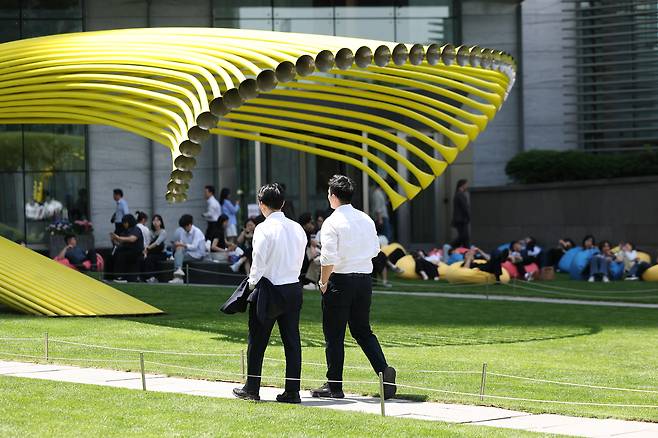
For Ella Mitchell, an Australian graphic designer, packing a pair of sunglasses for the office was once part of her daily summer routine.
But this summer, the 29-year-old living in Korea swapped her sunglasses for a parasol, or sun umbrella.
"Any time I had to go outside at work, whether it was for lunch or a meeting, I'd put on my sunglasses. But I was always the only one wearing them. Everyone else had a sun umbrella," said Mitchell, 29, who moved to South Korea in 2023 and has since worked at a Korean cosmetics company.
"I started feeling like I was the odd one out, so I bought a sun umbrella before this summer. It doesn't protect my eyes as well as sunglasses do, but I feel much more comfortable."
Leaving her sunglasses behind on workdays was one of the biggest cultural surprises she encountered in Korea, alongside everyone heading to lunch together at the same time.
What she found even more puzzling was that many Koreans had no hesitation about wearing sunglasses outside of work.
"Whenever I go to hangout spots like Hongdae or Seongsu on the weekend, I see a lot of people wearing sunglasses. But they're much less common on my commute to work. It's such a funny contrast," she said.
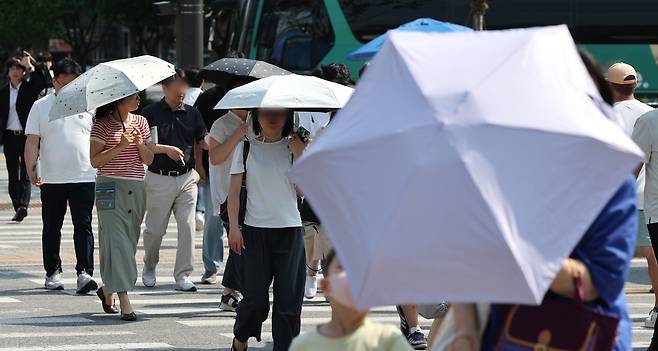
In Korea, sunglasses have traditionally fallen outside the office dress code, much like baseball caps. Instead, many office workers rely on sun umbrellas, arm sleeves and lightweight linen clothing when commuting or heading outside the office during the workday.
While some office workers wear sunglasses on their commute and take them off before entering the office, they remain a relatively rare sight on Korea's buses, subways and sidewalks compared with many other countries.
This unwritten rule also extends to schools. While hats are common among elementary school students, middle and high school students in uniform are rarely seen wearing sunglasses.
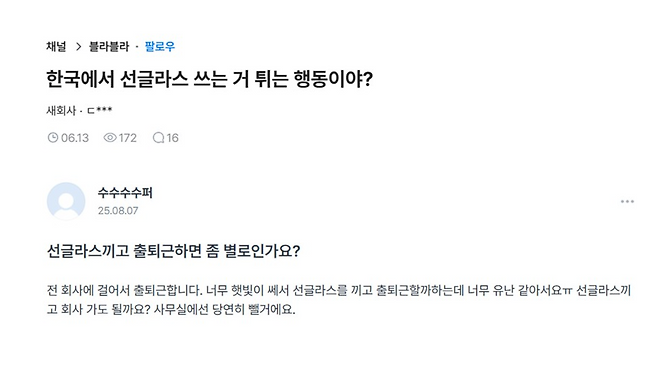
But as the weather heats up, the long-held norm against wearing sunglasses at work once again becomes a hot topic on online communities for office workers.
In a recent post titled "Is wearing sunglasses in Korea considered standing out?" on Blind, a workplace community app, the writer said he got some looks and comments from a senior colleague over wearing sunglasses to the office.
"I ran into him before I went into the office building, and I still had my sunglasses on. He asked if I'd had laser eye surgery. I said no, and he just gave me this weird look. It didn't feel great," he wrote.
The reluctance of many Korean office workers to wear sunglasses may be linked to an East Asian cultural norm that associates visible eyes with respectful communication, according to cultural psychologist Han Min.
He said that in societies influenced by Confucian traditions, including Korea and Japan, emotional restraint has long been regarded as a sign of maturity and consideration for others. As a result, people tend to rely more heavily on nonverbal cues — particularly the eyes — to interpret sincerity, discomfort and attentiveness.
"If you compare Eastern and Western emoticons, you'll notice that Eastern ones tend to emphasize the eyes, while Western ones focus more on the mouth," Han told The Korea Herald.
"Old Korean sayings such as 'The eyes are the window to the soul' reflect a long-standing belief that the eyes are central to understanding a person's thoughts and emotions."
As the cultural emphasis on keeping one's eyes visible meets the hierarchical culture of Korean workplaces, wearing sunglasses around colleagues has long been seen as a matter of workplace etiquette.
"If I'm just going outside with coworkers I'm close to, sure, I'll wear sunglasses. But not if senior colleagues are around. I sometimes wear them on my commute, but I always take them off before I get anywhere near the office. You never know who you'll bump into," said Kim Jin-hyung, a 33-year-old employee at a public financial institution in Yeouido, Seoul.
"I wouldn't call it being overly conscious of other people. It's just part of fitting in at work, and I don't really have a problem with it."
For some workers trying not to stand out, sunglasses can feel like one step too far.
Although workplace dress codes differ, Korean office workers often gravitate toward similar business-casual outfits in black, navy, gray and other muted colors. As a result, sunglasses tend to be associated more with style than with sun protection.
They're far more likely to appear on weekend dates, beach outings, or road trips than on an ordinary commute or lunch break.
That perception often discourages office workers accustomed to a collectivist culture that values blending in from wearing sunglasses in everyday work settings.
"Even with a simple outfit, sunglasses give the impression that you're trying to look stylish. They attract attention, so I usually avoid wearing them around coworkers," said Byun Sung-won, a 34-year-old office worker in Sangam-dong, Seoul.
Some foreigners find it curious that a country known for globally popular eyewear brands such as Gentle Monster has relatively few people wearing sunglasses in everyday life.
"Back home, most sunglasses are designed more for sports and performance than for fashion. In Korea, they're much more stylish while offering the same level of protection, so I figured people would wear them more as an everyday accessory," said Lena Fischer, a 24-year-old German exchange student at Ewha Womans University who came to Korea last year.
"But when I'm out walking around or taking public transportation, I notice a lot more sun umbrellas than sunglasses."
The recent boom in sun umbrellas reflects a broader tendency in Korea to prioritize protecting the skin over the eyes from UV exposure.
According to convenience store chain GS25, its parasol sales surged 351 percent last year from a year earlier and rose another 79.5 percent in the January-April period.
Once associated with middle-aged women carrying floral-patterned parasols, the accessory has become a common sight on university campuses and in business districts, with understated monochrome designs replacing colorful prints.
Some experts say the widespread use of parasols over sunglasses reflects a tendency to view UV protection through the lens of skin aging rather than eye health.
"In Korea, UV exposure has long been associated with skin aging and pigmentation. With strong public interest in beauty and the rapid growth of the sunscreen and functional skincare market, UV protection has naturally come to be seen as part of a daily skincare routine," said Jae Eun-jeong, a consumer psychology professor at Sungkyunkwan University.
The belief that darker eyes are less sensitive to bright light may also help explain the trend.
"People with dark irises, like most Koreans, tend to experience less glare during the day because less light enters the eye. By contrast, people with lighter-colored eyes are generally more sensitive to bright light, which is one reason sunglasses are more commonly worn in many Western countries," Hwang Hyung-bin, an ophthalmologist at the Incheon St. Mary's Hospital, said in a report.
Hwang stressed, however, that reduced sensitivity to glare does not mean darker eyes are better protected against UV damage.
"Dark irises can reduce glare, but they don't protect your eyes from UV damage. UV rays can still increase the risk of cataracts and other eye conditions, so UV-blocking sunglasses are important regardless of iris color," he added.

Copyright © 코리아헤럴드. 무단전재 및 재배포 금지.