S. Korea’s political deadlock deepens, won near crisis levels
이 글자크기로 변경됩니다.
(예시) 가장 빠른 뉴스가 있고 다양한 정보, 쌍방향 소통이 숨쉬는 다음뉴스를 만나보세요. 다음뉴스는 국내외 주요이슈와 실시간 속보, 문화생활 및 다양한 분야의 뉴스를 입체적으로 전달하고 있습니다.
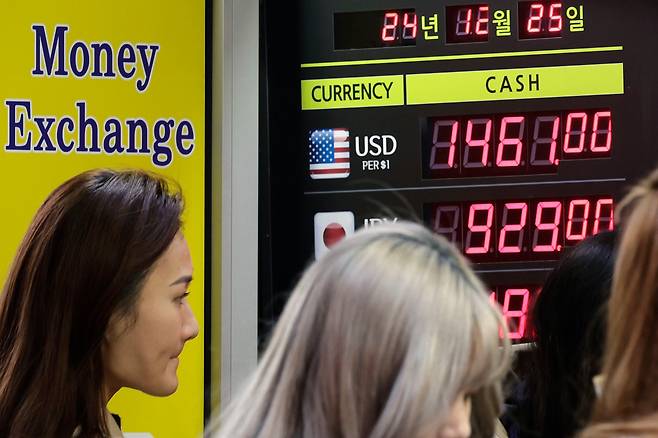
South Korea’s currency markets are reeling as the main opposition party escalates its push to impeach Prime Minister Han Duck-soo, following its earlier move against President Yoon Suk-yeol. The political instability has driven the Korean won sharply lower against the U.S. dollar, with the exchange rate closing at 1,457.5 won per dollar early Dec. 25, up 5.5 won from the previous week’s close. Intraday trading saw the rate briefly hit 1,460.2 won, marking the fourth consecutive trading day above the 1,450-won threshold—a level last seen during the 2009 global financial crisis.
The won’s recent slide reflects a combination of domestic political turmoil and a strengthening U.S. dollar. The dollar index, which tracks the greenback against six major currencies, has risen 4.5% to 108.12 since before the U.S. presidential election. Over the same period, other currencies have weakened against the dollar, including the Japanese yen (-3.6%), Chinese yuan (-2.7%), euro (-5.1%), British pound (-3.6%), and Taiwan dollar (-2.5%).
The Korean won, however, has experienced a steeper decline, dropping 6% in the same timeframe, with 4% of that loss occurring since President Yoon declared martial law earlier this month. “If Prime Minister Han Duck-soo is also impeached, it could severely damage the nation’s creditworthiness,” said Kim Jung-sik, an economics professor at Yonsei University. “Without intervention from foreign exchange authorities, the won-dollar rate could surpass 1,500 won.”
The current dollar rally differs significantly from the dynamics of the 2008-2009 global financial crisis. Back then, the dollar’s strength was accompanied by gains in other major currencies, such as the yen, euro, and yuan, which provided South Korea’s export-driven economy with a competitive edge. In March 2009, when the won last traded at 1,450 per dollar, South Korea posted a record monthly trade surplus of $4.3 billion.
Now, the dollar is the sole beneficiary of global economic conditions. The yen has weakened to 157.4 per dollar from 97.7 during the financial crisis, while the euro has fallen to 0.96 per dollar from 0.77. The yuan has also depreciated to 7.3 per dollar from 6.8. While the won remains at a similar level as in 2009, the concurrent depreciation of competing currencies has eroded the potential benefits of a weaker won for South Korea’s exporters.
“If the won were the only weak currency, it would enhance the price competitiveness of South Korean exporters,” said Kim Sang-bong, an economics professor at Hansung University. “But with competitors’ currencies also falling, the positive impact on exports is limited.”
The dollar’s dominance is underpinned by the U.S. economy’s relative strength and speculation that Donald Trump’s return to the White House could further fuel the greenback’s rise. Trump has pledged to raise tariffs, and the Federal Reserve has indicated it may delay interest rate cuts next year, bolstering the dollar further.
“The dollar’s strength is at a different level now, with U.S. economic growth outpacing the rest of the world and the potential for Trump’s policies to exacerbate this trend,” said Ahn Dong-hyun, an economics professor at Seoul National University.
Economists caution that the current high exchange rate poses a more severe, long-term threat than the 2009 crisis due to South Korea’s weakened economic fundamentals. Slowing potential growth, an overreliance on semiconductors for exports, and the demographic challenges of low birthrates and an aging population have all eroded the nation’s resilience.
“The 2009 high exchange rate was like an acute attack that could be managed,” said Heo Jun-young, an economics professor at Sogang University. “Today’s high exchange rate is more like a chronic illness, and it’s an entirely different challenge.”
Copyright © 조선일보. 무단전재 및 재배포 금지.
- [속보] 국힘 당명 개정, 6·3 지방선거 뒤로 연기
- [오늘의 운세] 2월 23일 월요일 (음력 1월 7일 戊辰)
- 美 대사 “이스라엘이 중동 모두 차지해도 괜찮을 것”… 아랍권 “용납 못해” 반발 확산
- 무릎에 착 달라 붙어 무릎 마사지와 찜질 한 번에, 2만원 대 초특가
- 귀에 꽂으면 상대 말소리와 TV 소리가 또렷하게 들리는 신기한 이어폰
- 겨울 못 먹으면 섭섭한 여수 새조개, 손질 마쳐 당일 특가 직송
- 가수 김창열 “‘다케시마의 날’ 앞두고 일본서 입국 거부… 표적 심사"
- [모닝] 샘 올트먼 “기업들이 해고를 AI 탓으로 돌리며 ‘AI워싱’하고 있다”
- 출소 2주 만에 또 ‘허위 신고’ 50대, 징역 1년 8개월
- “한일 관계 전문 플랫폼 가능성은?”...부산·후쿠오카 저널리스트 포럼 열려