'Everything in life is a cycle of relationships': Hwang Sok-yong's new novel traces bonds linking humans, nature
전체 맥락을 이해하기 위해서는 본문 보기를 권장합니다.
He moved there, he said, hoping for "a quiet final chapter and the chance to write something satisfying," only to encounter an unexpected "problem."
Woven through the novel is a meditation on connection and the cyclical interplay that links one being to the next. Nature and humans, the author suggests, are not discrete existences but lives linked through birth, death and memory. The decades surrounding the hackberry tree, Hwang said, revealed to him "not a linear history, but a cycle of relationships and entanglements."
이 글자크기로 변경됩니다.
(예시) 가장 빠른 뉴스가 있고 다양한 정보, 쌍방향 소통이 숨쉬는 다음뉴스를 만나보세요. 다음뉴스는 국내외 주요이슈와 실시간 속보, 문화생활 및 다양한 분야의 뉴스를 입체적으로 전달하고 있습니다.
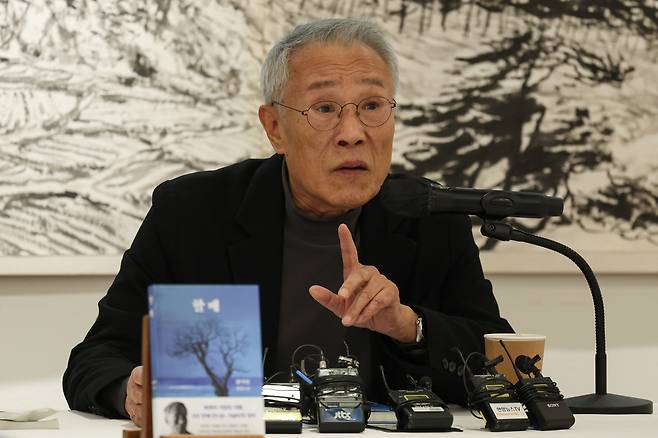
A single bird in flight opens Hwang Sok-yong's new novel. Even in a 64-year career, it was a first: a novel with no human character until halfway through.
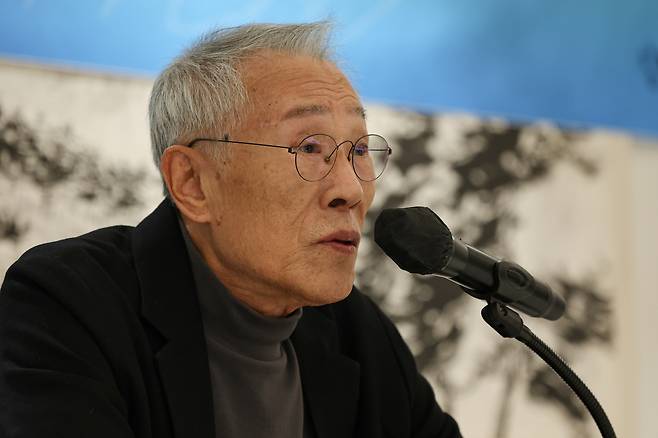
“It was the first time I’d written a story with no people in the opening half,” Hwang said during a press conference in Seoul on Tuesday. “As a writer, crafting a narrative emptied of human characters felt awkward. But as I kept writing, I also felt a kind of joy and surprise. ‘Ah, I’ve never written anything like this before.’ I don’t think I would have felt that if I were younger.”
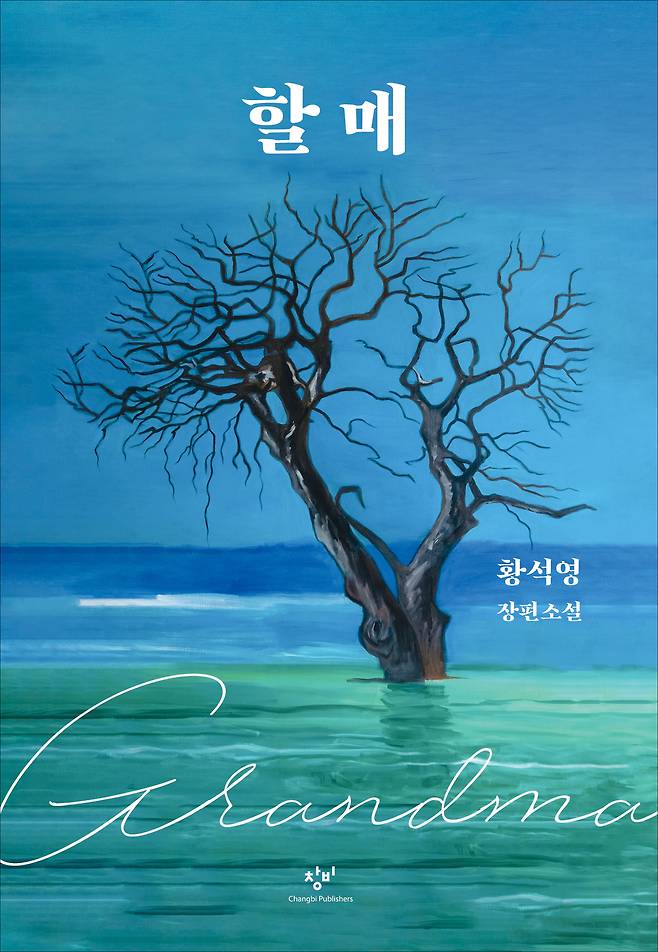
The towering figure of Korean literature has returned with "Grandma," his first full-length novel since "Mater 2-10" (2010), which was shortlisted for the International Booker Prize in 2024. His latest book extends his long engagement with history into a meditation that stretches beyond humanity to the life that precedes and outlasts it.
It begins with the journey of a bird — a dusky thrush that pushes through Siberian snowstorms before dying over the Geum River estuary. The bird’s body returns to the earth, but a single hackberry seed resting in its belly survives the winter and sprouts into a tree that villagers will come to call Halmae, a familiar term for grandmother.
From this hackberry tree, revered as the village’s guardian, the novel unfurls a panoramic 600-year chronicle of nature and humankind. Hwang traces the lives of those who brushed past the tree across centuries, from the early Joseon era in the 14th century to the upheavals that shaped Korea’s modern era.
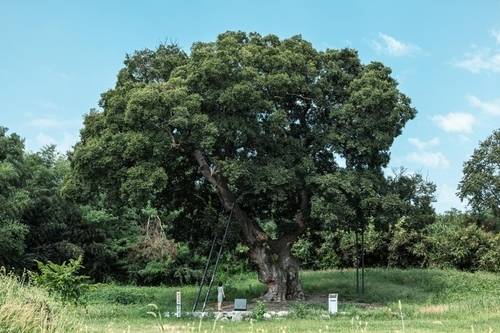
The inspiration came from a real hackberry tree in Gunsan, estimated at roughly 537 years old as of 2020, in North Jeolla Province where Hwang has lived in recent years.
He moved there, he said, hoping for “a quiet final chapter and the chance to write something satisfying,” only to encounter an unexpected “problem.”
He met Father Mun Jeong-hyeon, who, together with environmental groups, had been working to protect the village’s centuries-old hackberry tree amid reports that the Defense Ministry might hand over the surrounding land to the US military. In 2000, Haje Village, where the tree once stood, was emptied after officials declared it too close to a US base ammunition depot. Some 644 households (about 2,000 residents) were relocated for safety clearance, and every home was demolished, leaving the village abandoned.
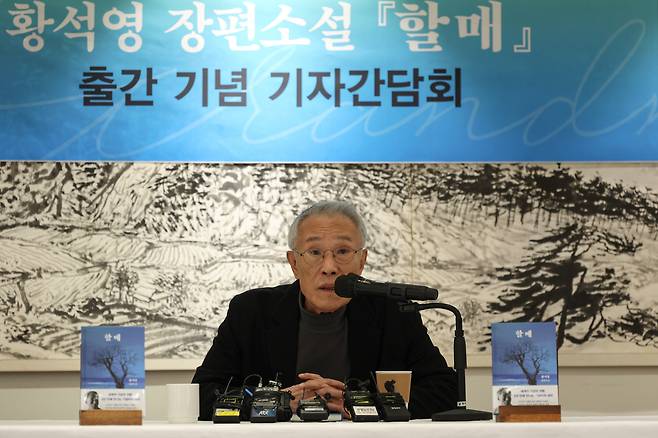
Woven through the novel is a meditation on connection and the cyclical interplay that links one being to the next. Nature and humans, the author suggests, are not discrete existences but lives linked through birth, death and memory. The decades surrounding the hackberry tree, Hwang said, revealed to him “not a linear history, but a cycle of relationships and entanglements.”
“In recent years, I’ve often found myself thinking that I may not have much time left. And during the (COVID-19) pandemic, I spent a lot of time reflecting on life and death,” he said.
“I felt that all relationships move in cycles, that karma is constantly shifting and flowing from one person to another. I’m not approaching this story as an environmental activist, but with a planetary perspective. I wanted to portray a hackberry tree fated to disappear in the name of development, and the 600 years of ordinary lives that endured alongside it.”
The real hackberry tree was designated a natural monument by the Korea Heritage Service in October 2024.
“Now no one can cut it down,” Hwang said. “The tree’s time and ours still continues. Even after I die, the hackberry may live on for centuries. I hope this story gives readers a chance to rethink the society and civilization we’ve built.”
As an octogenarian still writing at full pace, he reflected on what it means to keep working in old age.
“An old writer’s wish is 'baekcheokgandu jinilbo' — to take one more step even when you're at the very top of a hundred-foot pole, to go beyond the edge. That means to push yourself to write something truly 'new,'” he said.
“Recently, I lost sight in my right eye,” he added. “I’m managing with one, but even so, it turns out I can still write. My body already flinches with the urge to start the next book.”
Copyright © 코리아헤럴드. 무단전재 및 재배포 금지.