China’s CXMT IPO clouds memory upcycle outlook

China’s largest DRAM maker, ChangXin Memory Technologies, is accelerating plans for an initial public offering on Shanghai’s Star Market, aiming to raise about 29.5 billion yuan ($4.3 billion) to fund capacity expansion.
The planned listing — expected as early as June, according to industry sources — is sharpening focus on the supply outlook in the global memory market, as new capacity could arrive just as the current upcycle begins to mature.
CXMT is expected to use the proceeds to build additional semiconductor production lines.
The move is drawing close attention across the memory sector. CXMT has already unsettled the market by ramping up shipments of commodity DRAM such as DDR4, often competing aggressively on price and pressuring the industry’s “big three” of Samsung Electronics, SK hynix and Micron Technology.
This time, both the scale and timing stand out. With fresh capital set to accelerate expansion, CXMT could increase output just as supply-demand dynamics begin to shift, raising the risk of a more balanced — or even looser — market.
CXMT’s presence has already grown rapidly. Its global DRAM market share reached 5 percent as of the end of the third quarter last year, up 2 percentage points from a year earlier, while utilization rates climbed to 94.6 percent. China’s NAND maker Yangtze Memory Technologies is also gaining share, underscoring a broader push by Chinese memory suppliers.
An increase in CXMT’s output is now starting to factor into market expectations.
The tight supply conditions that drove the recent upcycle could begin to ease, reducing the need for front-loaded purchases. A sharp price drop is not the base case, but analysts expect a slower pace of price increases — a shift that would directly weigh on earnings momentum.
That matters because the current cycle has been driven by pricing strength.
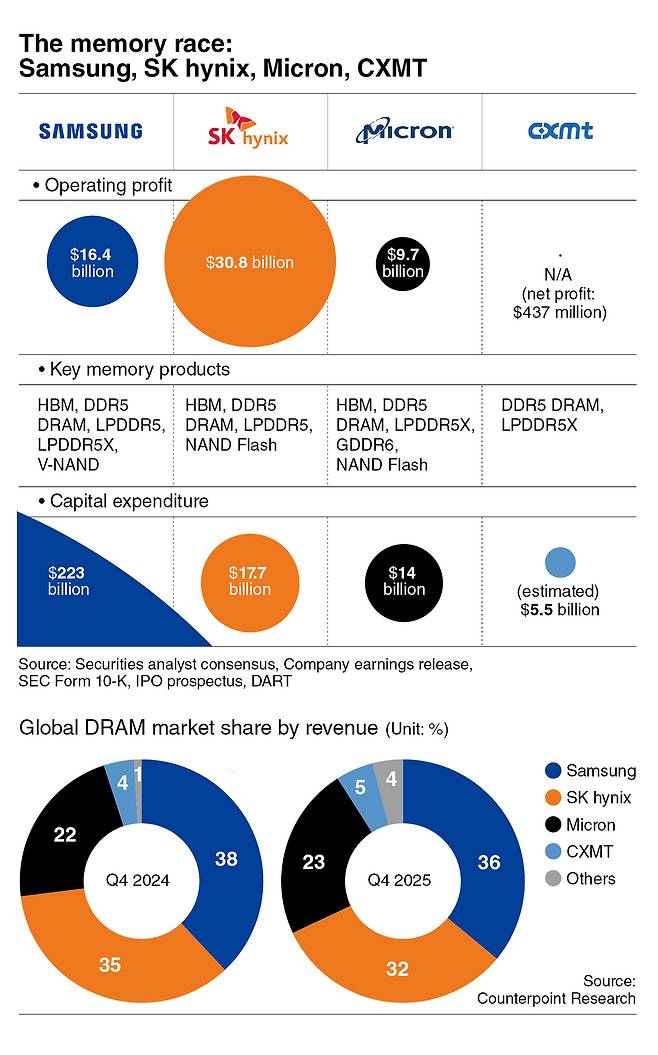
Samsung Electronics and SK hynix have posted strong earnings on the back of high-bandwidth memory, but commodity DRAM still underpins a large share of revenue. If price gains fall short, earnings growth is likely to lose momentum.
Samsung, with the most diversified product mix, is expanding high-value offerings such as HBM and server DRAM. Still, mobile LPDDR and PC DRAM remain significant contributors. Its exposure to Chinese smartphone and PC makers could also leave it vulnerable to pricing pressure as CXMT expands domestically.
A slower rise in average selling prices would cap profit growth in Samsung’s memory business, particularly as current forecasts assume a strong pricing uptrend.
SK hynix faces similar dynamics. While HBM has been the main earnings driver, segments such as DDR5 remain sensitive to pricing, leaving profitability exposed if the cycle softens.
“HBM is clearly driving earnings right now, but commodity DRAM still forms the backbone of revenue. High-value products are growing fast, but not yet enough to change the overall structure. If commodity prices weaken, earnings growth will inevitably slow,” an industry source said.
The source added that price-sensitive segments — including server DDR5 and mobile memory — tend to reflect market shifts quickly in profitability.
Beyond near-term supply, a bigger question is how CXMT deploys the proceeds.
The funds are unlikely to be used solely for commodity DRAM expansion. As China pushes for greater memory self-sufficiency, investment could extend into higher-value segments such as HBM.
That is where longer-term risks begin to emerge.
If CXMT develops competitive HBM capabilities, the market structure could shift from three major players to four, challenging the dominance of Samsung Electronics, SK hynix and Micron.
For now, the immediate impact is expected to be limited.
Lee Jong-hwan, a professor of system semiconductor engineering at Sangmyung University, said the effect on Samsung and SK hynix would likely remain modest in the near term.
“Samsung is already investing on a much larger scale,” he said, adding that while the $4.3 billion fundraising is meaningful, it is not enough to fundamentally reshape the market.
Still, the development is seen as an early signal of a shifting competitive landscape — one that could test how resilient the current structure remains as new capacity and new players emerge.
Copyright © 코리아헤럴드. 무단전재 및 재배포 금지.