[Herald Interview] Banksalad relieves financial information overload
전체 맥락을 이해하기 위해서는 본문 보기를 권장합니다.
The next step was to develop customer services based on the database, which he found "highly demanding."
"Financial companies in the beginning did not like the way the information about their products were laid bare," he said. "But as time went by, companies started to take advantage of Banksalad platform that has a heavy user influx."
이 글자크기로 변경됩니다.
(예시) 가장 빠른 뉴스가 있고 다양한 정보, 쌍방향 소통이 숨쉬는 다음뉴스를 만나보세요. 다음뉴스는 국내외 주요이슈와 실시간 속보, 문화생활 및 다양한 분야의 뉴스를 입체적으로 전달하고 있습니다.
The Korea Herald is publishing a series of interviews on promising startups in the financial technology industry. This is the 13th installment. - Ed.
Despite having easy access to thousands of financial products in South Korea, as one of the world’s most wired countries, consumers often find most of them irrelevant and largely fail to figure out which offers the biggest financial advantage.
In a bid to simplify the myriad of choices, former owner of a street food vender Kim Tae-hoon co-founded financial technology startup Rainist in 2012, putting together information scattered by different financial companies.
Rainist operates Banksalad, a financial service provider ranging from financial product recommendations tailored to an individual, to expenditure analysis and personal financial management, targeting retail financial consumers. The service is now being used by millions, just four years after it was launched.
“Information asymmetry was severe especially among financial consumers,” Kim, who is also the chief executive officer, said in an interview with The Korea Herald.

When he created Rainist, he said he manually compiled a list of financial products from each financial company.
Soon, Banksalad’s database was made up of over 4,200 financial products available online for customers -- credit cards, deposits, savings, cash management accounts, loans, insurance products and pension schemes. These accounted for 84 percent of all existing products in Korea, Kim said.
“I pictured a company that collects all the information because, as a student (in college), I couldn‘t understand why there was no company doing just that,” the 32-year-old said.
“If I hadn’t started, someone else would have done it and dominated the market.”
The next step was to develop customer services based on the database, which he found “highly demanding.”
Working 16 hours a day and teaming up with another Rainist co-founder and data analyst Park Kyu-in, they developed an analytical framework for a qualitative measurement of spending pattern for a year, adding another layer on the Banksalad database.

“I was sure consumers would like it, because I knew I was dealing with what consumers found cumbersome to do themselves,” Kim said, adding such effort gave birth to Banksalad‘s flagship recommendation service in 2017.
Banksalad currently has two adaptions -- a website and a mobile app.
Banksalad website, launched in 2014, concentrates on recommending financial products based on a customer survey made up of dozens of questions on its website. It also lists up the top-10 products sorted by advantages.
The mobile app, commercialized in June 2017, offers automatic compilation of consumers’ assets, in part through data mining techniques such as screen scraping technology. Also, mobile app users can receive consumption analyses.
The website had over 1 million monthly active users as of March, while the mobile app adaption, launched last year, was downloaded more than 1 million times in the first 10 months, according to Rainist.
“Financial companies in the beginning did not like the way the information about their products were laid bare,” he said. “But as time went by, companies started to take advantage of Banksalad platform that has a heavy user influx.”
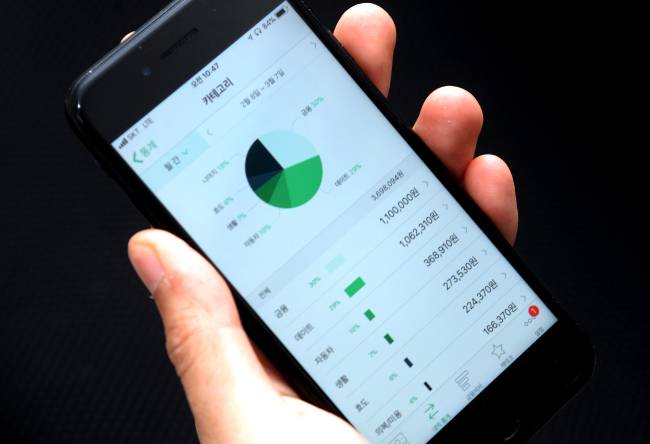
To further serve to his mission to prevent retail financial consumers from being marginalized in Korea, Kim launched an online “magazine” on Banksalad website.
The online contents curated by outside contributors offer financial tips to boost consumers‘ profit and minimize cash losses in life, he said.
According to Kim, the company is only at its first stage out of three to make Banksalad into a full-fledged online personal financial management service.
The next goal, he said, is to develop analytical frameworks for outgoing transactions.
“We haven’t yet categorized outgoing transactions into investment, deposit, asset management or spending,” said Kim. pinning hopes on the role of the startup‘s in-house data lab.
Through this, Banksalad hopes to analyze a user’s risk appetite in investment, in addition to spending pattern available now.
Rainist’s next steps could also involve seeking business approval as an online PFM provider in Korea. Kim hailed a decision by the Financial Services Commission in March this year to bring online PFMs into legal grounds, in a move to foster fintech startups using database.
By Son Ji-hyoung (consnow@heraldcorp.com)
<ⓒKoreaHerald(www.koreaherald.com)무단전재 및 재배포 금지>
Copyright © 코리아헤럴드. 무단전재 및 재배포 금지.