Korean Ruling Party Moves to Cap Stakes of Major Crypto-Exchange Shareholders
reflecting regulator’s view that exchanges are public-like infrastructure
Opposition warns of “state-led finance”
industry says forced dilution would be excessive.
By Hoon-gil Choi
South Korea‘s governing Democratic Party is moving to impose ownership caps on controlling shareholders of digital-asset exchanges, setting up a political fight over whether the fast-growing industry should face restrictions similar to those applied to other market infrastructure.
The push reflects the stance of South Korea‘s Financial Services Commission, which has argued that exchanges function as infrastructure with a quasi-public character — and that concentrated control by a single shareholder could heighten conflicts of interest.
The industry, however, says the plan would amount to forced divestment for private operators, while the opposition is portraying it as an attempt to tighten government control over crypto markets. The ruling party plans to finalize and introduce its draft as early as next week, after further talks with the FSC on the precise mechanism, people familiar with the discussions said.
The ownership-cap debate resurfaced during recent talks over stablecoin provisions within the second-stage legislative package. Materials the FSC submitted to the Democratic Party in December included a proposal to limit the stake of any single major shareholder in a digital-asset exchange.
The regulator’s benchmark draws on rules in Korea‘s capital-markets framework for alternative trading systems (ATS), where major shareholders are generally capped at 15%. Under the crypto-exchange plan, the FSC proposal would limit controlling stakes to roughly 15%–20%.
FSC Chairman Lee Eok-won publicly endorsed the approach at a press briefing on Jan. 28, citing the goal of bringing exchanges into the formal regulatory perimeter, their role as public-like infrastructure and the risk of conflicts when control is concentrated. It was the first time he had made the case in public, according to people familiar with the matter.
If applied uniformly at 15%–20%, the measure would force controlling shareholders across the country’s five largest exchanges to sell down stakes, industry estimates show.
Dunamu, which runs Upbit, has founder and chairman Song Chi-hyung as the top shareholder with 25.52%. Bithumb Holdings holds 73.56% of Bithumb.
Coinone is controlled by its founder, Chief Executive Cha Myung-hoon, with 53.44% including shares held via a personal company. NXC owns 60.5% of Korbit.Streami, operator of GOPAX, has Binance as a shareholder with 67.45%.
The proposed caps could also complicate ongoing takeover and investment talks. Market participants have been watching Naver Financial in connection with a possible acquisition related to Dunamu, and Mirae Asset in connection with interest in Korbit. Any hard cap on a single controlling stake would require restructuring of ownership arrangements, the people said.
Within the ruling party, some lawmakers are discussing a tiered system that would tighten caps only for exchanges with outsized market share, rather than imposing a one-size-fits-all limit.
Lee argued that uniform caps could inadvertently entrench the current market structure by constraining challengers and effectively favoring incumbents. He floated an example framework that would exempt platforms with less than 5% market share, impose a 40% cap on those above 10%, a 30% cap above 20% and a 20% cap above 50%.
Under that approach, smaller exchanges such as Coinone, Korbit and GOPAX could be excluded from the cap, while Upbit — with market share above 50% — would face a 20% limit, and Bithumb — above 20% — would face a 30% limit, according to industry estimates cited by Lee.
The opposition People Power Party has signaled it will fight any ownership cap, arguing it could weaken governance accountability and encourage capital outflows.
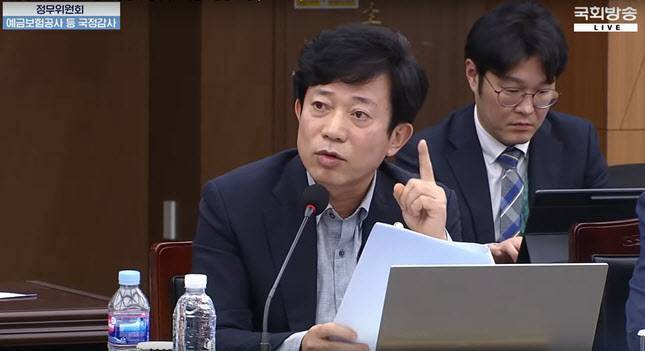
Kim Sang-hoon, who leads the party‘s special committee on equity and digital-asset “value-up” initiatives and sits on the National Assembly’s finance policy committee, said in an interview that stake limits could blur responsibility for management and create unintended side effects, including the risk of assets moving offshore.
Kim added that if policymakers intended to impose ownership rules, they should have done so when the industry was first emerging more than a decade ago — and suggested the sudden inclusion of the measure points to unseen political pressure to “control” exchanges.
The DAXA — a joint body that includes Upbit, Bithumb, Coinone, Korbit and GOPAX — has also come out against the idea. In a statement released last month, the group said attempts to “artificially change” the ownership structure of private companies would undermine the foundations of an industry that has grown organically.
With the ruling party aiming to finalize its bill next week, and the opposition framing the plan as a step toward government control of the market, the ownership-cap proposal is shaping up as one of the most contentious fronts in Korea‘s next phase of crypto regulation.
최훈길 (choigiga@edaily.co.kr)
Copyright © 이데일리. 무단전재 및 재배포 금지.
- 與, 대주주 지분 규제한다…코인거래소·네이버 충격[only 이데일리]
- S&P500, 사상 최고치 근접 마감…코스피 반등하나[뉴스새벽배송]
- 용산·태릉, 서울시 반대해도 개발 가능?…논란 부른 법안 보니
- “자랑한다, 돈 쓰고 왔는데…” SK하이닉스 직원 글에 ‘뭉클’
- ‘서울대 합격’ 이부진 아들, 공부법 공개…“3년간 스마트폰 단절”
- '밥 한 공기' 옆에서 홀로 숨진 2살 아들…544시간의 방치[그해 오늘]
- "수익보장 빼고 동의서 받아라"…불법리딩방 코칭한 변호사들
- 스타 안 보이고 관심도 뚝…'너무 조용한' 세계인의 축제
- 250만명 찾아오고 30억명 본다는데…현지 분위기는 썰렁
- 공정위 비상임위원 돌연 사임…‘설탕담합’ 앞두고 9인 체제 균열[only 이데일리]