Korea unveils new low-carbon bullet train
전체 맥락을 이해하기 위해서는 본문 보기를 권장합니다.
"This year will mark the first year of the nation's adoption of low-carbon, eco-friendly trains," Moon said, calling trains key to the government's push for sustainable growth with innovation, under the "Korean New Deal."
"Ultimately, Korea will become a powerhouse in the field of high-end transport infrastructure by adopting advanced technologies into our railways, roads, airports and ports overall."
이 글자크기로 변경됩니다.
(예시) 가장 빠른 뉴스가 있고 다양한 정보, 쌍방향 소통이 숨쉬는 다음뉴스를 만나보세요. 다음뉴스는 국내외 주요이슈와 실시간 속보, 문화생활 및 다양한 분야의 뉴스를 입체적으로 전달하고 있습니다.
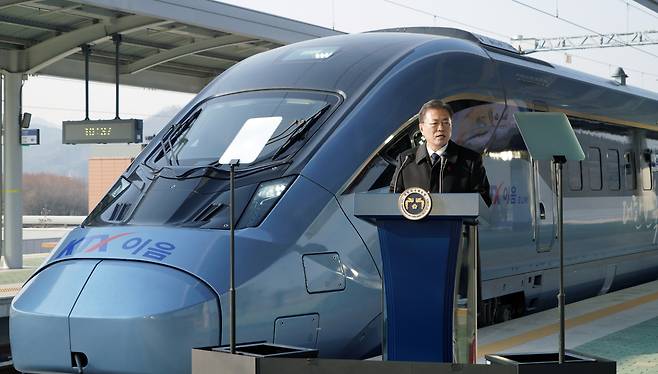
President Moon Jae-in started the year stressing a goal of reaching carbon neutrality during the unveiling of the nation’s new low-carbon, high-speed train -- the KTX-Eum -- in Wonju, Gangwon Province, Monday.
“This year will mark the first year of the nation’s adoption of low-carbon, eco-friendly trains,” Moon said, calling trains key to the government’s push for sustainable growth with innovation, under the “Korean New Deal.”
“Ultimately, Korea will become a powerhouse in the field of high-end transport infrastructure by adopting advanced technologies into our railways, roads, airports and ports overall.”
The new train, which boasts a maximum speed of 260 kilometers per hour, is the nation’s first multiple-unit train consisting of self-propelled carriages using electricity, which means the train requires no separate locomotive.
Compared to locomotive-type trains, the distributed power train has higher acceleration and braking performance, befitting the nation’s railway system where the distance between stations is relatively shorter than other countries.
Among other aspects, the train, developed by Hyundai Rotem of Hyundai Motor Group, is eco-friendly. It emits less carbon, about 70 percent of that emited by the current diesel-powered trains. By replacing all diesel-powered passenger trains with the low-carbon trains, the government aims to reduce carbon emissions from 23.5 tons in 2019 to 16.5 tons by 2029.
The train will start operation Tuesday on the 44.1-kilometer Wonju-Jecheon, North Chungcheong Province, route of the Jungang Line. With additional railways built along the line by 2022, the new bullet train line is expected to link Seoul and Busan within three hours, like the KTX-Sancheon high-speed train on the Gyeongbu Line.
“The expansion of high-speed railways will accelerate a more balanced growth across the nation,” Moon added. “Through these efforts, all big cities will be connected within two hours and the commuting time to the Seoul metropolitan area will be reduced by less than 30 minutes.”
"Eum" means “link” in Korean.
Moon pledged to ramp up efforts to export the nation’s high-speed train and other infrastructure technologies like LTE-R abroad. LTE-R is the fourth-generation LTE communications network for railways that connects trains, control towers and other related institutions for safer and more efficient operation of the railway system as well as allowing ultrafast mobile connectivity for passengers.
By Lee Ji-yoon (jylee@heraldcorp.com)
<ⓒKoreaHerald(www.koreaherald.com)무단전재 및 재배포 금지>
Copyright © 코리아헤럴드. 무단전재 및 재배포 금지.