Low-cost carriers bet on ‘premium economy’ to attract mid-tier travelers
이 글자크기로 변경됩니다.
(예시) 가장 빠른 뉴스가 있고 다양한 정보, 쌍방향 소통이 숨쉬는 다음뉴스를 만나보세요. 다음뉴스는 국내외 주요이슈와 실시간 속보, 문화생활 및 다양한 분야의 뉴스를 입체적으로 전달하고 있습니다.
Low-cost carrier (LCC) Air Premia, which operates long-haul routes to the Americas, said on June 23 that it will rename its “Premium Economy” class to “Wide Premium” beginning July 1. Positioned between business and economy, the seat class targets passengers seeking an upgraded experience without the high price tag of upper-tier cabins.
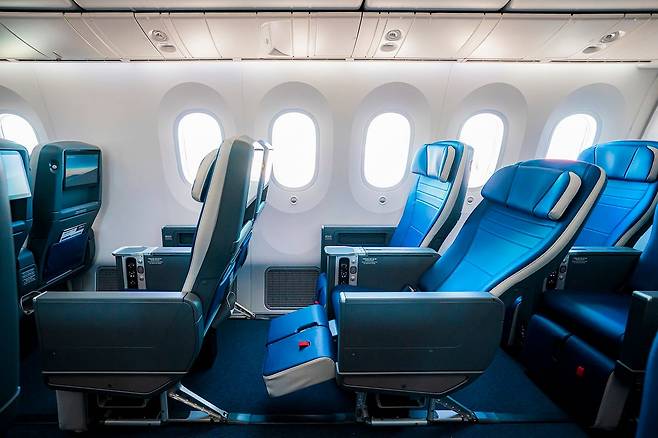
The airline noted that while many carriers offer premium economy options, the quality of service and seat pitch varies widely, often creating confusion among travelers. “We decided to rename the class to highlight our competitive edge—seat pitch ranging from 42 to 46 inches (106 to 110 centimeters), which is among the highest in the industry,” the company said.
Major South Korean carriers typically offer 29 to 32 inches between economy seats, making Air Premia’s offering roughly 1.5 times more spacious. This is the second time the company has rebranded the seat class. Originally launched as “Premia 42,” it was later renamed to align with the global “Premium Economy” standard before undergoing its latest rebranding to “Wide Premium.”
The move underscores the growing competition in the premium economy segment across the aviation industry. Jeju Air, South Korea’s largest LCC, operates a comparable product under the name “Business Lite,” while Korean Air is preparing to phase out first-class cabins on select routes and introduce premium economy seating later this year. The strategy aims to capture demand from mid-tier travelers—passengers who are willing to pay more than standard economy but less than the cost of business or first class, which often fly with empty seats. Asiana Airlines has also entered the space, offering its upgraded “Economy Smartium” seats for an additional fee.
The rising appeal of premium economy is largely driven by cost-effectiveness. Fares are typically about 1.5 times higher than standard economy—around 1.5 million won for a 1 million won economy ticket. The roomier seating is particularly appealing on long-haul routes. Additional perks such as dedicated check-in counters and priority boarding enhance the value proposition. With business class seats usually priced at two to four times the economy fare, and first class at up to six times more, many passengers view premium economy as a worthwhile and more affordable upgrade.
Copyright © 조선일보. 무단전재 및 재배포 금지.
- 우승후보 브라질-모로코, 북중미 월드컵 첫 경기에서 접전 1대1 무승부
- 北, 한미 NCG 회의 ‘비핵화’ 언급에 반발 “공허한 망상”
- 이란의 ‘찬물 공세’...제네바 서명식 거부, 美독립 250주년엔 하메네이 장례식
- DJ 와 고노의 ‘간담상조’...대통령 취임 다음날 단둘이 조찬
- 연금 부자들은 먼저 버렸다… 노후 자금 축내는 ‘생활 부채’ 6가지
- 역대급 상장 성공한 스페이스X, 함께 오를 한국 주식은?
- 손으로 일일이 살 발라내, 이혜정 뼈없는 순살 감자탕 한 냄비 7250원 특가
- 피렌체 찾은 李대통령...우피치미술관과 협력 MOU 체결
- “日 신사 닮았다” 욕먹던 건축가… 끝내 한국 건축의 전설이 되다
- 美상원의원, 명품 발리슛 인증… “월드컵 국대에 남는 자리 없나요?”