Trade minister emphasizes Korea, Japan differences as $350b investment talks with US drag on
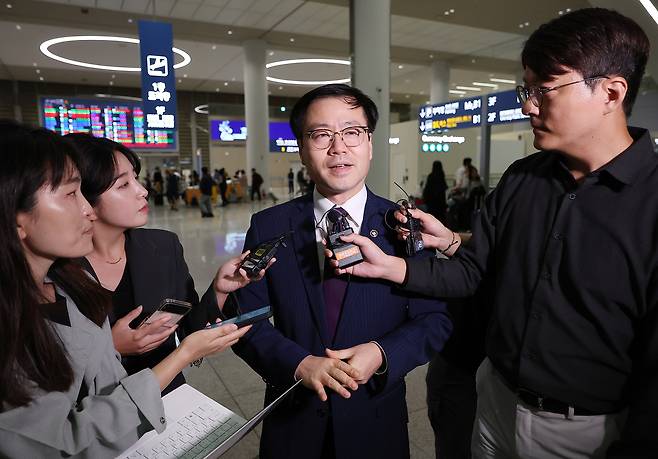
South Korea’s top trade envoy returned from follow-up talks in Washington linked to a multibillion-dollar investment deal, saying Friday he stressed to US officials that Seoul’s circumstances differ significantly from Tokyo's.
The deal remains stalled, with South Korea and the US divided over key details.
Trade Minister Yeo Han-koo told reporters at Incheon Airport that he was doing his “best to present objective data and analysis to persuade the US that Japan and South Korea are fundamentally different in many respects,” recounting his meetings with US Trade Representative Jamieson Greer and other senior officials in Washington. But he declined to offer further details on the ongoing talks.
Yeo’s visit followed a trip by Industry Minister Kim Jung-kwan, who met US Commerce Secretary Howard Lutnick last week, as Seoul hashes out the details of a tariff deal where it pledged to invest $350 billion in the US. In exchange, Washington would reduce its planned “reciprocal” tariffs against Korea from 25 percent to 15 percent.
The deal was broadly reaffirmed during President Lee Jae Myung and US President Donald Trump's summit held in Washington last month, but major differences remain over the structure of the investment and how returns will be shared.
Seoul wants to reduce upfront equity commitments by using loans and guarantees from state-run financial institutions, such as the Export-Import Bank of Korea and the Korea Trade Insurance Corp. Washington, by contrast, is pushing for a higher proportion of direct investment and wants control over project selection — similar to the $550 billion deal it struck with Japan.
Under the US-Japan deal, Washington will decide which projects the Japanese funds will go to, with profits split equally at first. But once Japan recoups its $550 billion investment, the profit breakdown will shift to 90 percent for the US and 10 percent for Tokyo.
Seoul insists such a financing scheme would destabilize its foreign exchange market and has reportedly suggested alternatives, including a possible unlimited currency swap, to break the impasse in talks.
The pledged $350 billion amounts to more than 80 percent of Korea’s foreign reserves of $416.3 billion as of the end of August, a level experts say is practically impossible to raise without risking a dollar shortage and potential financial instability.
Meanwhile, as a result of the Japan-US deal, 15 percent tariffs on Japanese automobiles took effect Monday. South Korean cars, however, still face 25 percent tariffs, despite a pledge during the July deal that Seoul would also benefit from reduced auto tariffs once terms are finalized.
“We fully recognize the urgency of the auto tariff issue and are making every effort to resolve it quickly,” said Yeo.
Yeo added that he also raised concerns over the massive immigration raid on Sept. 4 at the Hyundai Motor-LG Energy Solution battery plant in Georgia, where more than 300 Korean workers were detained and held for a week before returning home last Friday.
“I think the US side also understands the seriousness of the issue, and we urged the US to resolve visa issues,” he said.
Copyright © 코리아헤럴드. 무단전재 및 재배포 금지.