Consumer coupons now available at select stores across Korea
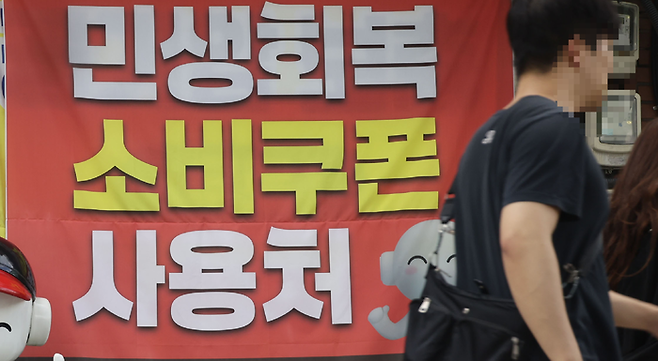
While the program covers a broad range of retailers, from food franchises to convenience stores and household goods shops, many remain confused about the specifics. Usage is limited to small businesses with annual revenue under 3 billion won ($2.16 million), and eligibility can vary by brand, franchise status, and store format.
According to industry sources, the coupons can be used from Tuesday onwards at small franchised stores, excluding major supermarkets, department stores, and entertainment venues. Among food franchises, for example, most BBQ, BHC, and Kyochon Chicken locations accept the coupons because over 90 percent of their branches are franchised. Starbucks, which operates entirely as company-owned stores, does not accept the coupons while franchise-heavy brands like Mega Coffee generally do.
Burger franchises show a clear divide: Mom’s Touch, with a 99 percent franchise rate, and Lotteria (90 percent) accept the coupons at most locations. However, usage is limited at Burger King (23 percent), McDonald’s (15 percent), and KFC (8 percent), where most outlets are not franchised.
Some food delivery services also support the coupons. Woowa Brothers, which operates Baemin, has improved access to its “meet-and-pay” function which allows for in-person payment at the restaurant’s own terminal - a condition required for coupon use. This option is only available through the “store delivery” method, not Baemin’s own delivery services.
Coupons are also valid at many small independent businesses. “I have been struggling for years as business has been slow. I hope this helps,” a restaurant owner in Seoul’s Euljiro area said. “We do not even have a signboard, but I will definitely put up the sticker that says coupons are accepted.”
Convenience stores are among the most accessible locations, as most operate under the franchise model. However, major supermarkets and SSMs (super supermarket chains) are excluded. Usage at Daiso stores varies; only 30 percent of the company’s 1,576 stores are franchised and eligible. A Daiso official said the company is listing participating stores on its website.
The government initially considered including food supply retailers, especially in non-metropolitan regions, but limited eligibility to stores with annual revenue under 3 billion won following objections from small business and market associations.
Struggling domestic fashion retailers also see the program as a potential boost. K2, for instance, is running a “Livelihood Recovery Event” through August 17th, 2025, offering discounts of up to 105,000 won at its stores. Other brands such as Crocodile Ladies, Chatelaine, Castelbajac, and Esquire, which operate a combined 1,500 franchise stores, also accept the coupons at street-level outlets.
In the beauty sector, participating retailers include select CJ Olive Young stores and Aritaum locations operated by Amorepacific. Olive Young has 154 franchise locations (about 11 percent of its network), while Aritaum has about 340 eligible stores. In Seoul, coupons can also be used at merchants that accept Seoul Pay.
Retailers plan to clearly mark participating stores with signage to avoid confusion, following a model used during the COVID-19 pandemic for emergency relief payments.
Copyright © 매일경제 & mk.co.kr. 무단 전재, 재배포 및 AI학습 이용 금지
- “힘들게 복지센터까지 왔는데”…소비쿠폰 신청 첫날부터 ‘혼선’ - 매일경제
- 옥중 메시지 낸 尹 “비상계엄 올바른 결단…결국 역사가 심판할 몫” - 매일경제
- 정성호 장관, 취임 후 1호 지시는...직무대리 검사 원대복귀 검토 - 매일경제
- “강남까지 40분이면 간다”…3호선 뚫린다는 ‘이 동네’ 집값도 기대감 - 매일경제
- “여보, 에어컨 끄면 못자”...밤엔 열대야, 낮엔 체감온도 35도까지 오른다 - 매일경제
- [단독] 블랙박스에 담긴 그날의 패닉…“제주항공 조종사, 보조 동력 장치에도 손 안댔다” - 매
- “3박4일은 옛말” 외국인들 한국서 K-뷰티보다 더 열광한다는 ‘이것’ - 매일경제
- “스마트폰 싸게 살 수 있대”…단통법 폐지 앞두고 커지는 기대감 - 매일경제
- “사정은 딱하지만, 해드릴 게 없어요”…신종 피싱 손놓은 기관, 허점 노리는 그놈 - 매일경제
- 토트넘만 ‘찬밥 대우’…“손흥민에 경의를 표하시오”, 2025 PL 베스트 플레이어 8위 등극 - MK스