Exclusive: Muan Airport fails to meet safety regulations on localizer setup
이 글자크기로 변경됩니다.
(예시) 가장 빠른 뉴스가 있고 다양한 정보, 쌍방향 소통이 숨쉬는 다음뉴스를 만나보세요. 다음뉴스는 국내외 주요이슈와 실시간 속보, 문화생활 및 다양한 분야의 뉴스를 입체적으로 전달하고 있습니다.
Muan International Airport failed to meet safety standards for installing a localizer, a critical landing guidance system, according to findings revealed Dec. 31.
The issue surfaced in the aftermath of a Dec. 28 crash in which a Jeju Air plane carrying 181 passengers struck the localizer and an outer wall during landing, killing 179 people. The tragedy has drawn scrutiny over whether regulatory compliance might have mitigated the accident’s severity.
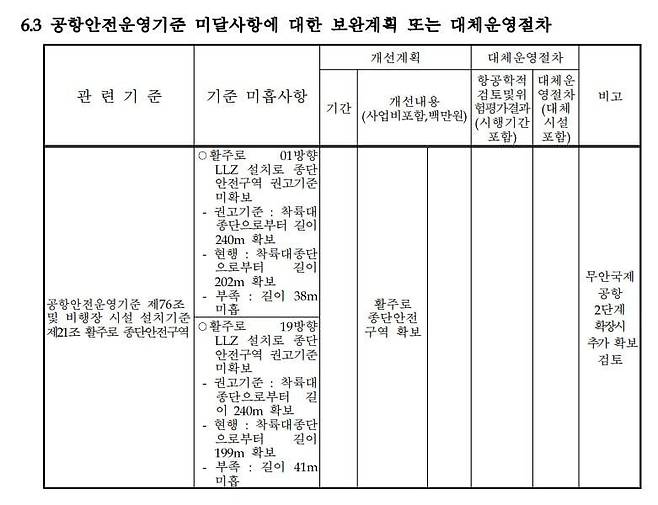
The airport’s operational manual, published on May 9 by Korea Airports Corporation (KAC), indicated that Muan International Airport failed to comply with runway end safety area (RESA) regulations outlined in the Ministry of Land, Infrastructure and Transport’s “Standards for Safe Operation of Airports.”
The manual, which details airport facilities, emergency operation plans, and safety management systems, specifically noted that the localizer’s installation point did not meet recommended standards.
Under the guidelines, the airport must maintain a safety area of 240 meters from the runway’s end. However, the localizer was installed just 202 meters from the southern end (01 direction) and 199 meters from the northern end (19 direction). The localizer, an antenna system that emits radio signals to guide aircraft toward the center of the runway, is essential for safe landings.
KAC flagged the airport for having a RESA that fell 38 meters short in one direction and 41 meters in the other. Airport officials responded that adjustments would be considered during the airport’s second-phase expansion.
Compared to other airports, Muan’s localizer placement lags significantly. For example, Incheon International Airport has its localizers positioned 295 to 298 meters from the runway ends, and other domestic airports adhere to the 240-meter standard.
Still, questions remain about whether adhering to the 240-meter guideline would have prevented the Jeju Air crash, as the aircraft also collided with an outer wall 323 meters from the runway’s end.
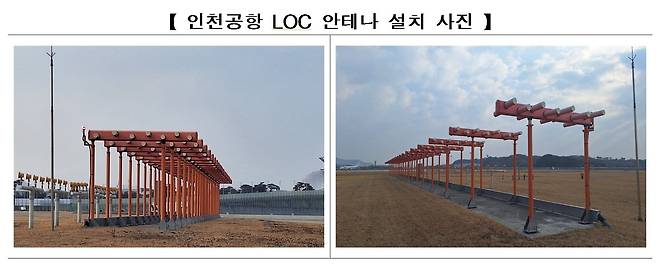
Experts have also criticized the physical structure of the localizer at Muan Airport, stating it does not meet regulatory standards. Article 24 of the “Standards for Establishing Airport and Aerodrome Facilities” requires RESA infrastructure to minimize damage to overrunning aircraft and facilitate rescue and firefighting operations.
At Muan, the localizer is embedded in a 2-to-3-meter-high mound, protruding about 7 centimeters above the surface and reinforced with concrete. Experts argue this design increases the risk of aircraft damage, falling short of safety standards.
In contrast, Incheon International Airport’s localizers are mounted just 7.5 centimeters above ground on a lightweight, breakable base designed to minimize aircraft damage. This design proved effective in 2016 when a UPS cargo plane overran a runway and struck a localizer, causing minimal damage to the aircraft.
“Regulations for localizer installations are based on common sense—structures must not be too rigid or high to avoid causing significant damage to aircraft,” an aviation industry official said. “Muan’s localizer design appears to violate these standards.”
Copyright © 조선일보. 무단전재 및 재배포 금지.
- [더 한장] 도쿄 긴자에 마련된 거대한 금붕어 수족관
- 美 이란 ‘군사개입’ 예고에, 러 “외부 간섭 절대 용납 못해”
- 경호원이 부통령 실시간 위치, 이동 동선 노출… 발칵 뒤집힌 비밀경호국
- 그린란드 정부수반 “미국 일부 되느니 덴마크에 남겠다”
- 한국서 ‘특허 사냥꾼’된 램리서치...소부장 기업들 떨고있다
- 연말까지 안 잡힌 환율에…수입 물가 6개월 연속 상승
- “탈모 정복하면 노벨상? 제가 한 번 받아보겠습니다”
- 겨울 해풍이 빚은 제철 감칠맛...구룡포 과메기 오늘 15% 타임 딜
- 갱년기 필요한 ‘진세노사이드’ 함량 높은 진한 홍삼, 한 포 1400원 조선몰 단독 특가
- 200억원 상속 받아 동생들에게 40억원씩 똑같이 나눠준 착한 장남의 최후