[Women Shaping Korean Art] Kim Soo-ja: Artist of boundaries, compassion
The following is the last installment of a three-part series exploring Korean female pioneers of the global art scene — Ed.
Kim Soo-ja appeared in her emblematic guise at Sunhyewon in Seoul in early September — dressed in black with her long hair tied back, a style that seemed to reflect her desire for invisibility. Her voice was calm, but her gaze carried resolve.
An artist's looks and personality are often reflected in the artist's works. Kim, the New York-based artist whose works explore migration and memories, recently returned to her home country after exhibitions overseas.
This year, Kim was named an Officer of the Order of Arts and Letters by the French government for her contribution to contemporary art. The exhibition “Kim Sooja, To Breathe — Sunhyewon” at Sunhyewon, a cultural space created in the former residence of SK Group founder Choi Jong-kun, is Kim's first presentation in Korea in a decade.
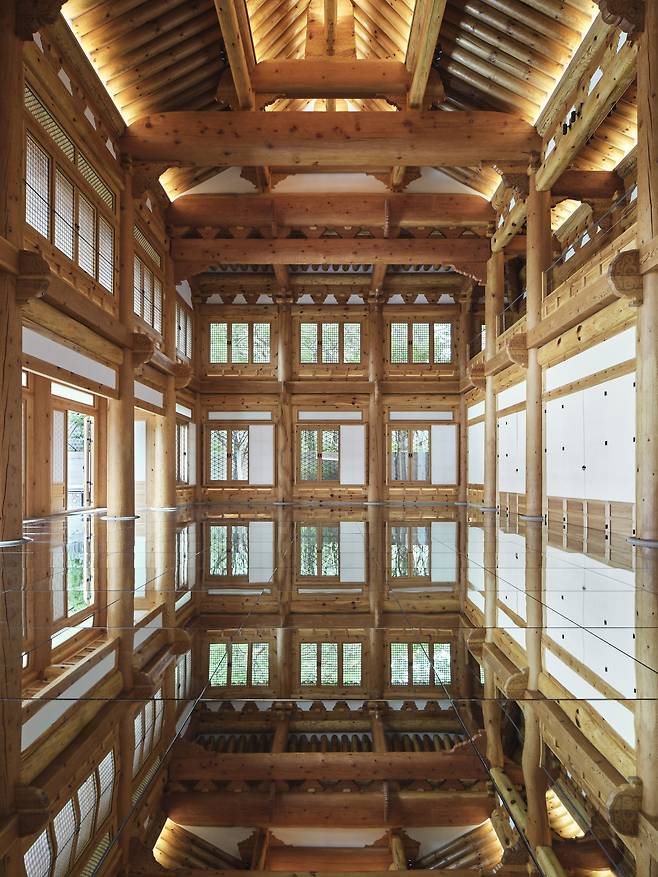
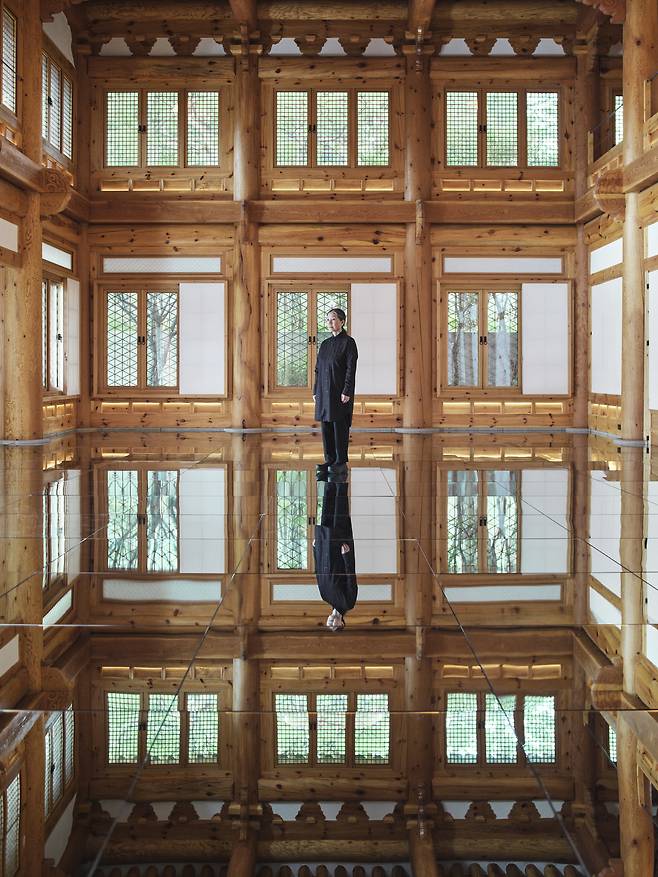
The large-scale mirror installation at a Sunhyewon hanok, a Korean traditional house, is the centerpiece of the exhibition. It is Kim's first mirror installation in Korea in nearly two decades since she first began working with mirrors.
“I had long wanted to work within a hanok after a bottari installation and performance in 1994 at a hanok in Yangdong Village (in South Gyeongsang Province). Since then, I have hoped to pursue a project in hanok or even temple settings, though the opportunity never arose,” Kim said on Sept. 4.
The site-specific installation with mirror panels titled “To Breathe — Sunhyewon” turns the hanok into an immersive space. Reflecting the architectural structures, such as wood rafters, as well as the natural light and outside views, it dissolves the boundaries between the structure and the viewer.
“I regard a mirror as an unfolded needle. I have long perceived the needle as a medium that does not reveal its own identity but serves to connect pieces. Once the stitching is complete, it leaves the place behind.
“In much the same way, the mirror reflects all things in the universe, yet never itself. It cannot reveal its own identity, and that paradox fascinates me,” she said.
The artist has long explored the notion of boundaries and connection, a pursuit closely tied to her enduring interest in migration and displacement as an artist who moved to New York, where she discovered diversity and a sense of liberation.
Living abroad has led her to see what was once familiar in a new light. "Bottari," the Korean word for a bundle wrapped in cloth, was one such thing. She was always surrounded by piles of fabrics in her studio in New York at the time, in 1992, she recalled.
Kim joined the MoMA PS1 residency in New York in 1992 for some 18 months and returned to Korea afterwards. She then moved to the city again in 1999, this time to settle.
“One day, a red bottari caught my eye and appeared entirely new. If my first revelation came in 1983, the moment I pierced a needle through a bedsheet, then discovering the bottari in the New York studio was the second most significant moment for me,” she said.
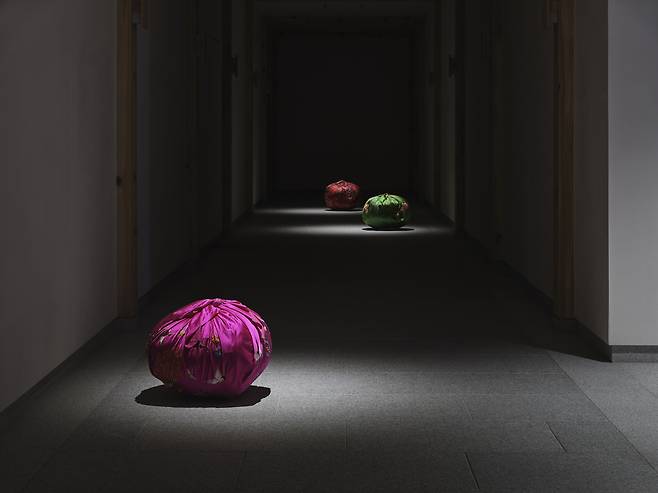
Holding an implication of both arrival and departure, a bottari carries the sorrows of one’s life, a medium of wrapping or containing, especially for those who traverse boundaries.
Three bundles of bottari are placed in a dim corridor at the exhibition hall, provoking curiosity, raising a desire to untie them. "In fact, a viewer once opened one in the past," she said.
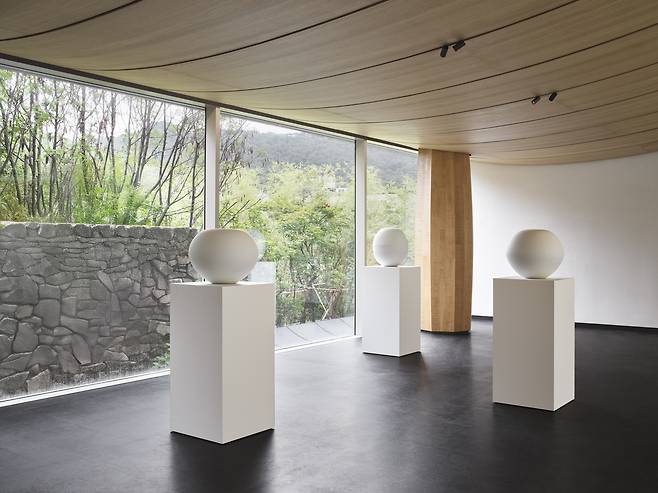
Kim also unveiled her new work “Deductive Object — Bottari,” a series of porcelain vessels inspired by the moon jar, produced with Germany’s Meissen porcelain manufacturer. Pierced with a single needle hole on top, the vessels embrace darkness and void with clay.
Weaving compassion into art
Born into a musical family, she carved out a different path for herself, Kim said. She recalled considering dropping out of high school to work with quarry workers.
“I had a strong empathy for people struggling through difficult lives, and it troubled me greatly,” she added, saying that she found solace in Yun Dong-ju’s poem “Prologue,” which resonated with her own struggles.
"Wishing not to have / so much as a speck of shame / toward heaven until the day I die, / I suffered, even when the wind stirred the leaves," she recited the lines.
When artists of Korea’s minjung art movement invited her to join them, she declined. While she shared their concern for marginalized lives, she resisted aligning herself with any collective movement as she felt a “strong sense of independence and individuality” was essential for an artist.
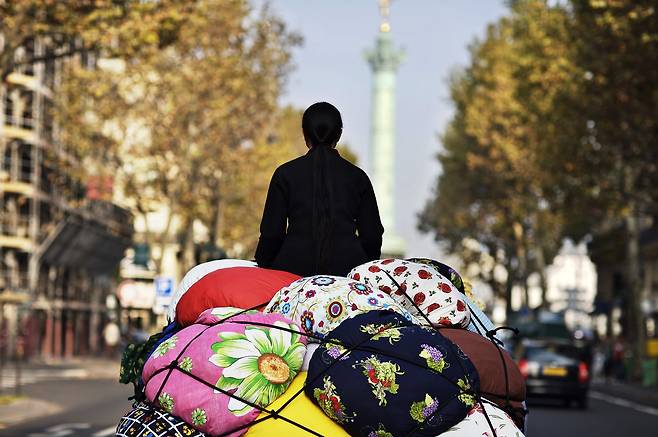
One of her representative works is “Bottari Truck — Migrateurs,” which is part of the collection of the National Museum of Modern and Contemporary Art, Korea and is on view at the museum.
The video work follows a truck loaded with bottari through Paris and its immigrant neighborhoods, culminating at the Saint-Bernard Church — a historic site of undocumented migrants’ protests.
Only the artist’s back is shown with her long hair tied back, a gesture that makes her an invisible mediator, like a needle or a mirror.
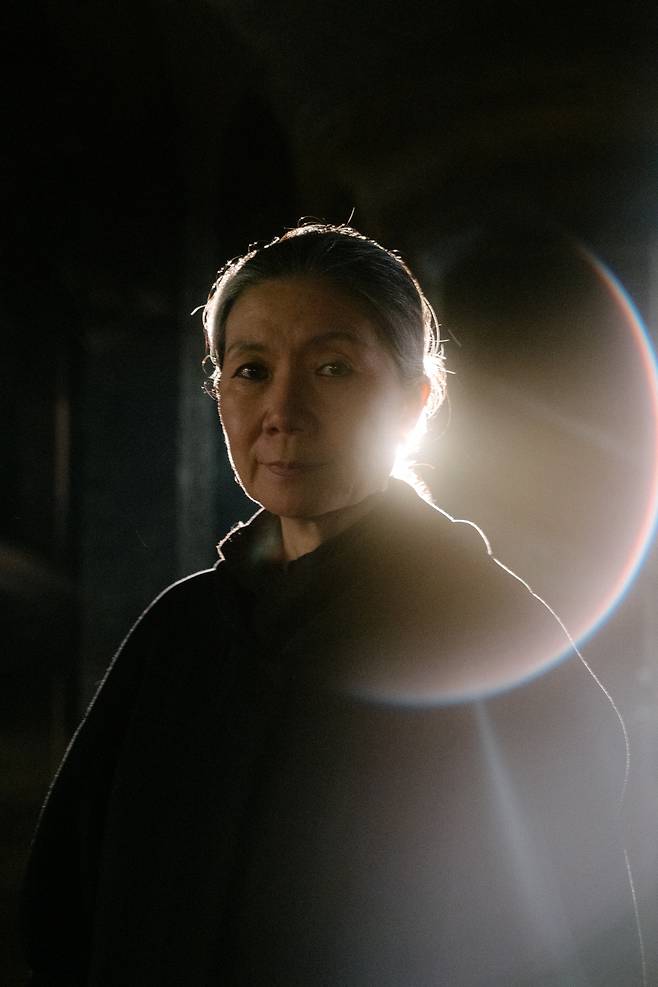
“I did not set out to become a visual artist with a defined goal. Rather, I embraced it as a way of life. Art, for me, has been a means to contemplate existence more profoundly and to sustain that contemplative state of mind,” she said.
The exhibition at Sunhyewon, curated by Podo Museum Director Chloe Kim, opened on Sept. 3 and runs through Oct.19. Online reservation is required.
Copyright © 코리아헤럴드. 무단전재 및 재배포 금지.