US-Japan summit to test Seoul as Trump presses allies for Hormuz role
전체 맥락을 이해하기 위해서는 본문 보기를 권장합니다.
"Tokyo is expected to remain cautious about dispatching warships, while signaling a degree of alignment with Washington at the diplomatic level," Yu said. "Due to legal and political constraints, as well as public opinion, Japan is likely to avoid direct military involvement and instead focus on de-escalation, ensuring maritime safety and contributing in noncombat roles."
Dispatching naval assets also presents complex challenges. "If multiple countries deploy ships, they would effectively need to form a combined naval force, requiring coordination on command structures, operational zones, mission roles, intelligence sharing and interoperability," Yu said. "Such a framework is not yet fully in place."
이 글자크기로 변경됩니다.
(예시) 가장 빠른 뉴스가 있고 다양한 정보, 쌍방향 소통이 숨쉬는 다음뉴스를 만나보세요. 다음뉴스는 국내외 주요이슈와 실시간 속보, 문화생활 및 다양한 분야의 뉴스를 입체적으로 전달하고 있습니다.
Click here for [Key points] US-Japan summit to test Seoul
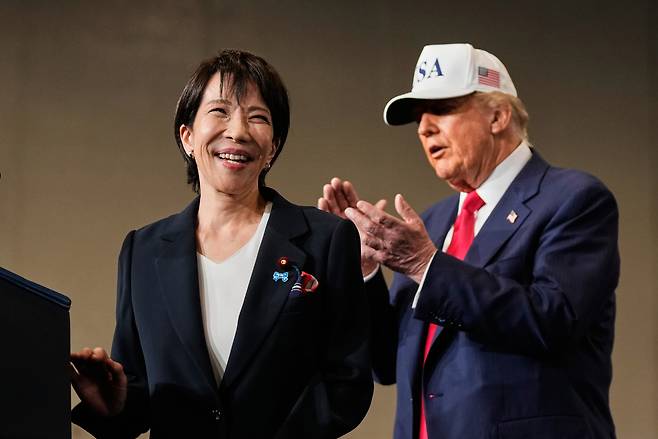
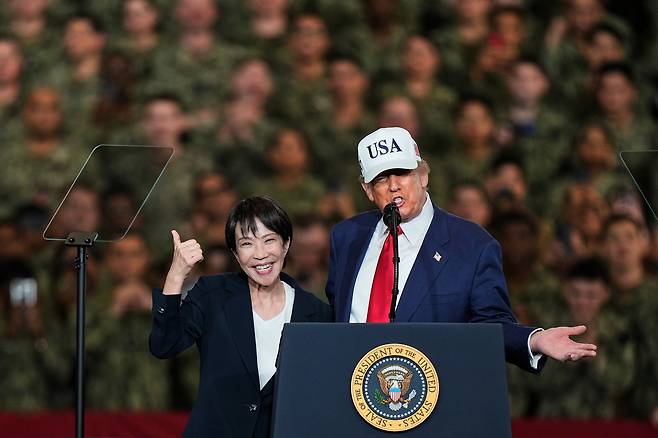
US President Donald Trump's summit with Japanese Prime Minister Sanae Takaichi is expected to sharpen a strategic dilemma for Seoul, as the US president ramps up pressure on allies to contribute to maritime security operations in the Strait of Hormuz.
If Tokyo were to signal even limited participation following the Thursday meeting in Washington, analysts say the United States is likely to intensify calls for Seoul to follow suit — raising the stakes for a government already juggling alliance expectations, domestic political risks and broader security negotiations with Washington.
Trump is expected to press Takaichi for military support in securing the Strait of Hormuz, a critical global oil choke point destabilized by the ongoing conflict involving the US, Israel and Iran.
As Trump urges allies to join a multinational maritime security effort, the prospect of an expanded Japanese role is placing Seoul in a difficult position, observers noted.
“President Trump could demand more from American allies or take a colder stance toward those that do not comply,” said Cha Du-hyeok, vice president at the Asan Institute for Policy Studies.
The issue could spill over into ongoing South Korea-US negotiations on key security matters, including nuclear cooperation, Seoul’s pursuit of nuclear-powered submarines and its long-sought push for uranium enrichment and spent fuel reprocessing rights — all outlined in the bilateral Joint Fact Sheet finalized in mid-November 2025, following summit talks between South Korean President Lee Jae Myung and Trump held a few weeks prior in late October.
Experts say Trump’s push reflects both operational needs and a test of alliance cohesion, at a time when alliance modernization is increasingly tied to burden-sharing and tangible contributions.
“Trump’s recent remarks go beyond simple public pressure,” said Yu Ji-hoon, a research fellow at the Korea Institute for Defense Analyses and a former Navy commander. “They carry a dual message — assessing both actual military needs and the political willingness of allies and partners.”
Yu noted that maritime security in the Strait of Hormuz has deteriorated significantly, justifying Washington's calls for allied naval support. However, Tokyo is expected to tread carefully, balancing alliance expectations with legal constraints and domestic opinion. Experts say Japan is likely to avoid direct combat roles and instead focus on noncombat contributions such as intelligence gathering and maritime safety.
"Tokyo is expected to remain cautious about dispatching warships, while signaling a degree of alignment with Washington at the diplomatic level," Yu said. "Due to legal and political constraints, as well as public opinion, Japan is likely to avoid direct military involvement and instead focus on de-escalation, ensuring maritime safety and contributing in noncombat roles."
The constraints stem largely from Japan’s postwar pacifist framework. Under Article 9 of its Constitution, Japan renounces the use of force as a means of settling international disputes, limiting the scope of overseas military operations. While Tokyo has reinterpreted the constitution to allow limited exercise of collective self-defense, its Self-Defense Forces remain restricted in engaging in combat unless Japan’s survival is directly threatened.
Dispatching naval assets also presents complex challenges. “If multiple countries deploy ships, they would effectively need to form a combined naval force, requiring coordination on command structures, operational zones, mission roles, intelligence sharing and interoperability,” Yu said. “Such a framework is not yet fully in place.”
He also pointed to operational risks, including uncertainty over Iran’s deployment of naval mines and the broader threat posed by asymmetric tactics such as drones, fast attack boats and anti-ship missiles in the narrow waterway.
Yu similarly stressed the need for a calibrated approach, suggesting that Seoul frame any potential involvement in terms of maritime security rather than direct combat.
“It would be more appropriate to focus on protecting sea lanes, escorting commercial vessels, maintaining safe shipping routes and sharing information,” he said. “This would demonstrate alliance solidarity while minimizing the risk of direct confrontation with Iran.”
Trump’s call for allied participation in the Strait of Hormuz presents a fresh obstacle for Seoul, which only recently cleared a key legislative hurdle tied to its economic alignment with Washington. The National Assembly’s passage of a bill to establish a Korea-US strategic investment framework — aimed at supporting a pledged $350 billion investment in the United States across sectors such as shipbuilding and semiconductors — had been seen as a step toward easing tensions with the Trump administration.
Concerns are mounting in Seoul that countries that decline to contribute forces could face economic repercussions. South Korea and other nations asked to support the Hormuz mission were included in the Office of the US Trade Representative’s Section 301 investigation announced earlier this month, fueling speculation that security cooperation could be linked to trade pressure.
Meanwhile, Trump has signaled growing frustration with allies’ reluctance to commit.
In a social media post Wednesday, he suggested shifting responsibility for securing the Strait of Hormuz to countries that rely on it, saying such a move would kick “non-responsive” allies “in gear.”
He also claimed earlier this week that the US military had already achieved “military success” in its campaign against Iran and no longer required assistance from North Atlantic Treaty Organization allies, South Korea, Japan or Australia — remarks seen as part of a broader pressure tactic.
Seoul has so far maintained a cautious stance on potential involvement in the Strait of Hormuz, emphasizing the need for close consultations with Washington before determining the scope and nature of any possible contribution.
Asked about Trump’s recent remarks suggesting that countries reliant on energy shipments through the Strait of Hormuz should take responsibility for its security, a Foreign Ministry official said on Thursday, speaking on condition of anonymity, “We need to closely examine President Trump’s exact intent and what he truly means.”
On whether the issue was discussed during a phone call between Foreign Minister Cho Hyun and US Secretary of State Marco Rubio on Monday, the official said, “Given the Strait of Hormuz’s importance to the global economy and oil prices, there was a shared understanding on the need for cooperation among multiple countries.”
South Korea maintains a limited naval presence in nearby waters through its Cheonghae Unit, an anti-piracy mission based in the Gulf of Aden, on the other side of the Arabian Peninsula. While its primary mandate is to protect Korean vessels from piracy, the unit has at times been flexibly tasked to support broader maritime security operations in the region.
Copyright © 코리아헤럴드. 무단전재 및 재배포 금지.