Korean startups share insights for U.S. expansion
전체 맥락을 이해하기 위해서는 본문 보기를 권장합니다.
"Koreans are often too critical of each other and have high expectations," she said. "But this environment has been a key factor in success."
"We are fostering early-stage startups in Korea, but moving forward, we aim to support the overseas expansion of startups that have reached a certain level of growth," Park Young-hoon, who heads the foundation, said. "By collaborating together, we will help startups continue to develop from Korea to the United States."
이 글자크기로 변경됩니다.
(예시) 가장 빠른 뉴스가 있고 다양한 정보, 쌍방향 소통이 숨쉬는 다음뉴스를 만나보세요. 다음뉴스는 국내외 주요이슈와 실시간 속보, 문화생활 및 다양한 분야의 뉴스를 입체적으로 전달하고 있습니다.
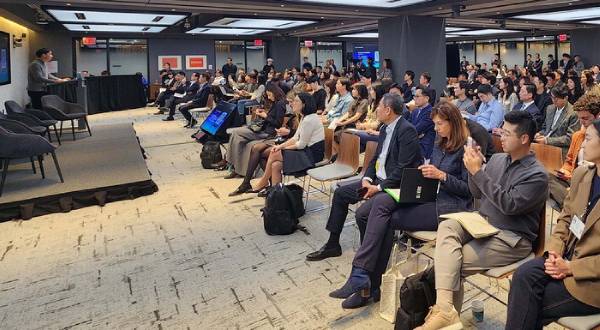
“When I was in a difficult situation, feeling desperate as I sent emails to hundreds of venture capital firms and hoping for any help, a Korean-run investment firm reached out and offered assistance,” Woo Seong-hoon, co-founder and chief executive officer of Amogy Inc., said at the 2024 NYC Startup Summit.
Amogy is a company that develops ammonia-based hydrogen fuel cell systems. It successfully sailed the world’s first carbon-free ammonia-powered demonstration ship on a tributary of the Hudson River in New York in September 2024.
“The reason I was able to overcome tough moments during the startup process was due to the strength of the Korean network,” Woo said.
According to Woo, Amogy was founded in Brooklyn by four Korean students attending MIT. Not only did they receive significant help from Korean investors in Silicon Valley during the early stages of investment but they also benefited from the global Korean network as they expanded their business.
Amogy has received investments from foreign companies including Amazon and Aramco as well as Korean companies like SK innovation and Korean Zinc.
The most successful example of an immigrant community in the U.S. merging with a startup ecosystem in its home country is the Jewish-Israeli community.
According to the U.S.-Israel Business Alliance, there are 88 unicorn companies founded by Israelis, as of October 2024. Over 60 Israeli-founded companies are listed on U.S. stock exchanges, and many Israeli firms have been acquired by major U.S. tech companies.
Nvidia, a leader in the AI semiconductor industry, and TSMC also owe their current standing to the collaboration between Taiwanese companies and Taiwanese-born entrepreneurs.
Nvidia, founded in Silicon Valley in 1993, was able to produce semiconductors with Taiwan Semiconductor Manufacturing Company Ltd. (TSMC)’s help and it was TSMC founder Morris Chang who first reached out to Nvidia CEO Jensen Huang. The duo has maintained a cooperative relationship for over 30 years since then.
UKF is an organization that includes startups founded by Koreans born in Korea as well as Korean American startups founded in the United States. The event not only featured entrepreneurs from Korea but also second- and third-generation Korean American entrepreneurs.
Diana Lee, founder and CEO of Constellation, grew up as the daughter of Korean immigrants and has built a global ad-tech company with 200 employees.
“Koreans are often too critical of each other and have high expectations,” she said. “But this environment has been a key factor in success.”
Kim Dong-shin, founder of Sendbird, who built a unicorn company after successfully launching a startup in Korea and then moving to the United States, advised that “as Korea’s population continues to decline, companies that stay only in the domestic market will face increasingly fierce competition.”
“Korean startups must consider international expansion from the get-go,” he said.
Maeil Business Newspaper and Maekyung Media Group, in the meantime, participated as media partners with UKF to help build a startup ecosystem linking Korea and the United States.
The startup winners of the Try Everything competition, co-hosted by the Seoul Metropolitan Government and Maekyung Media Group, will be able to participate in events hosted by UFK in the United States.
Before UKF’s main event, Maeil Business Newspaper held an advisory board meeting with domestic startup-related organizations. Participants included representatives from the Korea International Trade Association, Korea Development Bank, and the Banks Foundation for Young Entrepreneurs.
“We are fostering early-stage startups in Korea, but moving forward, we aim to support the overseas expansion of startups that have reached a certain level of growth,” Park Young-hoon, who heads the foundation, said. “By collaborating together, we will help startups continue to develop from Korea to the United States.”
Copyright © 매일경제 & mk.co.kr. 무단 전재, 재배포 및 AI학습 이용 금지
- 오늘의 운세 2024년 10월 21일 月(음력 9월 19일) - 매일경제
- ‘13남매 장녀’ 남보라 깜짝 결혼 발표...日여행 중 프러포즈 받고 감격의 눈물 - 매일경제
- “뇌사자 장기 적출 직전 몸부림치며 눈물”…그런데 수술 강행한 병원 ‘발칵’ - 매일경제
- “해외여행 두시간 전에 갈 필요 없겠네”...탑승 수속시간 빨라진다는데 - 매일경제
- 中서 ‘발전기 단 전기차’ EREV 인기…한달새 12만대 팔려 - 매일경제
- “트럼프 되기 전에 사놓자”…요동치는 자산시장 ‘이것’ 급등한다는데 - 매일경제
- 미모의 패션회사 CEO, 갑자기 개인 유튜브서…“이젠 내가 입고 싶은 옷을” - 매일경제
- 9조 프로젝트 유치에 “원룸 다 동났다”…오일머니 덕에 들썩이는 이 도시 - 매일경제
- 곳곳에 경고등 켜졌다는 한국...5대 싱크탱크 한 목소리로 “가장 큰 문제는” - 매일경제
- 방심했던 린가드 “K리그 쉬엄쉬엄해도 되겠지 생각했다 김기동 감독 말에 정신 차려” - MK스포