Jesse Lee: Catering to 'cool' Millennial, Gen Z tastes
Founder of Basic.Space strives for 'IRL to URL' experience in art, design, fashion
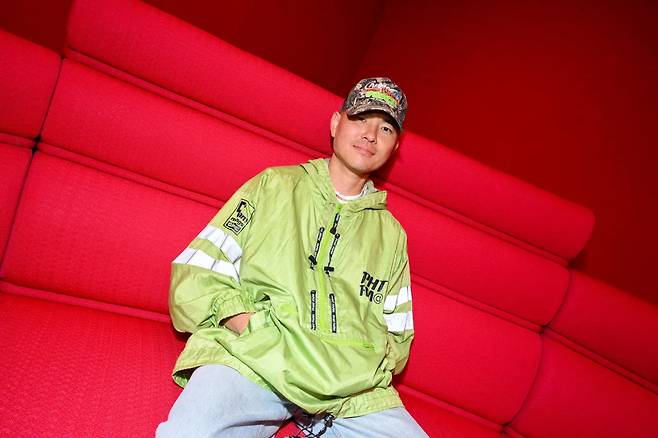
Rooting for the underdogs is a mission that courses through Jesse Lee, founder of Basic.Space, a curated online site for design, art and fashion, who on Sept. 5, announced the acquisition of Platform, an e-commerce site for art and artist collaborations.
On top of the latest acquisition, Lee owns Aquatic Leisure Center, an e-commerce site for unique baseball caps, Period Correct, an online shop for unique fashion and vintage cars, as well as Basic.Space and his 2023 acquisition, Design Miami, which was a departure from Lee’s focus on e-commerce that brings together collectible designs in a fair setting with hubs in Los Angeles, Paris and Basel, Switzerland.
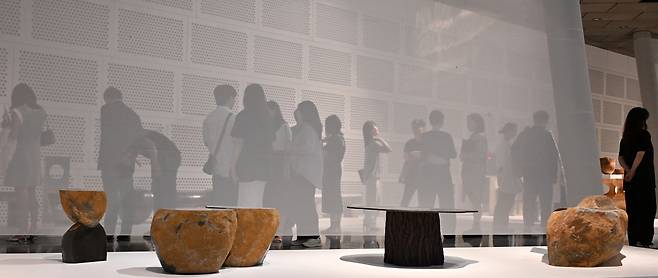
“I always knew that I wanted to start my own company,” says Lee, sporting a cap from his own company that reads “Deep Funk and Divine Intervention,“ in an interview with The Korea Herald in Seoul on Sept. 4. He was in Seoul for the opening of Design Miami:In Situ Seoul, the design fair’s first edition in Asia, which ran from Sept. 1 to Sept. 14 at Dongdaemun Design Plaza, featuring 170 collectible designs.
Upon graduating from the University of Illinois at Urbana-Champaign, Lee headed to Los Angeles, where he worked for a number of small, indie label record companies and magazines. “For three to four years, I worked for other people and moved my way up,” he says. “But I always knew that I wanted to start my own company.”
He rolls up a sleeve of his T-shirt to show a tattoo with the letters “dF.”
“This is the logo I had in college for my club work, which I called ‘Dub Frequency,’” he says, explaining he did DJ gigs and ran a music blog during college.
He got the tattoo when he moved to LA to remind himself that he had to start his own business one day.
That day came at 27 years old, convinced it would be now or never.
The timing could not have been worse, in most people’s eyes -- it was right after the financial crisis of 2008, which had resulted in the deepest recession in the US since the Great Depression some 70 years earlier.
But Lee believed otherwise. “This is the best time to start a business. When the economy is tanking, there aren’t great jobs. You might as well start a business when people aren’t doing it,” he says.
For his business acumen, Lee credits his father, Lee Byung-kyoo, who was in the leather business in Seoul until the family moved to the US in 1994.
From early on, when he was 6 or 7, the father would talk to the son about his business -- what happened that day, what he did wrong.
“That ended up helping me when I was an adult, of what to do right,” he says.
From his mother, who was an art major, he picked up his work ethic. She had never held a job until her 40s, when the family moved to the US and she became a small business owner. “I saw my mom work really hard,” he recalls.
The first business he started was DFM, or Dub Frequency Media. In the late 2000s, he revived his music blog from his college days at dubfrequency.com, posting about up-and-coming musicians, artists, rappers and indie rock DJs. He also organized parties in Los Angeles and New York.
Soon, he was in business and getting sponsors to cover the expenses.
DFM began as a creative agency, but as it started helping fashion brands and tech companies market to young people, it evolved into a marketing company.
Lee ran the business for about 10 years, he said, having started out with no investors -- just his credit card -- and growing it to an agency business.
He “fell into it,” but knew that it was not something he wanted to do “forever.”
Looking to do something more impactful, Lee decided to start something more akin to a tech company, for which he raised money from investors. This was in the 2010s, at a time when tech startups and Silicon Valley were all the rage.
Founded in 2020, the concept for Basic.Space is discovering creative talent in design, fashion and art and selling their products directly to consumers.
“It was about entrepreneurial creatives that don’t usually have a platform,” he says. Once again, rooting for the underdogs.
Today, the curated platform has more than 500 active sellers at a given time, selling by invitation only.
Pursuing “IRL to URL,” Basic.Space’s mission is to create a place online and offline.
“This is very native to the Millennial, Gen Z shopping experience. That is a big part of Basic.Space,” Lee says.
Chasing the cool factor
Lee himself has been on something of a shopping spree in recent years, buying Design Miami in October 2023 and now Platform, which launched in 2021 during the pandemic.
“The funny thing is, it is not what I had intended when I started Basic.Space,” he says. Recalling how, in the second half of 2022, “money was dry,” he says, “That’s my time to go, ’You know what, I’m going to go buy some distressed assets or take opportunities and grow them while everybody else is standing on the sidelines.’”
“The acquisition strategy kind of just came to be in 2022 because there were opportunities to acquire assets on a good deal,” he says.
“Miami Design is the top collectible design fair globally. I knew that design is a huge category that a lot of people my age and younger were getting into because fashion sort of became mainstream,” he says about the acquisition that put Basic.Space on the map.
Pointing out that luxury fashion has become “super mainstream” in the last 15 years, Lee says, “People don’t all have a Jean Prouvet bed or a Charlotte Perriand bookshelf. It’s not about price. Again, it’s about discovery.”
Indeed, discovery is one of the three tenets of Basic.Space -- discovery, authenticity and curation.
“For Basic.Space, it’s all about discovery, finding what’s new and empowering the next generation,” he says.
“The second circle is authenticity. We want to work with real people that are authentic, people who are like-minded. What we actually do is curation. We curate the sellers, the products, the experiences,” he adds.
Then there is the globally trademarked statement: “Own the Future.”
“I trademarked it globally in 2020 so nobody could use it,” he says.
It was not a frivolous move. “I spent time and money to have it trademarked,” he says emphatically, explaining, “It’s about supporting people own the future. It also just means controlling your own destiny,” he says.
Exporting Korean design
Coming back to Design Miami, Lee says he is open to holding the fair in other Asian cities as well. “There are only a couple of other places that would make sense, but we chose Seoul as our first go-to, just like Paris is a big focus in Europe,” he says.
“Seoul is way more open to these commercial opportunities from the US than China, for obvious reasons. Tokyo is still a very important cultural epicenter, but Seoul seemed to provide a faster commercial opportunity,” he says.
Design Miami will still look into China and Japan, and eventually the Middle East and India, Lee predicts.
“You can’t predict five, 10 years from now, but if you have to choose a place now, I think Seoul is the best place for Asia,” he says, adding that Frieze Seoul, whose fourth edition took place in proximity to the Design Miami:In Situ Seoul opening, also helps.
His goal for next year’s Design Miami in Seoul is a much bigger version of what took place this year.
However, there is a hurdle that needs to be resolved for the design fair to take root in Seoul.
“What we’re trying to resolve for next year is the import tax,” he says.
“This year is mostly an exhibition. A typical fair would have gallery booths and exhibitors and selling and more of the marketplace component,” he says.
“Here, what we don’t know is ‘Is there enough market, a robust collector base that will spend six figures on furniture and willing to pay 20, 30 percent on top (on taxes)?” he says. “Galleries, I am sure, aren’t going to want to lower the price, because someone has to pay the difference.”
“That’s why it’s hard for galleries in Europe and America to come here, if they don’t know for sure they can sell six, seven figures worth of furniture even if they give discounts to pay the difference of the tax,” he says, suggesting a change in law that would declare the fair area temporarily exempt from import tax, or categorizing collectible designs as art. “They are one-off things, not stuff you buy at a store.”
He observed that Koreans seem to have a very high interest in design. “I think the interest is there. We just have to figure out the buying and the buying power coupled with the subsidy or sorting out the tax issue.”
It was due to import tax issues that the items on sale in the inaugural edition were by local artists and designers.
Lee expresses surprise at finding many European and US galleries, including Carpenters Workshop and Friedman Benda, two of the biggest design galleries in the world, representing many Korean artists. They’re more famous in LA, New York and Paris than they are at home, he noted.
“These designers are based in Seoul, but their works are being purchased in the US and in Europe,” he says. “They don’t travel outside, but their works travel. I’m sure there are dozens of cool, 30-something artists, designers that I think we could help export and be seen around the world more, too.”
Copyright © 코리아헤럴드. 무단전재 및 재배포 금지.