Michael Porter Stresses Idea of 'Competition to Be Unique'
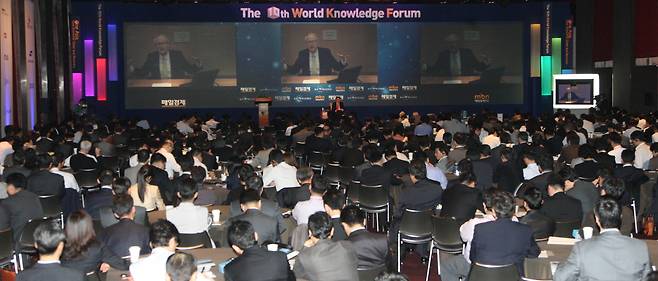
The very first lecture of the 2009 World Knowledge Forum (WKF) has been presented by Michael E. Porter, Professor at Harvard University, on October 13 at the Vista Hall, at the Sheraton Grande- Walkerhill Hotel, Seoul. Porter's lecture titled "On Competition" has been given via satellite since he was unable to attend the forum in person.
Under the topic of "On Competition", management guru Professor Porter lectured on the 'Strategy in the post-crisis world: Implication for Korean and Asian Companies'. The professor started off with explaining how the current moment of time that the world is in right now is a transition period and pointed out that the recent economic crisis has caused most of countries across the world to face difficulties, particularly for the U.S. and the U.K. Porter views transitions that had been made over the last 10 to 20 years quite positive with a rapidly growing global economy, in general.
Professor Porter mainly talked about ways for companies to win against their rivals in a fierce market competition. The core principal for companies to keep in mind is 'strategic thinking' which includes an idea of 'competing to be unique' rather than 'competing to be the best', the professor explained. He then pointed out one of the common mistakes that most companies seem to be making which is how corporations see the way to achieve success is to become the best company by manufacturing the best of everything such as the best product or the best supply chain. Regarding such a mistake commonly made by corporations, Professor Porter said, "Strategic thinking is much more than that," and added, "It depends on how you are trying to deliver your products and what your particular service or particular model looks like."
Throughout the lecture, the professor stressed the significance of 'distinctiveness' and 'uniqueness'. "It is not about being the best, but putting yourself into a unique position," and added, "There is no need to serve everybody or fulfill everyone's needs," said Professor Porter stressing the importance of unique ways of serving customers.
Professor Porter went on to talk about 'flawed concepts of strategy', citing how some companies set 'internalization' as their strategy. "Internalization is not a strategy, it is a step," and added, "We can't get confused between goals and actions," explained the professor. To back up his explanation on concepts of strategy, vision statements of three major South Korean companies -- LG, Hyundai USA, and Samsung- were displayed on a PowerPoint slide which was shown through a wide screen at the Vista hall. The management guru gave a flawed concept of strategy, citing one sentence from LG's vision statement that consists of 'pursuing its 21st century vision of becoming a true global digital leader'. According to the professor's theory, becoming a 'global digital leader' is a great goal, not a strategy, and thus, in order to set a proper strategy out of this goal, the company needs to think about what it should do to become a global digital leader.
Regarding setting the right goals, Professor Porter underlined the fundamental goal of a company which is superior long-term return on investment. He pointed out that there is a need for companies to focus on 'return on capital' rather than 'growth', and also added that companies' shareholder value should not be a company's goal. "Measuring your success based on share prices is very dangerous," said Professor Porter underlining that pleasing shareholders is a trap that companies often fall into. He also highlighted that a great leader can be defined as a 'mediator' between a company and shareholders.
In terms of redefining industry competition, Professor Porter described an aspect of 'zero sum competition' and that of 'positive sum competition' to explain how those two types are contradictory to each other. 'Zero sum competition falls into a category where companies compete head to head, one company's gain requires other companies' loss, and competition undermines industry's value, whereas 'positive sum competition' belongs to a category where companies compete based on their strategies, more than one company can be successful, and competition expands the value pool. In short, the professor stressed that companies need to find a way out of their 'zero sum competition'.
Toward the end of the session, the professor presented 'five tests of a good strategy' which includes a unique value proposition, a different and tailored value chain, clear tradeoffs, activities in the value chain that fits together and reinforce each other, and strategic continuity with continual improvement in realization. He urged companies to adopt a different mindset that "I (a company) am going to try to target a certain set of customers with a certain set of needs through a value chain," citing the Swedish home furnishing retailer IKEA targeting a specific customer need.
The sector on 'strategic thinking at South Korean companies' is also discussed in the lecture. The professor pointed out that most of companies in South Korea focus on prices is quite problematic. He suggests South Korean companies to shift thinking from prices to values.
The professor wrapped up his lecture with a section on 'Strategy and Society'. Corporations tend to see social issues and economic issues as two different groups which is a wrong idea, according to the professor's logic presented in the lecture. Food giant Nestle was given as an example of a successful company that has incorporated the social dimensions to its value propositions.
Professor Porter concluded his session after answering some of questions from the crowd. The session lasted for 90 minutes and Dong-sung Cho, Professor at Seoul National University, served as moderator.
[written and edited by Jae-yoon Jung]
[ⓒ Maeil Business Newspaper & mk.co.kr, All rights reserved]
Copyright © 매일경제 & mk.co.kr. 무단 전재, 재배포 및 AI학습 이용 금지