Lee calls for robust Korea-Vietnam partnership to weather global shocks
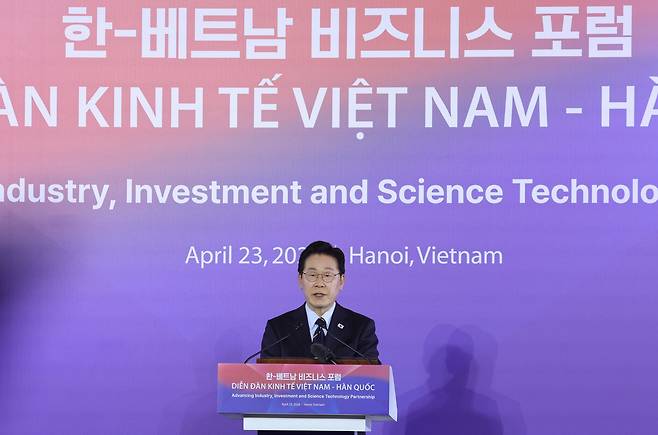
HANOI, Vietnam — President Lee Jae Myung on Thursday urged South Korea and Vietnam to forge a more resilient economic partnership, saying deeper cooperation on supply chains, energy and advanced industries is essential to weather growing global uncertainty.
“Global economic uncertainty is rising, creating a time of crisis. Under such circumstances, economic cooperation between South Korea and Vietnam has become more important than ever,” Lee said during a meeting with business leaders from the two countries in Hanoi.
The meeting came ahead of a large-scale business forum in Hanoi attended by around 500 participants, about 250 from each side.
Lee underscored that he was “confident that Korea and Vietnam are ideal partners to lead the global value chain.”
“Vietnam is a global manufacturing hub with strong production capabilities and abundant resources. If these strengths are combined with Korea’s advanced industrial technologies, we will be able to overcome any crisis,” Lee said.
“I also believe the two countries can together build out the ecosystem for future industries.”
Lee further underscored that “strengthening supply-chain linkages in energy and critical resources essential to advanced industries, including rare earths and urea solution, is also a very important task.”
According to the United States Geological Survey, Vietnam held an estimated 3.5 million metric tons of rare earth reserves in 2025, the world’s sixth-largest. Vietnam also became South Korea’s largest supplier of urea in 2024, accounting for more than half of its total imports.
“We should build a robust cooperative framework so that the economies of our two countries are not shaken by external shocks,” Lee said.
“To support Vietnam’s stable industrial environment, there is also a need to establish highly efficient power-supply networks, including LNG power plants and nuclear energy, and to expand infrastructure cooperation for that purpose.”
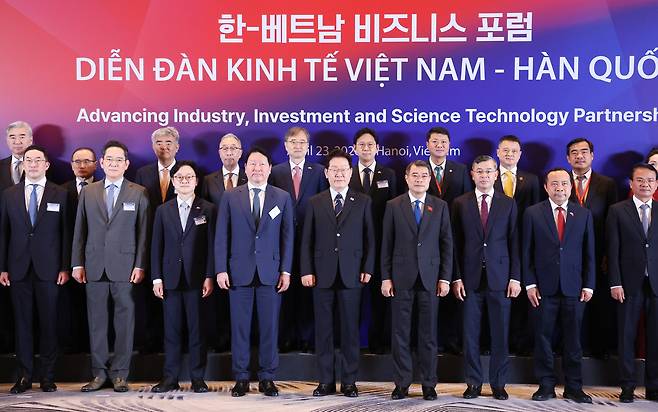
In a speech at the Korea-Vietnam Business Forum, Lee reiterated that South Korea and Vietnam should “lay the foundations for unshakable supply chain and energy cooperation,” as he laid out three broad directions for future cooperation.
“Securing stable access to resources and energy is the only way to guarantee the sustainability of economic growth,” Lee said. “If our two countries build firm safeguards in key strategic resources such as crude oil and rare earths, we will be able to create together a resilient supply chain ecosystem that can withstand any economic turbulence.”
Lee also called for the two countries to “plant together the seeds of future advanced industries such as artificial intelligence, semiconductors and digital technology,” while stressing that they “should prepare for the future together through cooperation in science and technology.”
At the forum, Prime Minister Le Minh Hung echoed that message, saying he hoped South Korea and Vietnam would “jointly build an advanced technology ecosystem.”
Hung also called for the two countries to “reorganize supply chains so they are flexible, robust and high in value,” adding that cooperation should go beyond simply improving access and instead focus on enhancing technological benefits and added value.
From the Korean side, around 250 attendees included Daewoo Engineering & Construction Chair Jung Won-ju, Samsung Electronics Chair Lee Jae-yong, SK Group Chair Chey Tae-won, who also serves as chair of the Korea Chamber of Commerce and Industry, and LG Group Chair Koo Kwang-mo.
Other participants included Lotte Group Chair Shin Dong-bin, Posco Holdings Chair Chang In-hwa, HD Hyundai Chair Chung Ki-sun, GS Group Chair Huh Tae-soo, CJ Group Chair Sohn Kyung-shik and Hyosung Group Chair Cho Hyun-joon, Doosan Enerbility CEO Park Gee-won, president of Hyundai Motor Group Sung Kim and Naver CEO Choi Soo-yeon.
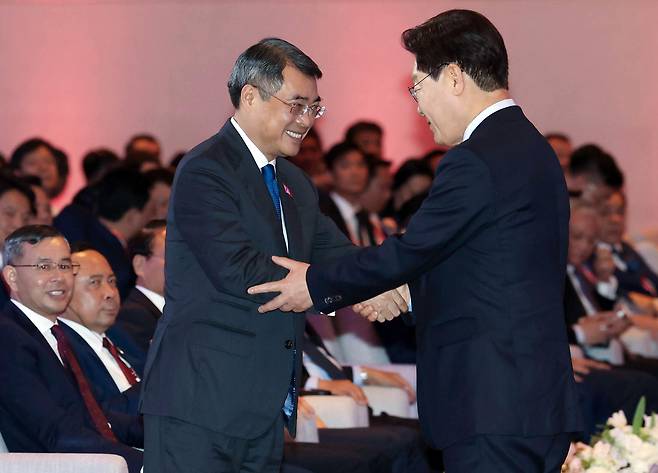
During a closed-door meeting with business leaders, Daewoo Engineering & Construction introduced its Haey Smart City project, which seeks to incorporate Korean Wave content into major developments across Vietnam, presidential chief of staff for policy Kim Yong-beom said in a press briefing following the meeting.
Daewoo E&C also expressed hope that its construction capabilities and know-how could be brought to bear on large-scale infrastructure projects such as the North-South high-speed railway and nuclear power plants, according to Kim.
Speaking at the briefing, Kim said the two countries should “advance to a new stage in which they build the future together on the basis of a stable relationship.”
“The direction ahead lies in building infrastructure — including nuclear power and energy facilities — capable of reliably underpinning the coming revolution in advanced industries,” Kim said. “In that sense, Lee’s state visit has become a good starting point for moving in that direction.”
Kim also drew attention to a notable shift in momentum behind the nuclear agreements signed after the summit, referring to the two memorandums of understanding on exploring options for new nuclear power plant construction in Vietnam and reviewing the feasibility of South Korean financial support.
“This time, the MOUs were concluded at the request of the Vietnamese side.”
That marks a contrast with the memorandum the two sides signed during To Lam’s visit to South Korea in August last year on cooperation in training nuclear power personnel, which Kim said had been pursued at Seoul’s request.
The Vietnamese side’s request for the latest MOUs comes as South Korea also seeks to win the project to build the Ninh Thuan No. 2 nuclear power plant.
Copyright © 코리아헤럴드. 무단전재 및 재배포 금지.