Delta resumes Korea flights with new Incheon-Salt Lake City route
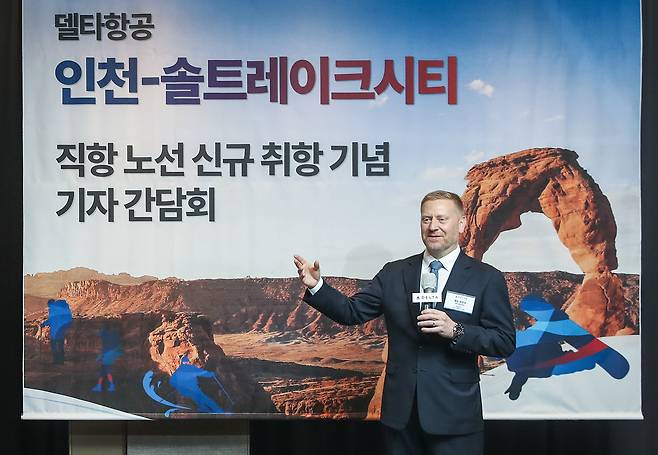
Delta Air Lines officially launched a new direct route between Incheon International Airport and US' Salt Lake City International Airport on Thursday, marking its return to the Korean market after a six-year hiatus, just ahead of the peak summer travel season. The airline also expressed its intention to further strengthen its partnership with Korean Air, its joint venture partner since 2018.
“This year marks Delta’s 100th anniversary, and introducing a new route to Korea during this milestone makes the occasion even more special,” said Jeff Moomaw, vice president of Asia Pacific for Delta Air Lines, at a press conference held in central Seoul on Thursday.
“Whether traveling for business or leisure, we’ve worked diligently to offer a flight experience that meets the expectations of Korean passengers. From Salt Lake City, travelers can conveniently connect to 35 destinations across the US, with a 55-minute international-to-domestic transfer time on par with that of Incheon Airport.”
Through its joint venture with Korean Air, Delta now connects Seoul to 14 US destinations. The expansion further solidifies Delta’s position as the largest long-haul foreign carrier operating at Incheon Airport.
“Our partnership with Korean Air has grown significantly over the past eight years, and we now consider ourselves the leading joint venture across the Pacific,” said Moomaw. “Together, we’ve made joint investments in digital solutions and customer experience improvements to deliver top-tier service.” For example, travelers can use either the Korean Air app or the Fly Delta app to book and check in for flights operated by both airlines, the vice president explained.
Regarding the recent controversy over a potential management dispute triggered by Hoban Group's acquisition of shares in Hanjin KAL, the parent company of Korean Air, Delta Air Lines downplayed concerns, stating it views the move as “pure investment.”
“I have good trust in Walter Cho (Korean Air Chairman). We view Hoban Construction’s recent increase in its stake in Hanjin KAL as a simple investment,” said Moomaw, adding that making such investments is a very natural business activity.
As of last month, Hoban Construction had acquired an 18.46 percent stake in Hanjin KAL, becoming its second-largest shareholder. While Hoban has stated the purchase was for investment purposes only, the market has speculated about a possible management rights dispute with Hanjin Group. In response, Hanjin Group transferred treasury shares of Hanjin KAL to its employee welfare fund, increasing Cho’s stake to 20.79 percent, widening the gap with Hoban to 2.3 percentage points.
Delta Air Lines currently holds a 14.9 percent stake in Hanjin KAL.
Meanwhile, Moomaw expressed strong support of the recent Korean Air-Asiana Airlines merger.
“We are very excited about the acquisition, since our priority remains aligning the right flights with the right markets to provide the best possible service to our passengers. We are confident that our close relationship with Korean Air will help us advance that goal even further," he added.
Copyright © 코리아헤럴드. 무단전재 및 재배포 금지.