On Blind, US workers fear layoffs while Koreans debate bonuses
In Silicon Valley, Blind has become a virtual space where tech workers ask who might be laid off next.
The anonymous workplace platform, where employees verify their employer via company email before posting under company tags, has drawn attention in the US for its Tech Layoff Tracker, which lists confirmed and rumored job cuts. The New York Times recently highlighted Blind as a window into the souring mood across Big Tech.
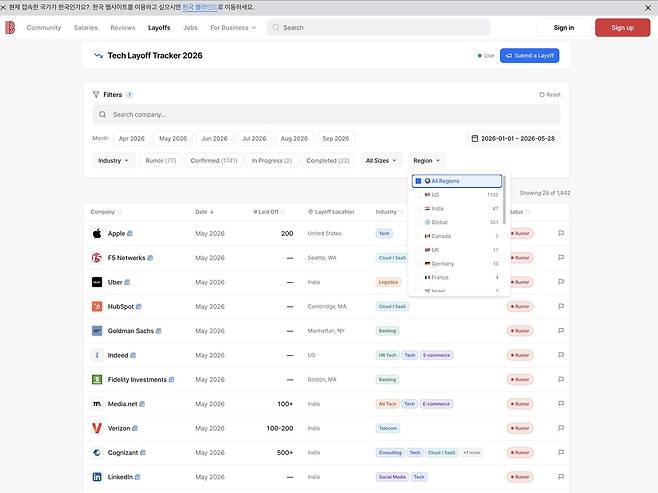
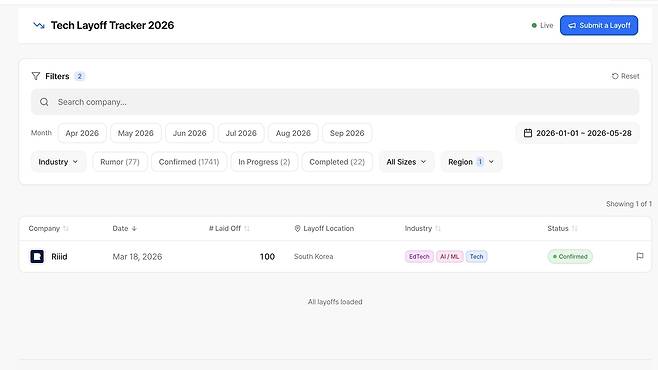
In South Korea, where Blind first took off before expanding to the US, the same tracker is almost blank. A recent check by The Korea Herald showed more than 1,100 US entries, compared with just one for South Korea: the lone exception Riiid, an AI education technology startup.
That contrast is notable because Blind is not exactly a stranger to Korea. Launched here in 2013 and now operated by Silicon Valley-based TeamBlind, it remains deeply embedded in Korean office culture.
A TeamBlind official explained that Korean interest in the layoff tracker is “not at the same level” as in the US. Korea’s large companies rarely carry out US-style mass layoffs of regular employees. Workforce adjustments more often appear as voluntary retirements, recommended resignations, transfers, job conversions or reduced hiring.
Oh Gye-taek, a senior research fellow at the Korea Labor Institute who studies wage systems, said the near-empty Korean tracker does not mean workplace anxiety is absent.
“Because both employment and wage flexibility remain low in Korea, performance bonuses could become one of the few places where conflict can surface,” Oh said.
Recently, that conflict surfaced loudly on Blind.
According to data provided by Blind to The Korea Herald, posts in Korean public topic channels mentioning the phrase “performance bonus” reached 18,862 in April, up 266 percent from a year earlier. From May 1 to 12, they marked 7,176, up 418 percent on-year.
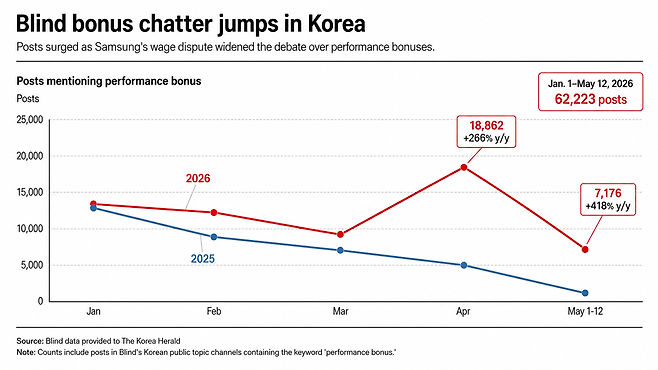
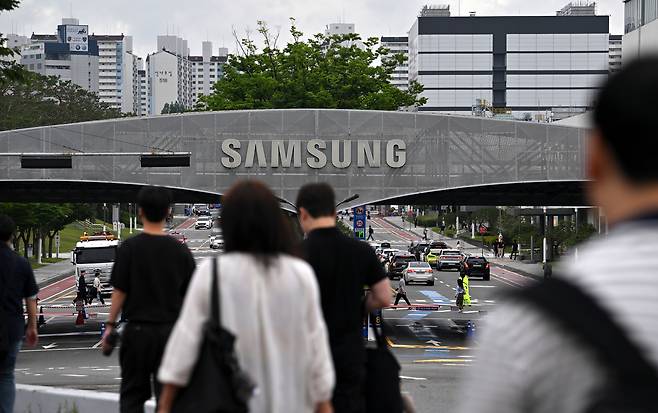
The timing tracked Samsung Electronics’ wage dispute. In April, major companies reported first-quarter earnings and Samsung’s bonus talks became a broader corporate topic. In May, as Samsung’s largest unions moved toward a possible strike, the discussion intensified.
From Jan. 1 to May 12, Blind counted 62,223 posts mentioning performance bonuses. Samsung Electronics employees wrote about 21 percent of them and SK hynix employees roughly 4 percent. Nearly three-quarters came from employees at other companies.
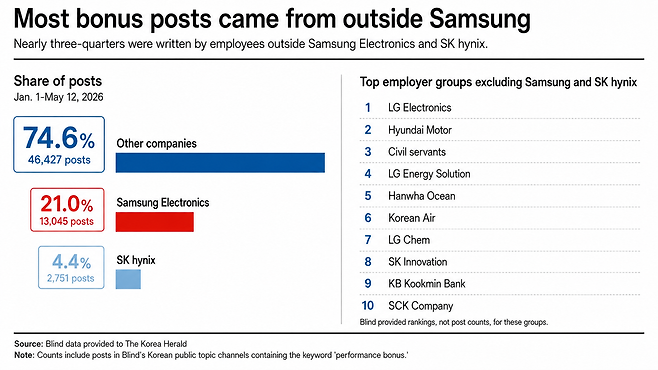
Excluding Samsung Electronics and SK hynix, Blind’s ranking of employer groups with the most posts concerning performance bonuses included LG Electronics, Hyundai Motor, LG Energy Solution, Hanwha Ocean, Korean Air, LG Chem and SK Innovation. The spread showed that Samsung’s dispute had become a reference point far beyond semiconductors.
The data only captures the volume of posts mentioning “performance bonus” -- not what each post argued or what exactly drove the spike; the timing nevertheless suggests Samsung’s dispute was a major part of the broader conversation.
Samsung’s wage deal was approved this week with 73.7 percent support and ended uncertainty over a planned strike. It introduced a special performance bonus for its Device Solutions division, which includes the semiconductors unit. Under hypothetical estimates cited in local reports, if Samsung Electronics’ annual operating profit reaches 300 trillion won ($200 billion), employees in the memory business could receive roughly 600 million won each before tax.
The number was explosive. But on Blind, the debate quickly moved beyond the size of a single payout.
A human resources official at a major Korean company said the biggest shift was visible in the language of Blind posts.
Until last year, the official said, most bonus discussions were written in the language of comparison: “Why are we getting only this much?” or “I heard SK hynix is paying that much.”
In April and May, the vocabulary changed. Posts increasingly used terms such as “OPI formula,” “EVA,” “percentage of operating profit,” “calculation standards” and “bonus caps.”
That matters because performance bonuses have long been one of the few flexible parts of Korean corporate pay. Base salaries are difficult to cut once raised, and dismissals are complicated. Bonuses allowed companies to pay more in good years and less in bad years without permanently lifting fixed labor costs, the official said.
Another HR official at a major manufacturer said Samsung’s case could change the “grammar” of wage talks. Negotiations used to center on how much a rival company paid. The next round, the official said, may focus on whether bonuses should be codified as a fixed share of operating profit.
Such formulas are difficult for manufacturers because profit is rarely produced by one unit alone. Planning, R&D, procurement, production and support functions are tied together. If bonuses follow only the margins of individual divisions, the official said, future-growth units or support teams that do not generate immediate profit could "struggle to retain talent."
Labor-side experts say demand for clearer formulas should not be dismissed as imitation or selfishness.
“Employees are not asking for reckless payouts in downturns,” said Kim Sung-hee, head of the Institute for Industrial and Labor Policy. “They are asking that when companies enjoy record profits, the gains be shared by a clear and fair formula.”
Copyright © 코리아헤럴드. 무단전재 및 재배포 금지.