Speaker hopefuls make stronger Assembly diplomacy key pledge
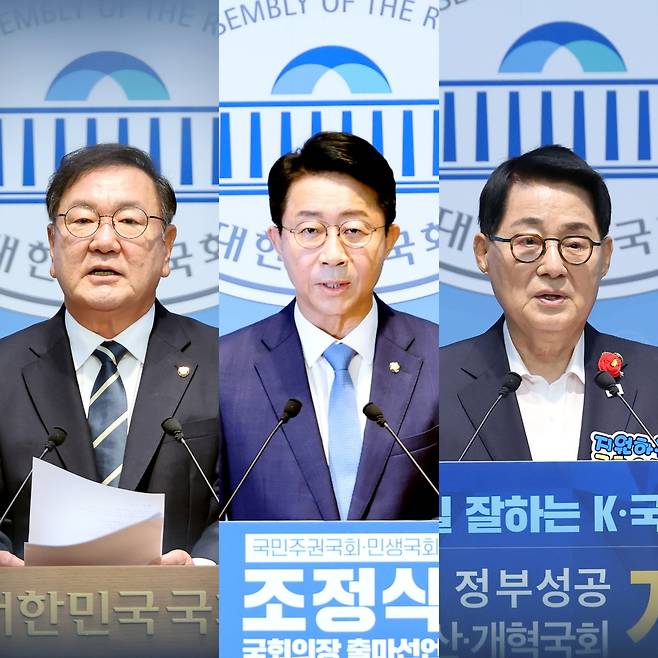
Three ruling party heavyweights launched bids for National Assembly speaker, each casting the post as a more assertive platform for domestic legislation and Assembly diplomacy as they called for a stronger role in foreign and security affairs.
Reps. Cho Jeong-sik, Kim Tae-nyeon and Park Jie-won of the Democratic Party of Korea held separate news conferences in succession on Monday, the candidate registration day for the race for Assembly speaker, the country’s No. 2 position in protocol hierarchy.
Six-term lawmaker Cho, who serves as the incumbent co-chair of the bipartisan Korea-US Parliament Union, pledged to “strengthen the National Assembly’s diplomacy in line with the nation’s status as a globally responsible country.”
“I will systematize Assembly diplomacy and strengthen institutional support for it so that it can function as one of the three core pillars of national diplomacy alongside summit diplomacy and public diplomacy,” he added.
“Furthermore, I will work with the government to gradually establish inter-Korean dialogue channels at the Assembly level to help thaw frozen ties between the two Koreas.”
Cho, who resigned as President Lee Jae Myung’s special adviser for political affairs on Sunday to declare his bid for Assembly speaker, pledged to “complete constitutional revision” by launching a special committee immediately if elected.
“Next year, with no elections scheduled, will be the optimal time to complete constitutional reform beyond partisan political interests,” Cho said.
Cho specifically vowed to pursue a “four-year presidential term with one consecutive re-election” and to “strengthen the legislature’s substantive authority” by transferring the Board of Audit and Inspection, currently placed under the president under the Constitution, to the Assembly.
In addition, Cho pledged to push ahead with relocating the National Assembly complex to Sejong as part of the Lee administration’s balanced national development initiative.
Cho underscored that “the latter half of the 22nd National Assembly will not be allowed even a single day of vacuum.” To that end, Cho would seek to complete the formation of Assembly committees by June and finish passing all legislation tied to the Lee administration’s key policy agenda by December.
Cho also proposed holding plenary sessions every Thursday to make the Assembly more predictable and designating the last Thursday of each month as a regular session for passing livelihood-related bills.
Five-term lawmaker Kim Tae-nyeon, who serves as chair of the Korea-China Parliamentarians’ Union, said he would “elevate Assembly diplomacy into a national strategy.”
“Assembly diplomacy is a national strategy in an era of great transformation marked by the reshaping of global supply chains, an unpredictable trade environment and rapidly changing external conditions,” Kim said.
Kim also proposed creating a stand-alone foreign affairs office at the National Assembly to strengthen the legislature’s external role.
“I will systemize fragmented Assembly diplomacy and pursue pragmatic, national interest-centered solutions that actively respond to economic security, industrial strategy and supply chain diversification,” he said.
Kim also committed to "making constitutional revision a reality," saying he would launch a constitutional revision roadmap as soon as the second half of the Assembly term begins if he wins.
Five-term lawmaker Park Jie-won, who previously served as director of South Korea’s spy agency, the National Intelligence Service, called for “strengthening Assembly diplomacy and special envoys from the National Assembly.”
Park said the National Assembly should “preemptively resolve headaches for the government” in foreign, security and trade affairs.
“I will support the Lee Jae Myung administration and safeguard the national interest by making full use of lawmakers’ expertise on the front lines of economic, diplomatic and security battles, including the US-Iran war and the Coupang issue, and especially in inter-Korean relations,” Park said.
Park said he would move swiftly to lay the groundwork for prosecution and judicial reforms while seeking bipartisan cooperation so the Assembly can get to work immediately in June. “However, I will not accommodate the ‘Yoon Again’ forces,” Park said.
The Democratic Party plans to complete the selection process before Speaker Woo Won-shik’s two-year term ends on May 29.
Rank-and-file party members will have a say in the speaker contest for the first time, accounting for 20 percent of the vote, alongside 80 percent allocated to sitting lawmakers. Online voting by dues-paying members will be held on May 11 and 12, followed by a vote by lawmakers on May 13.
After the party's internal votes, the speaker will be elected by secret ballot with support from more than half of the sitting lawmakers. The Democratic Party’s majority in the Assembly leaves little doubt its nominee will secure the post.
Copyright © 코리아헤럴드. 무단전재 및 재배포 금지.