South Korea’s growth outlook downgraded by OECD amid trade pressures
이 글자크기로 변경됩니다.
(예시) 가장 빠른 뉴스가 있고 다양한 정보, 쌍방향 소통이 숨쉬는 다음뉴스를 만나보세요. 다음뉴스는 국내외 주요이슈와 실시간 속보, 문화생활 및 다양한 분야의 뉴스를 입체적으로 전달하고 있습니다.
The Organisation for Economic Co-operation and Development (OECD) has cut its forecast for South Korea’s economic growth in 2025 to 1.0%, down 0.5 percentage points from its previous estimate of 1.5% issued just over three months ago. The downgrade reflects weakening exports, driven in part by rising tariff pressures from the United States and broader global uncertainty.
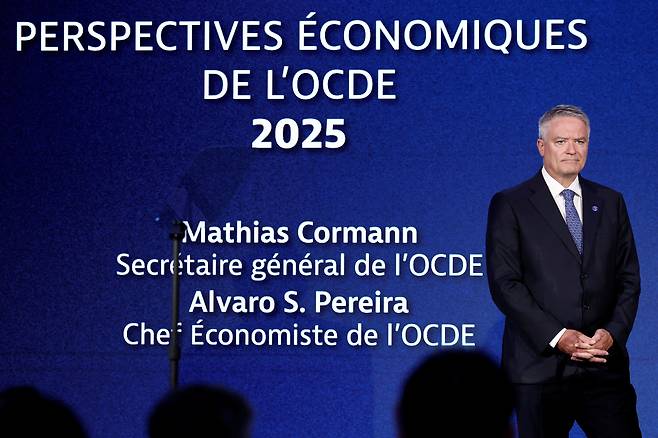
In its global economic outlook released on Jun. 3, the OECD projected that South Korea’s export-driven economy would face increasing headwinds from global trade tensions and reduced investor confidence. The organization had already revised South Korea’s 2025 growth projection once earlier this year—from 2.1% in December 2024 to 1.5% in March—before lowering it again. Among G20 countries, South Korea’s downward revision was the second steepest, following only the United States, which saw a 0.6 percentage point cut.
Despite the adjustment, the OECD forecast remains more optimistic than those issued by several major global investment banks, many of which expect growth in the zero percent range. It also stands slightly above the Bank of Korea’s 0.8% projection released on May 29 and matches the current estimate by the International Monetary Fund (IMF) at 1.0%. The OECD noted that private consumption is expected to recover in the second half of the year, supported by easing political uncertainty and a rise in real wages.
On monetary policy, the OECD recommended further easing to support investment, given the ongoing weakness in domestic demand. In terms of fiscal policy, it acknowledged the potential short-term need for public spending but stressed the importance of a sustainable long-term fiscal framework in light of the country’s rapidly rising national debt.
The OECD also revised its global growth forecast for 2025 downward from 3.1% to 2.9%, citing risks such as growing trade barriers, persistent inflationary pressure, and potential instability in financial markets as risk assets undergo repricing.
For the United States, the OECD expects economic growth to slow to 1.6% in 2025, down from a previous forecast of 2.2%, due to the rising impact of effective tariff rates and retaliatory trade measures by partner countries.
Copyright © 조선일보. 무단전재 및 재배포 금지.
- 빵 안 굽는 베이커리카페, 가업상속공제 안 해준다
- 울산 온산공단 배관서 유해 화학물질 누출…위기경보 ‘관심’ 발령
- AMRO, 韓 올해 물가상승률 2.3%로 0.4%p↑
- ‘군체’ 전지현, 11년만 스크린 복귀 “‘왕사남’ 흥행 이을 것”
- 꽃샘추위에 기온 뚝...내일 최저 -1도
- 나랏빚 1304조로 역대 최대 규모...나라살림 적자는 2년 연속 100조원 넘어
- 다카이치 日총리 “이란 정상 회담 적절한 타이밍에 하기 위해 준비” 미·이란 중재 노력
- 스토킹·교제폭력 4500건 점검했더니... 고위험 34명 구속
- 퇴직 후 쿠팡·네이버 두드리는 55세…‘나홀로 사장님' 역대 최다
- ‘예산 1600억 투입’ 섬박람회, 5개월 앞두고 허허벌판…여수시 입장 들어보니