South Korea passes sweeping corporate governance reform
이 글자크기로 변경됩니다.
(예시) 가장 빠른 뉴스가 있고 다양한 정보, 쌍방향 소통이 숨쉬는 다음뉴스를 만나보세요. 다음뉴스는 국내외 주요이슈와 실시간 속보, 문화생활 및 다양한 분야의 뉴스를 입체적으로 전달하고 있습니다.
South Korea’s National Assembly passed a landmark corporate governance reform bill on July 3, aiming to boost transparency in capital markets and enhance protections for minority shareholders. The bipartisan legislation, approved in a 220–29 vote with 23 abstentions, marks the first major policy collaboration under President Lee Jae-myung’s administration.
The reform revives key elements of a bill previously vetoed by former President Yoon Suk-yeol, signaling a renewed spirit of cooperation in Korea’s political landscape.
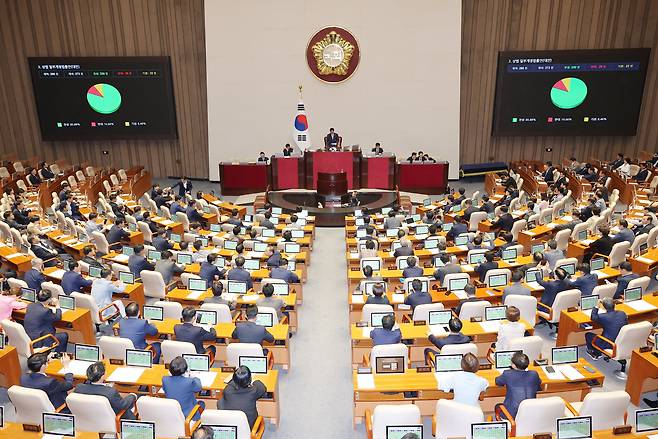
At the heart of the legislation is an expanded fiduciary duty for company directors, who will now be legally obligated to act not only in the interests of the company but also of its shareholders—a move intended to curb dominance by controlling families and reinforce minority investor rights. The bill also extends the so-called “3% rule”—which limits large shareholders’ voting rights in appointing audit committee members—to cover outside directors, further diluting insider control.
Other provisions mandate hybrid shareholder meetings, allowing listed companies to conduct online sessions alongside in-person ones. For publicly traded firms with more than 2 trillion won (about $1.45 billion) in assets, electronic shareholder meetings will become mandatory. The bill also rebrands “outside directors” as “independent directors” and raises the required proportion on boards from one-quarter to one-third.
Compared to last year’s vetoed proposal, the new version includes stricter governance measures. However, lawmakers agreed to shelve two controversial provisions for now: requiring two or more members on audit committees, and adopting cumulative voting—a mechanism that would allow minority shareholders to concentrate votes on specific board candidates. These proposals will be revisited after public hearings.
To ease concerns from the business community, lawmakers also pledged to pursue future amendments to the Criminal Act. One such proposal would explicitly protect directors from breach-of-trust charges when their decisions fall under legitimate business judgment. “We want to ensure that not all adverse outcomes in business are treated as criminal acts,” said a senior official from the conservative People Power Party (PPP).
PPP lawmakers, who had previously opposed the bill over fears of overregulation, expressed mixed reactions. Rep. Sung Il-jong, a senior party member, voiced support for measures such as mandatory online shareholder meetings and expanded fiduciary duties, but opposed the broader 3% rule. “This clause will suppress corporate initiative and lead to overly defensive management, which could ultimately harm the national economy,” he said.
Behind the scenes, PPP floor leader Song Eon-seok played a key role in driving negotiations forward, reflecting a notable shift in the party’s stance. “We pushed for revisions to avoid the worst-case scenario,” one senior PPP official said. “If we hadn’t engaged, the Democratic Party’s original bill would have passed as-is, creating chaos in corporate governance.”
Copyright © 조선일보. 무단전재 및 재배포 금지.
- [단독] 檢, ‘김용 재판 위증 교사’ 1심 무죄에 항소
- 불볕더위에 올해 첫 폭염주의보...작년 보다 2일 늦어
- ‘국힘 보좌진 폭행 논란’ 확산... 서울청, 자체 사실관계 조사 나섰다
- 서울7호선 청라연장선 개통 3~4년 늦어질 전망
- 국힘 의총 “전면 재선거 주장 않기로... 선거소청은 7곳만”
- 李대통령, G7 둘째날 공급망·에너지 논의...브라질 룰라와 대화도
- ‘음주 운전’ 尹정부 실세 행정관, 1심서 징역형 집유
- 아기 두상 예쁘게 만드는 법 “문 반대 방향으로 눕히세요”
- 체코전서 ‘눈 찢기’ 피해 당한 韓 유튜버, 멕시코전서 다시 관중석 앉는다
- 경찰, 개혁신당 정이한 부산시장 후보 ‘테러 자작극’ 의혹 수사