KBI Alloy targets EV signal wire market with high-heat copper innovation
The company plans to complete field testing by the end of next year.
It is also investing more than 1 billion won ($734,000) in a smart factory transition to enhance automation and operational efficiency across its production site.
Founded as a specialty copper alloy manufacturer, KBI Alloy operates a vertically integrated facility in Asan, South Chungcheong Province, where copper, chromium, and zirconium are melted at temperatures up to 1,350 degrees Celsius.
These materials are shaped into high-performance components through extrusion, wire drawing, and heat treatment.
The company produces materials for electrical resistance parts, electrodes, automotive welding components, and especially aircraft signal wire conductors.
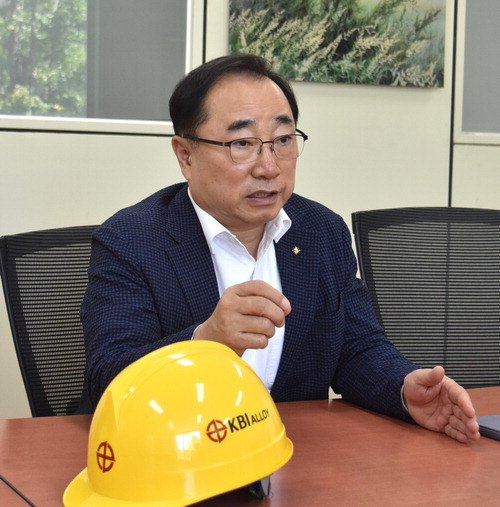
“KBI Alloy is the only company in Korea capable of performing the entire process in-house—from melting and extrusion to drawing, annealing, and precision processing,” said Kim Byung-je, the company’s chief executive officer, in a recent interview with Maeil Business Newspaper. “This allows us to lead the global market in the high-value copper alloy segment.”
KBI Alloy’s comprehensive in-house production has enabled it to break into global niche markets often overlooked by larger corporations.
Its most notable success is its entry into the highly regulated aircraft signal wire market in 2018. The company supplies copper alloy conductors to global aircraft manufacturers, which are used to transmit electronic signals between in-flight systems.
“These conductors must maintain performance even in extreme conditions, such as minus 50 to 60 degrees Celsius,” Kim said. “We’re the only producer in Korea capable of manufacturing such high-spec products.”
The company attributes its strong quality performance to advanced equipment. It uses a medium-frequency induction furnace that heats metal directly via electromagnetic induction, allowing for faster melting and better energy efficiency than conventional crucible furnaces.
The furnace also promotes better alloy mixing and minimizes segregation, a problem where metal components cluster unevenly during melting.
Its 3,000-ton indirect extrusion press is another major strength. Unlike direct extrusion, this process pushes impurities to the outer surface, improving product purity and material yield.
KBI Alloy’s export performance has also drawn industry attention.
In 2023, the company received Korea’s “30 Million Dollar Export Tower” award, with over 75 percent of revenue coming from global markets including the United States, Latin America, Europe, the Middle East, and Asia. The U.S. alone accounts for nearly half of the company’s total exports.
“Even when tariffs are applied under U.S. trade policy, our buyers are willing to absorb them because of our product’s superior performance,” Kim said.
With its EV signal wire project advancing and smart manufacturing investments underway, KBI Alloy is poised to strengthen its role in the high-performance copper alloy segment worldwide.
Copyright © 매일경제 & mk.co.kr. 무단 전재, 재배포 및 AI학습 이용 금지
- “사진 촬영 쇄도했다”…한복입고 등장한 김혜경 여사, G7서 첫 ‘영부인 외교’ - 매일경제
- “한국 올때마다 무조건 사갑니다”…외국인들 필수 ‘쇼핑템’으로 뜨는 이 제품 - 매일경제
- “15년간 고객사 클레임 한 건도 없었다”...틈새시장 뚫은 세계 1위 기업의 정체는 - 매일경제
- 김건희특검, 서울고검장·중앙지검장 직대·남부지검장 오후면담 - 매일경제
- 손석구 밤낚시로 ‘그랑프리’ 잡았다…현대차, ‘칸 광고제’ 4관왕 쾌거 - 매일경제
- “언제까지 내연차 탈 거니”...판매량 사상 최초로 역전, 친환경차 잘 나가네 - 매일경제
- “22차례나 칼에 찔렸는데”…‘가슴 수술’덕에 기적적으로 살아난 중국女 - 매일경제
- 이재명, 2천원 라면값에 놀랐는데...빵값 바가지는 무려...[여프라이즈] - 매일경제
- “쾅 쾅” 머리채 잡고 폭행…남편에 맞는 영상 공개한 女 가수 - 매일경제
- 고우석 빅리그 도전, 이대로 끝나나...마이애미에서 방출 - MK스포츠