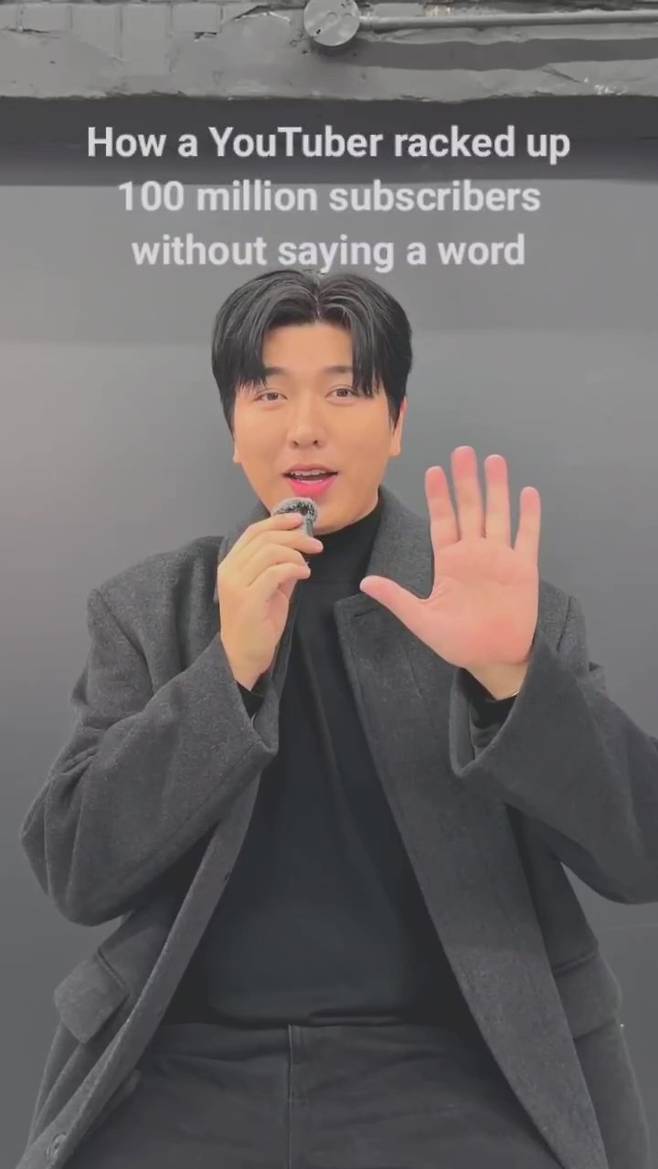
How a YouTuber racked up 100 million subscribers without saying a word
전체 맥락을 이해하기 위해서는 본문 보기를 권장합니다.
"I make content with the mindset of creating a performance," Kimpro said in an interview with The Korea Herald. "Even within a short length, I focus on making the scenes vivid and keeping the flow from breaking."
"I did shows for foreigners visiting Korea," he said. "Because there wasn't dialogue, their response was still really strong. I think that's when I realized how to break down the language barrier."
이 글자크기로 변경됩니다.
(예시) 가장 빠른 뉴스가 있고 다양한 정보, 쌍방향 소통이 숨쉬는 다음뉴스를 만나보세요. 다음뉴스는 국내외 주요이슈와 실시간 속보, 문화생활 및 다양한 분야의 뉴스를 입체적으로 전달하고 있습니다.

After a decade spent directing live shows for in-person audiences, Kim Dong-jun moved his stage online — and ended up building the world's most-watched YouTube channel of 2025.
Known to viewers as Kimpro, he leads a shorts-first channel that logged about 77.53 billion views last year, according to Playboard, a YouTube rankings analysis site.
In a media landscape where just a couple of seconds decide whether a viewer keeps scrolling or stays, Kimpro's work aims to treat vertical video not as disposable content, but as a carefully designed performance.
"I make content with the mindset of creating a performance," Kimpro said in an interview with The Korea Herald. "Even within a short length, I focus on making the scenes vivid and keeping the flow from breaking."
His rise has been swift. The channel surpassed 100 million subscribers in April last year — two years and eight months after launch — and now sits at around 129 million subscribers, placing it among the world's top YouTube channels by size.
Yet Kimpro is reluctant to frame his success as a dramatic career change. He describes it as translation: moving what he already knew about entertainment from the physical stage to a global platform.
"Rather than a job change, it was more like moving what I had been doing offline to the online platform," he said.
Before YouTube, Kimpro worked as a performance planner and producer, staging live productions, including theater and nonverbal formats such as shadow shows and bubble shows. Those earlier experiences, he said, provided him with the insight that later became central to his online storytelling: Language is not the only way to communicate.
"I did shows for foreigners visiting Korea," he said. "Because there wasn't dialogue, their response was still really strong. I think that's when I realized how to break down the language barrier."
That impulse is visible in the channel's core style: short videos built around expressions, physical comedy and situation-driven storytelling rather than speech. The result is content that travels across cultures with no need for translation.
"I think that's why the countries of our subscribers vary," he noted.
Geographically, he said, the subscriber base is dispersed rather than concentrated in a single country or region. He described seeing viewership across continents from Asia and the Americas to Africa — sometimes discovering countries he had rarely thought about before.
"People watch from everywhere," he said. "I'd say there's no country that doesn't watch."

Kimpro said fascination with entertainment began early. As a teenager, he wrote a script and took the lead role in a school play. He has always watched films and TV dramas — not just as a passive viewer, but with an analytical curiosity, asking why certain scenes feel compelling and how emotion is constructed.
The leap into YouTube, he said, began with curiosity about the shift from horizontal video to vertical viewing. He watched what early creators were doing and tested the format's constraints. Then came a moment of recognition.
"When I realized you could watch it without turning the phone, it clicked," he said. "I thought, 'This is it. I can do this well.' You can't start without confidence."
Even so, he says he did not "know" the channel would explode. He started with hope and a non-negotiable rule about craft.
"There was one principle," he said. "Even if it's short, the story and structure have to be clear."
While his videos are 15 to 60 seconds of tightly paced cuts, Kimpro cautions that "short" does not mean simple.
"Short doesn't mean you can shoot it roughly," he said. "It actually requires more precise and careful design. A lot has to fit inside."
"When we shoot one video now, it can take two or three days," he said. "People think a 15-second video takes five minutes or 10 minutes. That's not true. I'll reshoot one cut until I'm satisfied."
For Kimpro, perfectionism is not vanity — it is a promise to the viewer. He believes the creator's standard shapes audience experience.
That discipline also shows in how he thinks about storytelling. His goal is to build a complete arc — not a loose gag — inside a short runtime, so viewers understand the emotional rhythm through visuals alone.
"The most important thing is that the viewer doesn't feel a barrier because of language or culture," he said. "A flow that's understandable through visual information. That's the foundation of the channel."
He also pushed back against the common assumption that mainly children and teens watch shorts. His internal data, he said, shows the largest age group is 25 to 34 years old, followed by those 35 to 44. The gender split is close to even.
He also addressed criticism that short-form video inevitably "simplifies" thinking. In his view, the moral weight lies not in the format, but in how creators design what they publish.
"It depends on what you design, and with what sense of responsibility," he said. "Because it passes so quickly, misunderstandings can pile up. That's why the flow has to be clearer, and the delivery more accurate."
Asked how he wants to be remembered, Kimpro did not seek personal recognition. Instead, he returned to the idea of leaving a feeling behind — an experience that outlasts statistics.
"I want people to be happy through the content I make," he said. "If they enjoy my videos and gain even one more bit of joy, that's enough."
"It's OK if you don't remember me," he said. "Over time, numbers change. But what stays in people's hearts lasts a long time."
Copyright © 코리아헤럴드. 무단전재 및 재배포 금지.