K-defense climbs global rankings on Europe export boom
Korea’s four major defense companies — Hanwha Group, Hyundai Rotem, LIG Nex1 and Korea Aerospace Industries — boosted their combined arms revenues by 31 percent to $14.1 billion last year, cementing their positions on the world’s top 100 arms producers.
According to the Stockholm International Peace Research Institute’s 2024 Top 100 report released Tuesday, all four Korean firms made the list for the second consecutive year, reflecting the country’s rapid ascent as a global defense exporter.
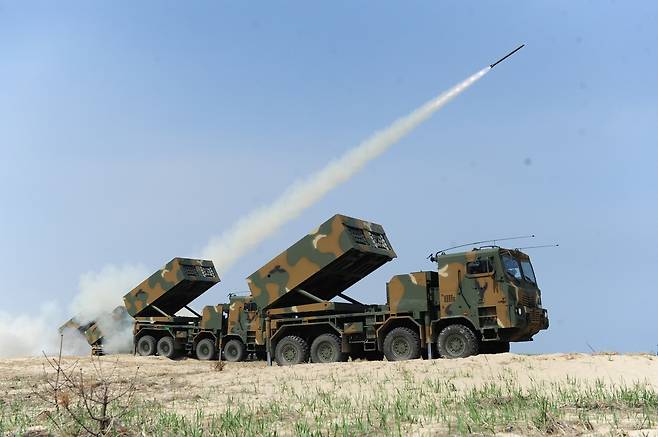
Hanwha delivered the strongest performance, climbing from 24th to 21st, with weapons sales surging 42 percent to $8 billion on the back of robust orders for K9 self-propelled howitzers, multiple-launch rocket systems and 120-mm self-propelled mortars — along with higher domestic procurement. LIG Nex1 also registered a major jump, rising from 73rd to 60th. Hyundai Rotem inched up from 84th to 81st, while KAI was the only Korean defense firm to fall in the rankings, sliding from 54th to 70th.
The four firms’ share of total Top 100 arms revenues increased from 1.7 percent to 2.1 percent over the past year.
By country, Korea ranked 10th worldwide in arms revenues, trailing the US, China, the UK, Russia, France, pan-European multinationals, Italy, Israel and Germany. SIPRI noted that Korea’s massive exports of K2 tanks, K9 howitzers and other armored systems to Poland since 2023 have put Seoul in close competition with Germany for the ninth and 10th spots.
The report highlighted that global defense revenues surged in 2024 as the wars in Ukraine and Gaza and broader geopolitical tensions drove up military spending. In Europe, countries such as Poland have rushed to rebuild their arsenals, but major US and European manufacturers have struggled to deliver weapons quickly enough.
Korean companies, meanwhile, have capitalized on the widening supply gap with fast production timelines, competitive pricing and strong performance records.
Since the outbreak of Russia’s invasion of Ukraine, Korean firms have exported K9 howitzers, K2 tanks and FA-50 light combat aircraft to multiple Eastern European nations, including Poland, Romania and Estonia.
In contrast, SIPRI said Chinese companies saw their arms sales fall 10 percent, with their share of the Top 100 dropping from 16 percent to 13 percent amid procurement corruption scandals that delayed or derailed major weapons programs.
Copyright © 코리아헤럴드. 무단전재 및 재배포 금지.