Busan as a wartime capital: How the city remembers the sacrifices and solidarity born from war
![A statue depicting a family on their journey to seek refuge stands near the Provisional Capital Memorial Hall in Seo District, Busan. [WOO JI-WON]](https://img2.daumcdn.net/thumb/R658x0.q70/?fname=https://t1.daumcdn.net/news/202605/28/koreajoongangdaily/20260528070310929kbsc.jpg)
[Busan Deep Dive]
BUSAN — On June 25, 1950, the sound of gunfire from the North shattered the dawn, forcing the South Korean government and civilians away from the battlefront.
Many of those who fled Seoul eventually reached Busan, located at the southern tip of the Korean Peninsula, and the city ultimately became their refuge.
Thus began Busan’s 1,023 days as South Korea’s provincial capital. Beginning on Aug. 18, 1950, the city transformed into the nation’s political, economic and cultural hub and sheltered public officials and intellectuals, as well as many other displaced men, women and children from across the peninsula.
By 1951, the city’s population had swelled to more than 840,000, nearly double its prewar population of around 470,000.
Exhausted newcomers flooded the alleyways and crowded hillsides with their makeshift homes. But rather than coldly turning them away, the city embraced them and slowly rebuilt itself.
“Busan, as a wartime capital, maintained state functions while protecting civilians and communities. It also practiced global cooperation and solidarity,” said Ahn Young-shin, the director of the Cultural Heritage Division of the Busan metropolitan government, at the former U.S. Embassy building — now serving as an annex of the Busan Modern & Contemporary History Museum — on Tuesday.
“It also speaks to the present day’s humanity, as the world struggles with various conflicts, such as the Russian invasion of Ukraine, military clashes in the Middle East, refugees displaced by environmental problems and so on. In that sense, [...] Busan is not just a war heritage but an example of how a city and a community operated and maintained themselves in the event of war.”
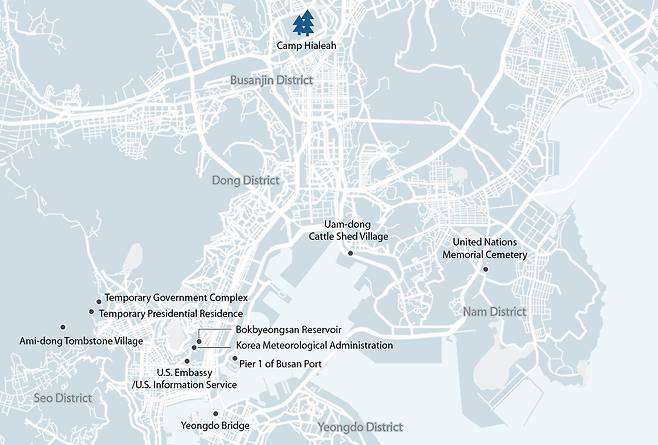
The government is now seeking to preserve that legacy by pursuing Unesco World Heritage status for a collection of 11 historic sites tied to Busan’s role as the temporary capital during the 1950-53 Korean War.
Together, the sites show how Busan continued to function as a city while embracing global solidarity, even under harsh and dire circumstances. Moreover, they offer a timely reflection on today’s world, which is still marked by conflict, hatred and violence.
Pier 1 of Busan Port
![Pier 1 of Busan Port [BUSAN METROPOLITAN CITY GOVERNMENT]](https://img1.daumcdn.net/thumb/R658x0.q70/?fname=https://t1.daumcdn.net/news/202605/28/koreajoongangdaily/20260528070314221baym.jpg)
Quiet neighborhoods near present-day Seoul suddenly descended into chaos in June 1950, when North Korea launched a surprise invasion across the 38th parallel, forcing civilians and soldiers alike to flee. Some crossed rivers or hopped on carts and freight trains to escape. Others boarded ships or walked for months until they arrived in Busan.
As a result, Pier 1 of Busan Port eventually became a landing point for displaced Koreans, as well as for United Nations soldiers, military supplies and humanitarian aid. The port also served as a key source of employment during the war, providing refugees with much-needed income.
Pier 1 is preparing for another transformation: The site of its old warehouses is set to become “Global Startup Hub Busan,” an innovation center for startups, investors and research institutions, scheduled to open sometime next year.
Temporary government complex
![Temporary government complex [BUSAN METROPOLITAN CITY GOVERNMENT]](https://img4.daumcdn.net/thumb/R658x0.q70/?fname=https://t1.daumcdn.net/news/202605/28/koreajoongangdaily/20260528070315784dfuj.jpg)
Following the fall of Seoul, the temporary government complex in Busan, originally the government office of Seo District in South Gyeongsang, became the government’s final refuge after brief stops in Daejeon and Daegu. It was here that the country began to regroup and rebuild itself. Ministries and government agencies made key political and economic decisions inside this building, which served as the heart of a machine that would bring the nation back to life. Today, the building is used as a museum operated by Dong-A University.
Temporary presidential residence
Until the Korean War Armistice Agreement was signed in July 1953, then-South Korean President Syngman Rhee stayed and worked at a two-story redbrick building, originally the residence of the governor of South Gyeongsang. Diplomatic, policy and UN meetings took place at this temporary presidential residence, and Rhee also made decisions here that would alter the fate of the country at a time when the nation was as fragile as a candle flame.
After opening its doors to the public in 1984 as the Provisional Capital Memorial Hall, the museum curators did their best to maintain the building’s layout as it was during Rhee’s stay.
![Temporary presidential residence [WOO JI-WON]](https://img1.daumcdn.net/thumb/R658x0.q70/?fname=https://t1.daumcdn.net/news/202605/28/koreajoongangdaily/20260528070317422ysyp.jpg)
“There were 216 photographs taken inside the building,” said Kim Ho-yeon, a commentator at the museum. Pointing to two photographs of Rhee that now hang on the wall, she explained, “The living room was recreated almost exactly based on those photographs.”
“Unfortunately, there were no photos of the restroom, sleeping quarters or dining room.” Those spaces were instead restored based on interior styles commonly used in upper-class homes at the time.
![The living room of the temporary presidential residence [WOO JI-WON]](https://img4.daumcdn.net/thumb/R658x0.q70/?fname=https://t1.daumcdn.net/news/202605/28/koreajoongangdaily/20260528070318959znax.jpg)
Behind the residence stands another building that recounts the history of Busan during the Korean War in greater detail, portraying the city as a center of reconstruction and revival during the conflict.
Uam-dong Cattle Shed Village
Busan and the government urgently requisitioned more than 40 locations as shelters for the growing number of refugees — even the cattle sheds in Uam-dong. Constructed in 1909 as a quarantine site for cattle being exported to Japan, the sheds were converted into living quarters for displaced people.
![Uam-dong Cattle Shed Village [WOO JI-WON]](https://img1.daumcdn.net/thumb/R658x0.q70/?fname=https://t1.daumcdn.net/news/202605/28/koreajoongangdaily/20260528070320474gjwy.jpg)
“People said that if you went to Uam-dong, at least you wouldn’t have to worry about finding a place to sleep because the sheds protected you from the rain and had high ceilings, so refugees poured in,” said Lee Hee-deuk, a commentator at Uam-dong Cattle Shed Village. “Tents were pitched in the empty spaces between the sheds. The distance between the cattle sheds also originally exceeded 10 meters [32.8 feet], but as people settled in between [the sheds], the alleys became only one to two meters wide.”
![How a cattle shed was used as a temporary shelter [WOO JI-WON]](https://img3.daumcdn.net/thumb/R658x0.q70/?fname=https://t1.daumcdn.net/news/202605/28/koreajoongangdaily/20260528070322096wbso.jpg)
A typical cattle shed — measuring 7.8 meters wide and 32 meters long, with a central corridor just 1.8 meters across — housed around 370 people under poor sanitary conditions.
Small shacks, often as small as 6.6 to 9.9 square meters (71 to 106.6 square feet), were built from easily obtainable natural materials such as soil, tree branches and bamboo. Believing they would soon return to their hometowns, many refugees did not grow attached to the land and even gave up their space to newly arrived families. Uam-dong eventually comprised more than 150 shelters, including cattle sheds, tents and shacks.
One of the original wartime sheds still retains its form as part of a museum, offering a deeper look into the history of Uam-dong before, during and after the Korean War.
![Naeho Naengmyeon's "milmyeon," or wheat noodles [WOO JI-WON]](https://img4.daumcdn.net/thumb/R658x0.q70/?fname=https://t1.daumcdn.net/news/202605/28/koreajoongangdaily/20260528070323659jukz.jpg)
Just a few minutes across the city is Naeho Naengmyeon, Korea’s first milmyeon (wheat noodles) restaurant. The place was already packed with locals and travelers before noon on a Tuesday. Old newspaper clippings featuring the restaurant hung on display, showcasing its long legacy. During the Korean War, the restaurant began serving Busan’s iconic milmyeon by mixing starch into flour provided through U.S. relief supplies, as buckwheat and sweet potato starch used for traditional naengmyeon (buckwheat noodles in cold broth) had become scarce.
Ami-dong Tombstone Village
![A house built atop former cemeteries in Ami-dong Tombstone Village [WOO JI-WON]](https://img2.daumcdn.net/thumb/R658x0.q70/?fname=https://t1.daumcdn.net/news/202605/28/koreajoongangdaily/20260528070325265evbg.jpg)
Those who lived in refugee shelters were considered fortunate, but most people had to find their own housing. They wandered from place to place, renting tiny rooms or building makeshift shacks on empty land, including Ami-dong Tombstone Village, already mostly occupied by a Japanese crematorium and cemetery established during the late Joseon Dynasty (1392-1910).
Today, the site vividly demonstrates both the desperation of the displaced people and their tenacious will to survive. Houses that refugees had built on top of former cemetery grounds remain, while the tombstones have become part of the neighborhood itself, embedded into stairways, alleys and even doorsteps. Eight wartime houses have been preserved as a museum to showcase refugee life during the war.
Bokbyeongsan Reservoir & Korea Meteorological Administration
![Bokbyeongsan Reservoir [BUSAN METROPOLITAN CITY GOVERNMENT]](https://img2.daumcdn.net/thumb/R658x0.q70/?fname=https://t1.daumcdn.net/news/202605/28/koreajoongangdaily/20260528070327049mnio.jpg)
For refugees, the lack of food and water was a major problem. Built in 1910, Bokbyeongsan Reservoir, a water treatment facility, supplied water to the downtown areas of Busan. At the time, only 20,000 tons were supplied, though double the amount was needed daily. Water was distributed every two to three days in lowland areas and every four to five days in hillside neighborhoods, with only three buckets provided to each household.
The weather forecast was another necessity, as it often determined how the day would unfold. The Korea Meteorological Administration conducted weather observations 24 times a day, providing critical information for humanitarian activities and military operations. Its building is still used for meteorological observation.
Yeongdo Bridge
![Yeongdo Bridge [WOO JI-WON]](https://img2.daumcdn.net/thumb/R658x0.q70/?fname=https://t1.daumcdn.net/news/202605/28/koreajoongangdaily/20260528070328696vgpu.jpg)
As people struggled to survive each day, a majority of them lived with constant sorrow, separated from loved ones whose fate they did not know. Measuring 214.7 meters long and 18 meters wide, Yeongdo Bridge became a place filled with both grief and hope for displaced refugees. The bridge was raised seven times a day to allow ships to pass, and many refugees gathered there, hoping to reunite with lost family members. Some were successful; others continued to wait.
Now, people can sit by the window of a nearby second-floor Starbucks cafe to admire the view of the bridge, crossed by countless refugees decades ago. The area becomes especially crowded on Saturdays, when a ceremonial bridge raising takes place at 2 p.m. for 15 minutes.
![People sit by the window at a nearby cafe to look at Yeongdodaegyo Bridge on May 5. [WOO JI-WON]](https://img3.daumcdn.net/thumb/R658x0.q70/?fname=https://t1.daumcdn.net/news/202605/28/koreajoongangdaily/20260528070330272zhno.jpg)
U.S. Embassy/U.S. Information & Camp Hialeah
![U.S. Embassy/U.S. Information Service [BUSAN METROPOLITAN CITY GOVERNMENT]](https://img4.daumcdn.net/thumb/R658x0.q70/?fname=https://t1.daumcdn.net/news/202605/28/koreajoongangdaily/20260528070331874vtcl.jpg)
South Korea needed help from other countries, particularly the United States, to survive. The U.S. Embassy/U.S. Information Service originally housed the Busan branch of Japan’s Oriental Development Company, an institution used by Japan to appropriate land from South Korea. After liberation, the building was temporarily used as a shelter for the U.S. military because it was modern enough to house flush toilets. Later, it served as a U.S. Embassy and hosted discussions on international aid and refugee relief efforts, linking the country to the UN and the wider world. The building now houses the Busan Modern & Contemporary History Museum.
Camp Hialeah, a former U.S. military base in Busanjin District , played a key role in accommodating UN soldiers. In addition to housing U.S. forces, the camp supported several UN organizations. These agencies carried out activities, such as providing medical aid and constructing houses, to help improve the lives of war-torn South Koreans. Today, the former military base has been transformed into Busan Citizens Park.
United Nations Memorial Cemetery
![United Nations Memorial Cemetery in Busan [KOREA HERITAGE SERVICE]](https://img4.daumcdn.net/thumb/R658x0.q70/?fname=https://t1.daumcdn.net/news/202605/28/koreajoongangdaily/20260528070333357ogmq.jpg)
As the world’s only cemetery dedicated to UN soldiers, the UN Memorial Cemetery in South Korea is the final resting place of 2,337 soldiers from 14 countries who fought in the Korean War. More than 10,000 bodies were once buried here, but many were later repatriated to their home countries at the request of their families or under respective national policies. Spread across approximately 40,500 pyeong (33.1 acres), the cemetery is lined with engraved bronze plaques that replaced the original cross-shaped gravestones.
The site carries a solemn atmosphere while remaining strikingly beautiful, particularly in summer, when roses bloom across the grounds. Nine landscape architects oversee the cemetery’s floral design and maintenance throughout the year. A Wall of Remembrance stands on one corner of the cemetery, inscribed with the names of some 40,000 soldiers who went missing or lost their lives during the war.
Every Nov. 11, the international memorial event “Turn Toward Busan” takes place here, with veterans, their families and people around the world facing toward Busan’s direction to observe a minute of silence, a reminder of the sacrifices and solidarity born from war.
BY WOO JI-WON, JIN EUN-SOO [woo.jiwon@joongang.co.kr]
Copyright © 코리아중앙데일리. 무단전재 및 재배포 금지.
- Petition calling for suspending MBC series 'Perfect Crown' gains 50,000 signatures
- Starbucks Korea weekly sales sink 8 billion won in wake of 'Tank Day' controversy
- Seoul concludes that Iranian-made missiles hit HMM Namu, summons Tehran's top envoy
- Busan KCC's Heo Ung denies defaming ex-girlfriend during first formal trial
- As Korea's currency weakens to 17-year low, concerns mount over inflation, business pressure
- North Korea's Kim sends condolences to China's Xi as speculation over Pyongyang visit grows
- Twice-detained Korean activist Kim Ah-hyun fails to overturn court order that invalidated her passport
- 'Higher than average' chance of heat waves expected this summer due to rapid decline of Arctic ice
- 'Genderless' K-pop band XLOV breaks boundaries by being themselves
- Labor Minister announces forum for 'social dialogue' on distributing windfall corporate profits