How Samsung, Apple are overcoming China’s smartphone chip crunch
전체 맥락을 이해하기 위해서는 본문 보기를 권장합니다.
"Apple has both financial firepower and bargaining power, allowing it to secure DRAM supply even at a premium," said an industry source, who requested anonymity. "Samsung is also minimizing procurement disruptions through close coordination between its mobile experience division and device solutions division."
"Chinese manufacturers have a high exposure to budget and midrange models, which makes it difficult for them to reflect higher component costs in retail prices," another industry source said. "If they raise prices, sales volume could fall. If they keep prices unchanged, profitability suffers. They are caught in a dilemma."
이 글자크기로 변경됩니다.
(예시) 가장 빠른 뉴스가 있고 다양한 정보, 쌍방향 소통이 숨쉬는 다음뉴스를 만나보세요. 다음뉴스는 국내외 주요이슈와 실시간 속보, 문화생활 및 다양한 분야의 뉴스를 입체적으로 전달하고 있습니다.
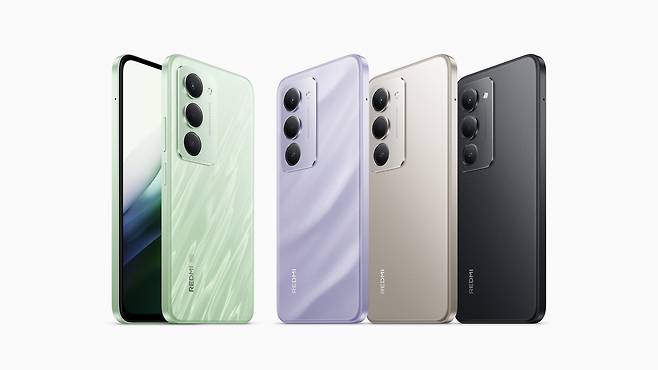
A tightening memory chip supply is reshaping the global smartphone market, squeezing Chinese vendors while lifting shipments at Samsung Electronics and Apple.
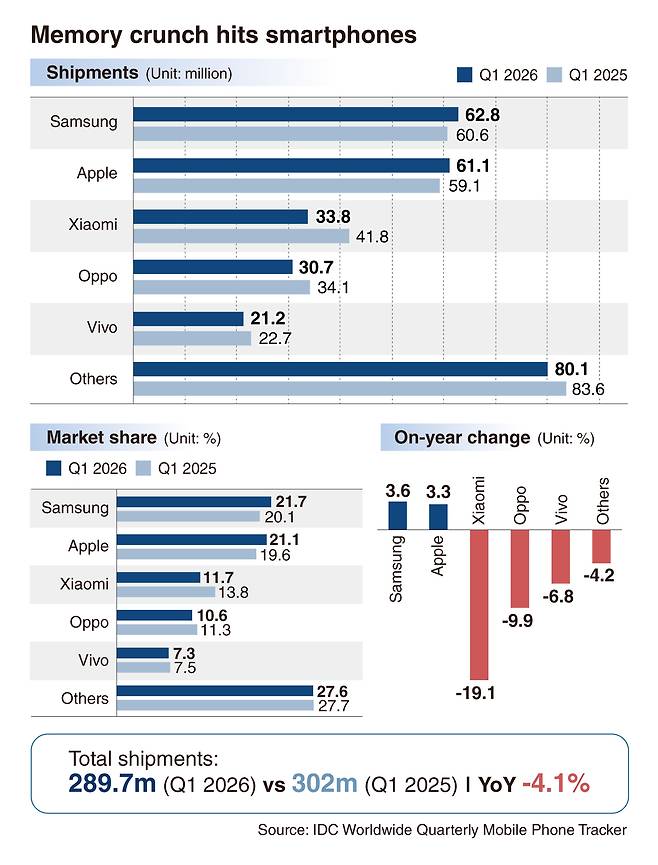
According to market tracker International Data Corp. on Tuesday, global smartphone shipments fell 4.1 percent on-year to 289.7 million units in the first quarter, marking the first decline for the January-March period since 2023.
Samsung ranked first with shipments of 62.8 million smartphones and a 21.7 percent market share. Apple followed with 61.1 million units and a 19.6 percent share. They were the only two brands among the top vendors to post on-year shipment growth.
Chinese smartphone-makers, meanwhile, lost ground. Xiaomi ranked third with 33.8 million units and an 11.7 percent share, down by 8 million units from a year ago. Oppo came in fourth with 30.7 million units and a 10 percent share, while Vivo ranked fifth with 21.2 million units and a 7.5 percent share.
Industry sources point to a tightening supply of low-power DRAM, or LPDDR, widely used in smartphones, as a key reason behind the split. Nvidia’s rising demand for LPDDR for its next-generation graphics processing unit platforms is squeezing supply for mobile devices, they said. The US chip giant is expected to use large volumes of SOCAMM2, an LPDDR-based memory module for AI servers, in its upcoming Vera Rubin GPU platform.
“Apple has both financial firepower and bargaining power, allowing it to secure DRAM supply even at a premium,” said an industry source, who requested anonymity. “Samsung is also minimizing procurement disruptions through close coordination between its mobile experience division and device solutions division.”
Market watchers expect memory prices to stabilize only in the second half of 2027. Some warn that the shortage could deepen further next year, as Nvidia’s Vera Rubin Ultra platform is expected to require even more mobile DRAM.
For smartphone-makers, securing memory chips is becoming as important as selling the devices themselves.
Samsung has room to coordinate between its smartphone and semiconductor operations, as the company runs memory, system large-scale integration and foundry businesses. Apple does not have its own memory unit, but it has disclosed in its 2025 10-K filing that it relies on long-term supply agreements and prepayment arrangements to secure key components.
Qualcomm CEO Cristiano Amon’s recent meetings with executives from Samsung and SK hynix are also being read as part of broader efforts to secure LPDDR supply.
That leaves Chinese vendors with narrow choices. Companies such as Xiaomi, Oppo and Vivo lack both Samsung’s internal supply cushion and Apple’s purchasing power, leaving them more exposed to the LPDDR crunch.
Their product mix makes the problem harder to absorb. Chinese vendors rely heavily on budget and midrange Android smartphones, where there is little room to pass higher component costs on to consumers. IDC has said rising memory prices are pushing up smartphone average selling prices, with low-end Android vendors likely to feel the greatest impact.
“Chinese manufacturers have a high exposure to budget and midrange models, which makes it difficult for them to reflect higher component costs in retail prices,” another industry source said. “If they raise prices, sales volume could fall. If they keep prices unchanged, profitability suffers. They are caught in a dilemma.”
IDC expects the memory price surge and supply shortage to drag global smartphone shipments down by about 12.9 percent this year to 1.12 billion units, the lowest level since 2013. The forecast shows the memory crunch is no longer a problem for purchasing teams alone. It is starting to affect how smartphones are priced, built and sold.
For Chinese vendors, the choices are narrow. Passing on higher memory costs would weaken their price competitiveness, while absorbing the costs would further squeeze margins. Xiaomi’s smartphone gross profit margin stood at 10.9 percent last year, leaving it vulnerable to even modest increases in component costs.
“This memory shortage could become a turning point that reshapes the competitive order of the smartphone market,” an analyst at a local brokerage said. “In the past, design, cameras and price competitiveness were the key factors. Going forward, the ability to secure core components reliably could determine shipments and market share.”
Copyright © 코리아헤럴드. 무단전재 및 재배포 금지.