Fuel Prices Surge to Three-Year High amid Iran Crisis... Oil Refiners Expected to Post Earnings Surprise
전체 맥락을 이해하기 위해서는 본문 보기를 권장합니다.
President Lee Jae-myung also weighed in on the issue, presiding over an emergency Cabinet meeting at Cheong Wa Dae on the 5th. "There has been no objectively serious disruption to fuel supplies, yet gasoline prices have suddenly skyrocketed," he said, adding that "attempts to exploit difficult market conditions for unreasonable profiteering must be cracked down on firmly."
Jo Hyeon-ryeol, analyst at Samsung Securities, stated that "if the Middle East conflict persists, companies producing refined products in Asia — away from the risks of war — will benefit from a geopolitical perspective."
이 글자크기로 변경됩니다.
(예시) 가장 빠른 뉴스가 있고 다양한 정보, 쌍방향 소통이 숨쉬는 다음뉴스를 만나보세요. 다음뉴스는 국내외 주요이슈와 실시간 속보, 문화생활 및 다양한 분야의 뉴스를 입체적으로 전달하고 있습니다.
Gasoline Tops KRW 1,800 per Liter... Supply Uncertainty Persists
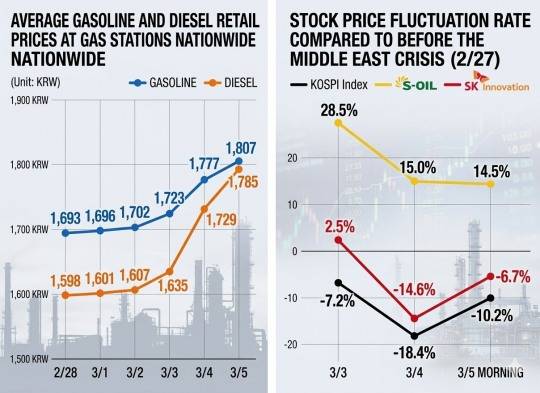
According to Opinet, the oil price information system operated by the Korea National Oil Corporation (KNOC), the average retail price of regular unleaded gasoline at gas stations nationwide stood at KRW 1,807.12 per liter as of 11 a.m. on the 5th. This marks the first time prices have exceeded the KRW 1,800 level since August 2022, when the Russia-Ukraine war broke out — a gap of three years and seven months. Compared to KRW 1,692.89 on the 28th of last month, prices surged KRW 114.23, or 6.7%, in just five days. In Seoul, which records the highest gasoline prices in the country, the average retail price stood at KRW 1,874.36 per liter on the same day.
The rise in diesel prices — which are directly linked to logistics and transportation costs — has been even steeper. Over the past five days, the national average retail price of diesel climbed from KRW 1,597.86 to KRW 1,785.31 per liter, an increase of KRW 187.45, or 11.7%.
The spike in fuel prices has been driven by Iran's blockade of the Strait of Hormuz following airstrikes by the United States and Israel, which has halted the passage of crude oil tankers and other vessels. According to the Korea Ocean Business Corporation, the Strait of Hormuz is a critical global maritime energy corridor through which approximately 34% of the world's crude oil trade passes. South Korea's exposure is particularly significant, given that the country relies on the Middle East for more than 70% of its crude oil imports.
International crude oil prices have also been highly volatile. According to Investing.com, the price of West Texas Intermediate (WTI) futures surged 18.4%, rising from USD 65.21 per barrel on the 26th to USD 77.24 per barrel as of the 5th. The rally briefly appeared to ease after U.S. President Donald Trump announced on his social media platform Truth Social on the 4th that "the U.S. Navy will begin escorting oil tankers through the Strait of Hormuz if necessary," but prices have since resumed their upward trend as the geopolitical threat stemming from the Iran crisis remains far from resolved.
However, criticism has emerged that domestic gasoline prices have risen too quickly. Typically, changes in international crude oil prices are reflected at local gas stations with a lag of two to three weeks, as refiners must import crude oil, process it, and manufacture the final products.
President Lee Jae-myung also weighed in on the issue, presiding over an emergency Cabinet meeting at Cheong Wa Dae on the 5th. "There has been no objectively serious disruption to fuel supplies, yet gasoline prices have suddenly skyrocketed," he said, adding that "attempts to exploit difficult market conditions for unreasonable profiteering must be cracked down on firmly."
Refinery Stocks Buck the Downturn
As South Korean equity markets sharply reflect the negative impact of the Iran crisis, shares of oil refining companies have held up relatively well. S-OIL, whose business is heavily weighted toward refining, surged 28.5% on the 3rd to close at KRW 141,300, marking a particularly strong session. As of the 5th, the stock has given back roughly half of those gains, but with an advance of approximately 15%, it continues to significantly outperform the broader market — in stark contrast to the KOSPI index, which has fallen nearly 10%.
Samsung Securities raised its target price for S-OIL on the 3rd by 12%, from KRW 125,000 to KRW 140,000. The brokerage also forecast that the company's operating profit for the first quarter of this year will reach KRW 595.8 billion, surpassing the consensus estimate of KRW 386.8 billion by 54% — an earnings surprise.
Jo Hyeon-ryeol, analyst at Samsung Securities, stated that "if the Middle East conflict persists, companies producing refined products in Asia — away from the risks of war — will benefit from a geopolitical perspective."
Gwak Horyung (horr@fntimes.com)
Copyright © 한국금융신문 All Rights Reserved.