Samsung chief acquitted in final ruling over 2015 merger
전체 맥락을 이해하기 위해서는 본문 보기를 권장합니다.
The judges at the Supreme Court said there were no errors in the appellate ruling that would suggest "a misunderstanding of legal principles regarding the Capital Market Act and External Audit Act, or a violation of rules on free evaluation of evidence."
Lee Sang-ho, head of the economic policy division at the Federation of Korean Industries, added that the verdict would allow Samsung to focus on "technological innovation and securing global competitiveness."
이 글자크기로 변경됩니다.
(예시) 가장 빠른 뉴스가 있고 다양한 정보, 쌍방향 소통이 숨쉬는 다음뉴스를 만나보세요. 다음뉴스는 국내외 주요이슈와 실시간 속보, 문화생활 및 다양한 분야의 뉴스를 입체적으로 전달하고 있습니다.
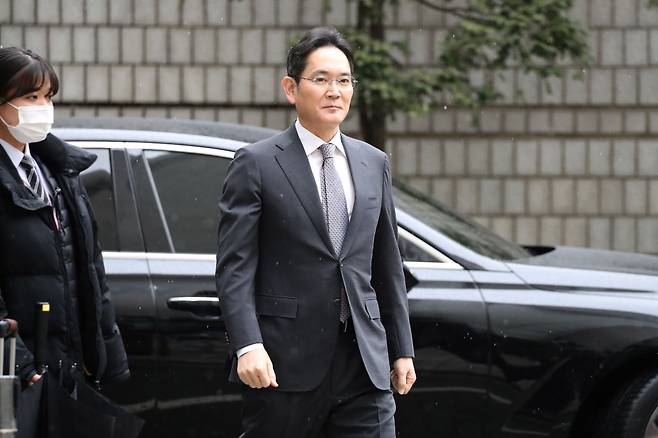
Samsung Electronics Chair Lee Jae-yong was acquitted by the Supreme Court on Thursday, clearing him of all charges tied to a contentious 2015 merger between Samsung affiliates that helped tighten his grip on the country's largest conglomerate.
The ruling, which is final and cannot be appealed, ends years of legal battles that have shadowed the Samsung boss, freeing him to focus on turning around the tech giant's struggling operations.
The country's highest court dismissed the prosecution’s appeal and upheld an appellate court's not-guilty verdict for Lee and 13 other former Samsung officials, including Choi Gee-sung and Jang Choong-ki, former executives of the group’s now-disbanded control tower, the Future Strategy Office.
They were accused of stock manipulation, breach of trust, accounting fraud and other irregularities in connection with the high-profile merger of Cheil Industries and Samsung C&T.
The judges at the Supreme Court said there were no errors in the appellate ruling that would suggest “a misunderstanding of legal principles regarding the Capital Market Act and External Audit Act, or a violation of rules on free evaluation of evidence.”
Lee and Samsung executives were indicted in 2020 for allegedly orchestrating wrongdoings in regards to the 2015 merger, which prosecutors argued was intended for Lee to cement his grip on Samsung Group at a lower cost.
Prosecutors alleged that Lee manipulated stock prices by inflating Cheil Industry’s values while depreciating Samsung C&T to create a favorable merger ratio.
The merger involved exchanging three shares of Samsung C&T for each Cheil Industries share. Lee, who was vice chair of Samsung Electronics at the time, held a 23.2 percent stake in Cheil but held no direct ownership in Samsung C&T. This exchange ratio worked in Lee's favor, making him the largest shareholder of the newly merged Samsung C&T, the de facto holding company of Samsung Group. The outcome effectively solidified Lee's succession as the head of the family-controlled group, taking over from his father Lee Kun-hee.
Prosecutors also contended that Lee Jae-yong was involved in fraudulent accounting practices at Samsung Biologics, a Cheil subsidiary, by more than 4 trillion won ($2.88 billion), to boost Cheil’s worth ahead of the merger.
Lower courts rejected these arguments. In February 2024, a district court acquitted Lee of all 19 original counts. The appellate court upheld the acquittals February this year, including the additional charges for a total of 23 counts, prompting prosecutors to take the case to the Supreme Court.
Following the ruling, Samsung's lawyers released a statement that they "sincerely thank" the Supreme Court for its "wise judgement after five years of thorough review." They said the ruling confirmed the Samsung C&T merger and Samsung Biologics' accounting treatment was legitimate.
With legal distractions lifted, Lee is expected to push for bold investments in high-tech sectors to regain momentum for the tech giant.
Since his acquittal earlier this year, Samsung and its affiliates have already unveiled three sizable deals. In May, Harman International agreed to buy US-based Masimo’s audio business for $350 million. The same month, Samsung signed a 1.5 billion euro ($1.74 billion) deal to acquire German HVAC company FlaktGroup, marking its largest takeover in about eight years. Most recently, the company announced plans to acquire the US-based health care company Xealth.
Lee is also tasked with dealing with challenges of reviving Samsung’s disappointing earnings and catching up with rivals in the pivotal AI chip sector.
The company projected its second-quarter operating profit to reach around 4.6 trillion won ($3.33 billion), a 55.9 percent drop from a year earlier. Analysts attributed it to the sluggish chip businesses, especially amid supply delays of AI-critical high bandwidth memory, or HBM, as well as the fallout from US tariff policies.
On Thursday, business groups also welcomed the court's decision, pinning hope on Samsung and the national economy's growth.
“At a time of fierce global competition in high-tech industries, we expect this decision to not only remove management risk for the company, but also generate positive ripple effects across the Korean economy,” said Kang Seok-koo, head of the research division at Korea Chamber of Commerce and Industry
Lee Sang-ho, head of the economic policy division at the Federation of Korean Industries, added that the verdict would allow Samsung to focus on “technological innovation and securing global competitiveness."
The Korea Enterprises Federation echoed the stance, raising hope that “under the strong leadership of Chairman Lee Jae-yong, Samsung Electronics will secure a competitive edge in the global market through more proactive investments and technological innovation,” while laying the foundation for the economy’s growth through new business engines and job creation.
Copyright © 코리아헤럴드. 무단전재 및 재배포 금지.