Yeoncheon invites visitors to sustainable tourism
전체 맥락을 이해하기 위해서는 본문 보기를 권장합니다.
"Of the 11 policy pledges related to preservative tourism put forward by Mayor Kim, 76.7 percent are currently being implemented."
Cranes are often seen feeding in nearby grain fields after harvest, particularly those growing adlay millet, earning them the local nickname "adlay cranes."
이 글자크기로 변경됩니다.
(예시) 가장 빠른 뉴스가 있고 다양한 정보, 쌍방향 소통이 숨쉬는 다음뉴스를 만나보세요. 다음뉴스는 국내외 주요이슈와 실시간 속보, 문화생활 및 다양한 분야의 뉴스를 입체적으로 전달하고 있습니다.
Situated north of Seoul and tucked beside the North Korean border, Yeoncheon-gun is transforming years of restricted access into an advantage, promoting its preserved volcanic terrain and ecosystems as a tourism draw.
Shaped by decades of limited access linked to nearby military zones, the county has retained a largely untouched landscape that now sets it apart from more developed regions.
At the center of the effort is Yeoncheon’s UNESCO-listed volcanic terrain and biosphere.
The county is expanding ways for visitors to experience these sites through guided routes, interpretive programs and improved access, while keeping conservation at the forefront.
By pairing environmental protection with carefully planned visitor facilities, Yeoncheon is pursuing a tourism strategy designed to deliver steady and sustainable local growth.
County officials said Tuesday that the current administration, which took office in 2022, has embraced conservation tourism as its guiding principle.
Since then, Mayor Kim Deok-hyeon has focused on making key natural sites such as the Hantangang River Geopark and the Imjin River Biosphere Reserve easier for visitors to reach, adding modern facilities while keeping environmental impact to a minimum.
The Hantangang River Geopark was designated a UNESCO Global Geopark in 2020, and the Imjin River Biosphere Reserve received UNESCO Biosphere Reserve status in 2019.
Alongside its natural attractions, the county has worked to bring its long history closer to the public, sharing stories that date back to the Paleolithic era in ways that appeal to visitors of all ages. It has also expanded leisure and sports facilities that make use of the area’s natural landscape, offering a wider range of outdoor activities.
Alongside these efforts, Yeoncheon has continued working to keep tourist areas clean and protect local wildlife.
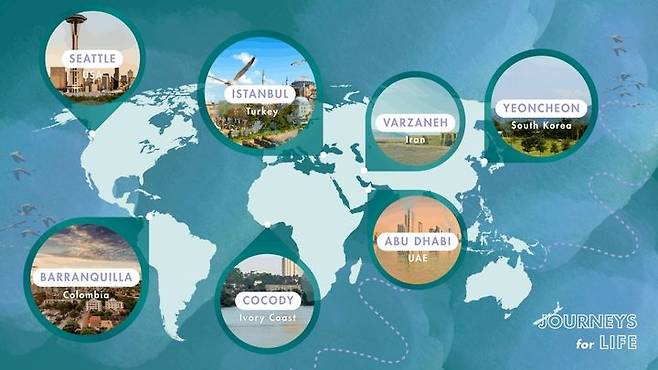
In 2025, the county became the first local government in East Asia to join Journeys of Life, an international initiative that links seven cities worldwide in efforts to protect migratory animals. A year earlier, Yeoncheon designated parts of the Hantangang River area as a special management zone, introducing stricter rules to curb visitor behavior that could harm the environment.
“Yeoncheon is concentrating its administrative capacity on building a sustainable tourism model that balances nature conservation with stimulus for the local economy,” a county official said.
“Of the 11 policy pledges related to preservative tourism put forward by Mayor Kim, 76.7 percent are currently being implemented.”
To support tourism development in a more structured way, the county is also preparing to establish a dedicated tourism foundation. A feasibility review has already been completed, and Yeoncheon plans to work with Gyeonggi Province to finalize the details.
Officials point to several sites that reflect the county’s natural and historical character, including a crane habitat along the Imjin River, Jaein Falls, Horogoru Fortress, Kochia Park and the Auraji pillow lava formation.
Located beyond the civilian control line near military facilities, the Imjin River has become a habitat for crane species with minimal human intervention.
Of the estimated 11,000 red-crowned and white-naped cranes worldwide, about 1,500 spend the winter in Yeoncheon, according to the county. Korea has protected the endangered species as Natural Monuments.
Other species, including hooded cranes, Siberian cranes and black-necked cranes, have also been observed in the area.
Despite its northern location, sections of the river do not freeze in winter, creating favorable conditions for cranes to rest and forage. The county attributed this to the presence of gravel beds and shallow water, which help prevent ice formation.
Cranes are often seen feeding in nearby grain fields after harvest, particularly those growing adlay millet, earning them the local nickname “adlay cranes.”
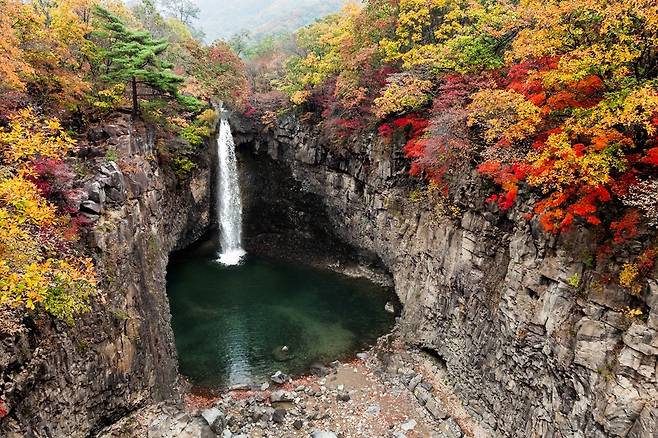
Jaein Falls is considered one of the must-visit sites in the Hantangang River Geopark and is a state-designated scenic site.
Water plunges 18 meters from the falls, creating a striking contrast with the dark basalt columns and forming an emerald pool below.
The volcanic landscape formed as multiple lava flows between approximately 120,000 and 540,000 years ago were gradually eroded by mountain streams originating from Bogaesan. Over time, the basalt cliffs receded, leaving the falls about 350 meters from the main stream of the Hantan River.
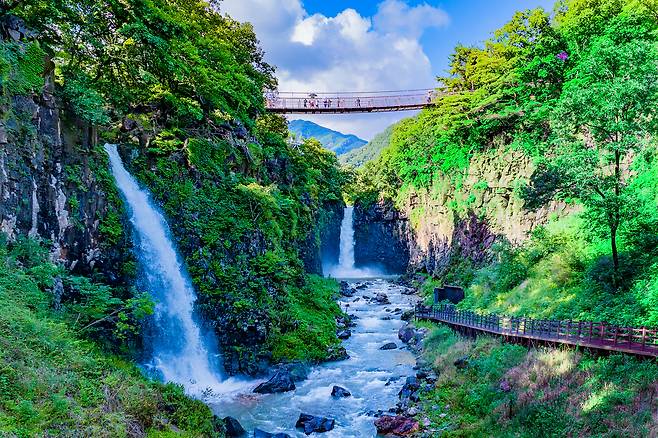
According to local folklore, the name Jaein comes from a clown who died at the site, though there are two differing legends surrounding his death.
In one version, a local magistrate cut the rope while the clown was performing on a tightrope above the cliff. After the clown’s death, the magistrate attempted to take his wife, who instead bit off the magistrate’s nose and took her own life. The nearby area is said to have been named after the Korean word for “bitten nose.”
In the other version, which portrays the clown as a villain, villagers cut the rope while he was performing a dangerous wager involving the village wives.
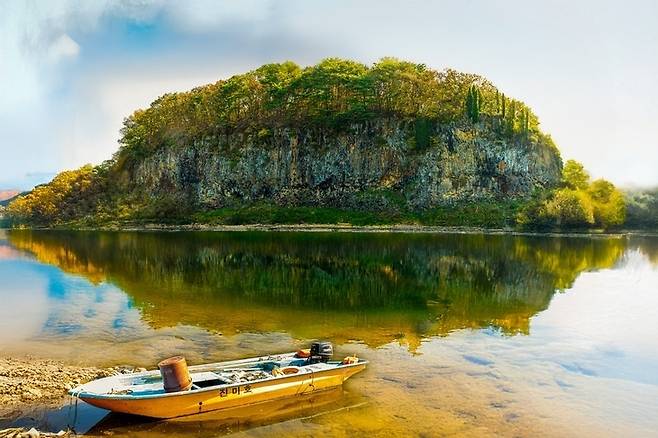
Horogoru Fortress, a relic with a perimeter of about 400 meters, is located atop a basalt cliff along the Imjin River.
Its structure and strategic location resemble fortresses found near former capitals of the Goguryeo Kingdom (37 BC-668 AD), leading scholars to believe it was first built during the period when Goguryeo, Silla and Baekje competed for control of the region — around the fifth to sixth centuries.
Archaeological excavations conducted between 1991 and 2003 uncovered relics spanning a wide historical range, including Paleolithic hand axes, Goguryeo-style official hat models and roof tiles reaching the Joseon era (1392-1910), suggesting the site has been continuously inhabited since the stone age.
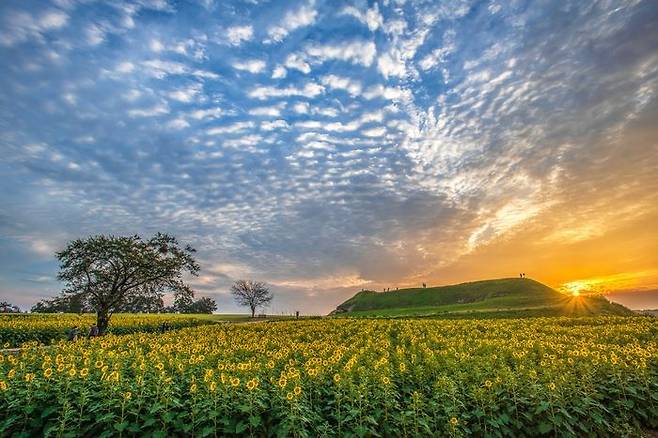
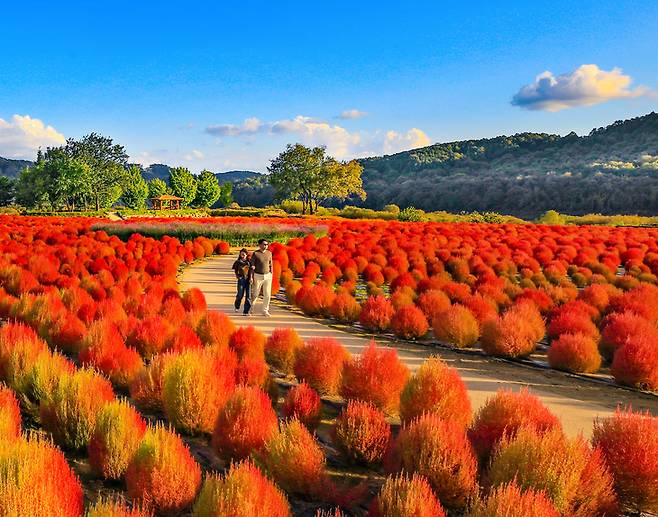
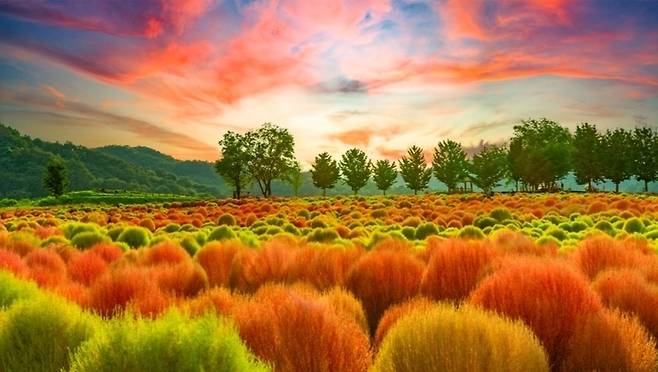
The 40,000-square-meter Kochia Park is located along the Imjin River and is home to tens of thousands of kochia plants.
In autumn, the plants turn red, creating a vivid contrast with the river’s volcanic terrain.
The park was created as part of an environmental restoration project after invasive plant species spread following the construction of Gunnam Dam.
In cooperation with nearby residents, the county installed walking paths and rest areas while minimizing alterations to the natural riverside landscape.
The Auraji pillow lava formation is located at the confluence of the Hantan River and Yeongpyeong Stream. The site takes its name from the cylindrical shape of the lava formations.
Pillow lava is typically found underwater, as it forms when lava cools rapidly upon contact with cold water. Its presence inland gives the site particular geological significance, the county said.
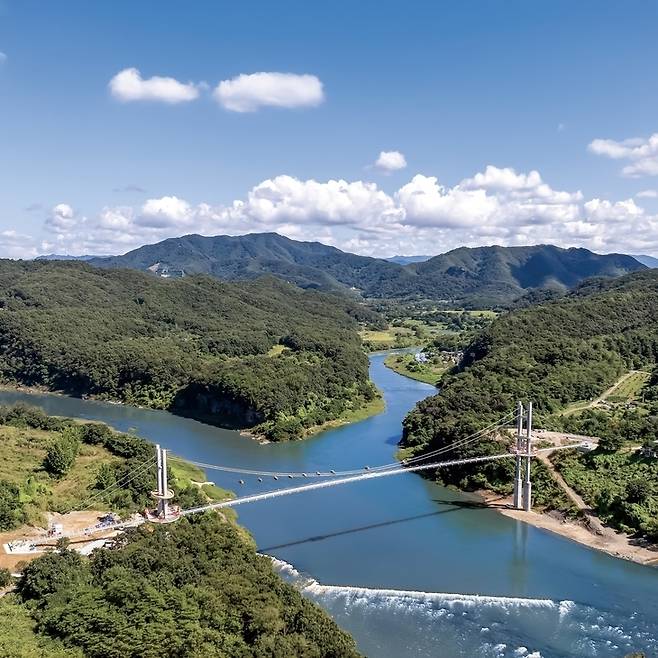
To improve visitor access, Yeoncheon completed a 300-meter-long suspension bridge on Dec. 1, 2025. The bridge allows visitors to view the surrounding landscape without detours, offering clear river views in summer and snow-covered scenery in winter.
Copyright © 코리아헤럴드. 무단전재 및 재배포 금지.