One month into Iran war, S. Korean economy reels
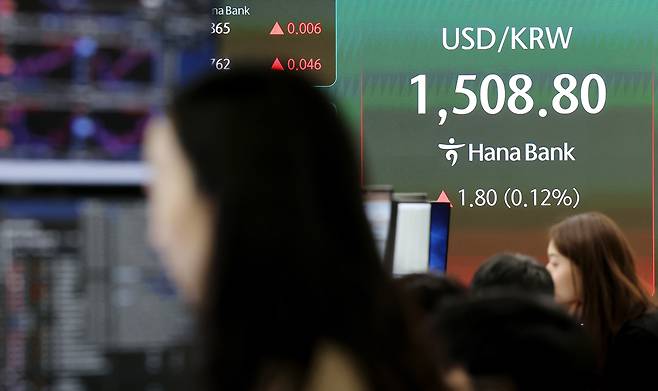
A war that once seemed distant is now taking a visible toll on Asia's fourth-largest economy, with South Korea emerging as a clear casualty of the energy shock rippling through global markets as the US-Iran conflict enters its second month.
The won has taken the sharpest blow. It touched 1,518.4 per dollar on March 23, its weakest level since March 2009, after first breaching the 1,500 mark earlier this month. Through Friday, it averaged 1,489.3 per dollar, the fourth-weakest monthly level on record and even weaker than the 1,488.87 recorded in March 1998, during Korea's worst foreign exchange crisis. Last week's average of 1,503.4 also marked the first weekly average above 1,500 in 17 years.
The currency's slide has outpaced moves in other major currencies. The won has fallen 4.72 percent in March, versus a 2.6 percent gain in the dollar index.
Foreign outflows have added to the pressure, accelerating the retreat from what had been Asia's best-performing equity market. Overseas investors sold a net 29.8 trillion won ($19.75 billion) worth of Kospi shares in March, following net sales of 21.1 trillion won in February, the two biggest monthly selloffs by foreign investors on record.
The damage to stocks has been severe. Kospi market capitalization fell to 4,480 trillion won on Friday from around 5,150 trillion won at the end of February, wiping out nearly 670 trillion won, or roughly $444 billion. In the market's most violent stretch, stocks erased 817 trillion won over two days, including a record 12 percent plunge on March 4.
Volatility has surged. Sidecars were triggered 10 times on the Kospi this year, including seven times in March alone, while market-wide circuit breakers were activated twice this month.
Korea’s vulnerability to external shocks is now feeding directly into the growth outlook. The Organization for Economic Cooperation and Development on Thursday cut its 2026 growth forecast for South Korea to 1.7 percent from 2.1 percent.
Before tensions in the Middle East escalated, the Korean government and the Bank of Korea had projected 2 percent growth this year. The Korea Development Institute and the International Monetary Fund had forecast 1.9 percent.
In the Economy Ministry’s summary of the OECD outlook, the Paris-based institution cited Korea’s heavy reliance on Middle Eastern energy. It also raised its inflation forecast to 2.7 percent from 1.8 percent, warning that a prolonged war would weigh more heavily on Korea and other energy-dependent Asian economies.
South Korea gets about 70 percent of its oil from the Middle East, leaving its export-driven economy highly exposed to external disruptions. Since the end of last month, Brent crude has climbed more than 40 percent, while the Platts Dubai benchmark has surged nearly 90 percent.
Jeong Se-eun, an economics professor at Chungnam National University, said the OECD's downgrade suggests policymakers now see the war’s economic fallout lasting longer than initially expected.
"It implies the OECD sees the impact lasting at least several more months," Jeong said. Even if the conflict ends within two to three months, the shock is still likely to weigh on Korea's economy through the rest of the year because global oil markets are tightly interconnected, she said, adding that the key question is no longer whether the shock will be felt, but how long it will last.
The OECD is not alone in turning more downbeat. Citi recently trimmed its forecast to 2.2 percent, while Seoul-based NH Financial Institute said annual growth could slow by 3 percentage points if the Iran war persists for more than three months. In a scenario where the conflict lasts more than a year, growth could slip below 1 percent.
Authorities are stepping up their response. The government launched a 5 trillion won emergency bond buyback after the war triggered a selloff in local debt and pushed yields higher. It also raised fuel price caps, boosted nuclear plant utilization and lifted seasonal limits on coal-fired generation to cushion the energy shock. Temporary curbs on naphtha exports were also imposed after supply disruptions hit a key petrochemical feedstock, roughly half of which is imported via the Strait of Hormuz.
A supplementary budget of about 25 trillion won is now under discussion, aimed at easing higher fuel costs, supporting vulnerable groups and affected businesses, and strengthening supply chains and energy stability.
Still, not all researchers have embraced a worst-case view. Woori Financial Research Institute recently raised its growth forecast for Korea this year to 2 percent from 1.8 percent, even as it said the hit from higher oil prices was unavoidable. Goldman Sachs also reiterated in a mid-March report its 7,000 target for the Kospi this year, citing stronger earnings growth and resilience in sectors including semiconductors, AI, defense and shipbuilding.
Copyright © 코리아헤럴드. 무단전재 및 재배포 금지.