Why more chaebol heirs are choosing longer military service, including Samsung chair’s son
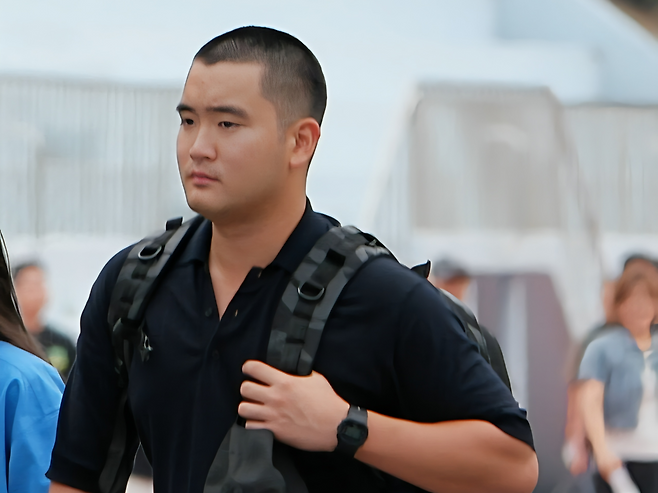
In South Korea, most young men try to finish their mandatory military service as quickly as possible. But a growing number of chaebol heirs, the sons of the country’s powerful family-run conglomerates, are taking the opposite path.
The latest example is Lee Jee-ho, the 24-year-old eldest son of Samsung Group Chairman Lee Jae-yong.
On Monday, Lee entered the Republic of Korea Naval Academy as an officer candidate, beginning 39 months of military service.
That's nearly twice as long as the typical 18 to 21 months required of Korea's enlisted soldiers. To do so, he also gave up his American citizenship, which he had held since being born in New York in 2000.
The move surprised many in South Korea.
Local media outlets described it as an act of noblesse oblige, while online comments praised it as a rare display of sacrifice by the heir to the country’s wealthiest family.
“It’s no easy decision, giving up US citizenship and committing three and a half years,” one commenter wrote on an article about Lee’s service. “Especially for the eldest son of a top chaebol family.”
Military service has long been one of the most sensitive issues in South Korea. Attempts to dodge conscription can have social consequences that last for decades.
The most infamous case is pop star Steve Yoo, better known as Yoo Seung-jun. In 2002, after publicly promising to serve, he renounced his Korean citizenship and obtained American nationality to avoid the draft. The Justice Ministry responded with a permanent entry ban, which remains in place 23 years later.
Cases like this left deep scars in the public memory. For public figures, there is little tolerance for appearing to take the easy way out. Even BTS, the seven-member K-pop juggernaut, all enlisted to fulfill their obligation, either in active duty or alternative service.
However, that raises a question: If completing 18 months as an enlisted soldier would suffice, why commit to more than three years as an officer?
Industry insiders say the officer route helps chaebol heirs project the kind of leader image expected of future conglomerate heads.
“Their roles are simply different as military officers,” one insider said. “Officers handle planning and decision-making, qualities that align with having the leadership image chaebol heirs want to convey.”
Hwang Yong-sik, a professor at Sejong University’s College of Business and Economics, agreed.
“When chaebol heirs serve transparently in the military, it offsets much of the negative perception surrounding them,” he told The Korea Herald. “Serving as officers, in particular, reinforces an image of leadership.”
A recent article in the Korean daily Chosun Ilbo noted that service as a Navy or Air Force officer can also provide access to global networks that would otherwise be difficult to build.
It cited HD Hyundai Vice Chairman Chung Ki-sun, a former Army ROTC officer, who continues to maintain ties he built during his service by sending food to officer candidates and visiting the US Naval Academy.
Such connections, the article noted, are especially useful for HD Hyundai, one of whose main businesses is shipbuilding.
Also, interpreter officers, in particular, often gain opportunities to attend high-level meetings and interact with global figures.
Hanwha Vice Chairman Kim Dong-kwan, for example, drew media attention in 2009 when he served as an interpreter officer during a meeting between then-Prime Minister Chung Un-chan and US Defense Secretary Robert Gates.
A former Air Force interpreter officer who asked to be identified only by his last name Hwang said such positions indeed provide invaluable firsthand lessons.
“As an interpreter officer, you work closely with commanders. It's a position where you can directly observe leadership and learn from it,” he said.
Lee is not alone in making such a choice. A growing number of chaebol heirs are choosing longer officer service instead of minimal enlistment.
At Hanwha Group, with its deep ties to defense and aerospace, the practice has almost become a tradition.
Vice Chairman Kim Dong-kwan, a Harvard graduate, served 39 months as an Air Force interpreter officer. His younger brother Kim Dong-won, now CEO of Hanwha Life Insurance, followed the same path.
At HD Hyundai, Vice Chairman Chung Ki-sun served as an Army ROTC officer, following in the footsteps of his father Chung Mong-joon.
At Dongkuk Steel, Chairman Chang Sae-joo completed ROTC service, while his brother graduated from the Korea Military Academy and went on to serve a decade as an officer. The next generation continued the tradition. Chang Hoon-ik, for instance, served as an Air Force interpreter officer.
Copyright © 코리아헤럴드. 무단전재 및 재배포 금지.