Top lenders cover only 10% of voice phishing losses
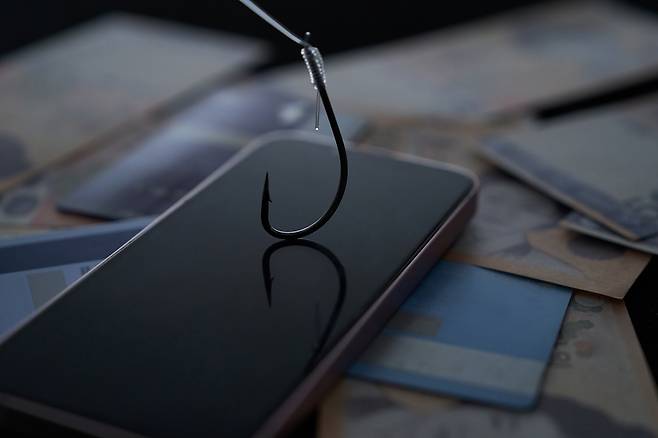
South Korea’s five major banks have compensated only 10 percent of customer-reported voice phishing cases this year, with the payout ratio dropping even lower when including cases that were consulted but not officially reported, according to regulatory data released Friday.
Data from the Financial Supervisory Service submitted to Democratic Party lawmaker Lee In-young showed that between January and August, 173 voice phishing cases were reported to KB Kookmin Bank, Shinhan Bank, Hana Bank, Woori Bank and NongHyup Bank. Of those, 92 cases were reviewed, and only 18 resulted in compensation.
The voluntary payout rate falls to just 0.8 percent when compared with roughly 2,100 consultation cases, including those that were not formally registered for examination.
Voluntary compensation covers losses not reimbursed under the Telecommunications Fraud Refund Act, which is examined and enforced by the FSS. By bank, KB handled six cases with 83.52 million won ($58,800) in compensation; Shinhan, seven cases totaling 13.16 million won; and NongHyup, five cases amounting to 44.51 million won. Woori and Hana made no voluntary compensation.
Nonbank institutions, including card issuers, brokerages and insurers, also began offering voluntary compensation this year, but their payout rate has reached only 1.6 percent so far.
Of the 173 cases reported to banks, 60 were excluded from review for reasons such as voluntary money transfers, so-called romance scams or fraud related to online secondhand trading.
Eighteen cases were found to involve banks’ negligence, but compensation covered only 22 percent of the total losses, or 142 million won out of 638 million won in damages.
Rep. Lee noted nontransparent procedures and low compensation rates leave victims with little recourse, as most are forced to accept the banks’ examination results and payout decisions. Only one case proceeded to dispute mediation after the victim challenged the bank’s compensation.
Lee explained that banks assess compensation through internal systems, including review committees that assign scores from 0 to 3 each for customer responsibility and the institution’s preventive measures. The process, however, can appear arbitrary and unsubstantiated from the victims’ perspective.
For example, victims deceived by scammers impersonating their children, who were persuaded to download malicious apps and enter sensitive information such as account numbers and passcodes, were given the highest score of 3, deemed gross negligence on the customer’s part.
Banks, which operated fraud detection systems but had shortcomings in their scenario operations, received a score of 1 for prevention due to deficiencies in their response scenarios. Combined, these assessments resulted in a compensation rate of just 10 percent.
With losses from voice phishing on the rise and expected to top 1 trillion won for the first time this year, the government has been stepping up efforts to strengthen consumer protection.
In August, the Office for Government Policy Coordination and related agencies announced a set of measures aimed at tightening protections and imposing tougher penalties on financial firms and mobile carriers.
These include plans to revise the Telecommunications Fraud Refund Act to require banks and other financial institutions responsible for preventing voice phishing scams to compensate victims in part or in full, regardless of their actual negligence. The government and ruling party aim to draft the amendment within the year.
Separately, the government will roll out an artificial intelligence-powered platform this month to collect voice phishing-related data from financial firms, telecom carriers and law enforcement agencies and reinforce preventive systems.
Copyright © 코리아헤럴드. 무단전재 및 재배포 금지.