Korea Has Lowered World Standard for Women’s Health Rights
전체 맥락을 이해하기 위해서는 본문 보기를 권장합니다.
On the 14th of this month, Korean Womenlink will also hold a debate about their own proposed "Artificial Insemination Act". Jeong Eun-ji, project manager at the organization, explained that while Womelink's bill also includes content about the systematic management of embryos and eggs, "the purpose of this legislation is different" from that of the Grand National Party's bill. The GNP is concerned with "a monitoring system for eggs and embryos that will be used in research," while Womenlink's bill focuses on "the effects that life science technology has on women's health, and the reproductive rights of infertile women [who are undergoing fertility treatments]."
이 글자크기로 변경됩니다.
(예시) 가장 빠른 뉴스가 있고 다양한 정보, 쌍방향 소통이 숨쉬는 다음뉴스를 만나보세요. 다음뉴스는 국내외 주요이슈와 실시간 속보, 문화생활 및 다양한 분야의 뉴스를 입체적으로 전달하고 있습니다.
*Originally published in Korean by ILDA on Published: December 13, 2005
MizMedi Hospital Director No Seong-il’s recent admission that he engaged in egg dealing has sparked suspicions about the source of the human egg cells that Dr. Hwang Woo-suk and his team used in their stem cell research. The entire affair has exposed problems with the harvesting and use of eggs, the buying and selling of eggs, and procedures involving surrogate mothers within embryo research institutions and fertility clinics, and has clearly revealed the need for a national record keeping and management system, as well as the weak points of the Bioethics and Safety Act.
|
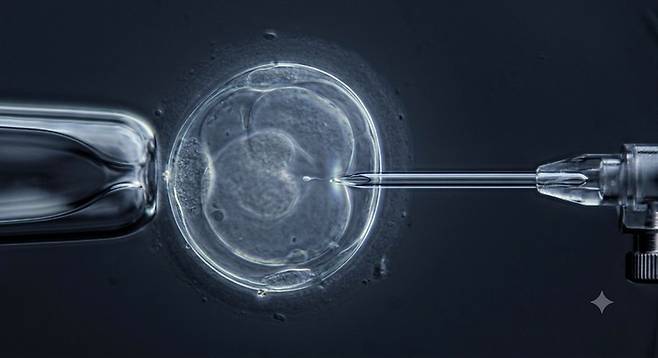
▲ [Source: Image generated with Gemini AI] |
Attempts to enact an “Artificial Insemination Act”
While the questions about egg dealing have led to a battle over the truth about Dr. Hwang and his team’s article in “Science”, efforts to amend the Bioethics and Safety Act and to enact new legislation are underway in several quarters. On the 9th, the office of Grand National Party Assemblyman Park Jae-wan hosted a public forum to discuss legislation, and the “Artificial Insemination and Surrogate Motherhood Act” was submitted, in addition to amendments to the existing Bioethics and Safety Act.
The office of Assemblyman Park, who is promoting amending the act, explained at the public forum that it is necessary to “systematically organize our country’s system of ethical rules for life sciences technology, which are lax compared to the international standard, in light of the current scandal involving human eggs.” With the intent to “consider the rights, safety, and welfare of research subjects to be paramount when life science technology research or development is to be done with human subjects,” the amendment would include researchers’ responsibilities and the duty to protect research subjects.
More than anything else, “establishing a ‘National Embryo Management Center’ [provisional name] as a permanent organization that would generally manage and oversee human embryo research institutions and medical institutions involved in creating embryos, and systematically manage the eggs and sperm involved,” is the main point of the amendment. Also, the Artificial Insemination and Surrogate Motherhood Act that was submitted that day would permit surrogate motherhood with the restriction that commercial surrogate motherhood in which financial compensation is involved would be prohibited.
It is true that despite the increasing demand for eggs for stem cell research and fertility treatments, the current version of the Bioethics and Safety Act fails to consider the health rights and safety of the women who provide eggs, and lacks a monitoring system for the collection of eggs and sperm, and thus the amendment provides several necessary revisions.
On the 14th of this month, Korean Womenlink will also hold a debate about their own proposed “Artificial Insemination Act”. Jeong Eun-ji, project manager at the organization, explained that while Womelink’s bill also includes content about the systematic management of embryos and eggs, “the purpose of this legislation is different” from that of the Grand National Party’s bill. The GNP is concerned with “a monitoring system for eggs and embryos that will be used in research,” while Womenlink’s bill focuses on “the effects that life science technology has on women’s health, and the reproductive rights of infertile women [who are undergoing fertility treatments].”
Foundation for Egg Donation Established in the Absence of Regulations
During MizMedi Hospital Director No’s press conference or through Dr. Hwang’s research, we have had to observe helplessly that the holes in the current version of the Bioethics and Safety Act have become dangerous opportunities and how they are being exploited. Despite violating medical and research ethics and current law, these men are attempting to escape legal punishment by saying the incidents happened before the law was enacted.
Furthermore, though questions continue to be raised about the danger of harvesting eggs by inducing superovulation and about the serious human rights violation of degrading women’s health rights by making them into laboratory tools, an organization called the “Foundation for Egg Donation for Research” has been founded and begun activities by taking advantage of lax laws that fail to stipulate legal procedures or grounds for egg donation.
At a time in which there is a worldwide demand for egg donors to be provided with medical information through an independent process, the majority of the board of directors of this foundation are politicians and people who have a financial stake in the research results. That there is no system in place to regulate and monitor their activities is also a serious problem.
In this respect, the system based on “the responsibilities of researchers and the research subjects’ rights, safety, and welfare” that Assemblyman Park discussed is urgently needed. However, a more urgent issue in Korea is changing the social perception of women’s bodies. This is essential because though the human rights of the women who have become experimental subjects in Dr. Hwang’s team’s research are the heart of this matter, far from political and social understanding and agreement on this point, there is not even widespread recognition of it as a problem.
Having One’s Own Physician and Research Into Long-Term Effects Are Imperative
Consider the United States, where egg donation and the environment around it are the most similar to in Korea. In a California State Senate hearing early in the year, the Pro-Choice Alliance for Responsible Research (PCARR) raised questions about egg harvesting on the basis of damage to women’s health rights. At the hearing, Dr. Suzanne Parisian, MD, former divisional Chief Medical Officer of the Food and Drug Administration, warned that various aspects of the process of harvesting eggs using superovulation promotion could potentially damage women’s health, causing cancer, infertility, and even death.
Dr. Parisian also pointed out that “the long term health risks for a woman receiving IVF [in vitro fertilization] drugs for egg retrieval are unknown.” In consideration of these problems, PCARR’s recommendations to the Senate included that “all data on drugs used in such procedures should be reviewed by a neutral, knowledgeable, and independent oversight body” and a woman who provides eggs “should have her own physician who is independent of the research and the research institution.”
Ha Jeong-ok, doctoral student of sociology at Seoul National University and long-time researcher into the relationship between science and women’s rights in Korea, also stressed the point that “research into the long-term effects of harvesting eggs on women’s health” has never been done thoroughly. In order to trace the relationship between superovulation-promoting drugs and death or the occurrence of diseases including cancer, women who have had eggs harvested must have long-term medical supervision. This may also benefit the women themselves, in the event that problems with their health do arise.
In Korea, thought to be the easiest country in the world in which to get human egg cells, those who see the significance of the current situation agree that this kind of research must be started immediately. This is not only because Korea is the target of “disgrace and worldwide criticism that its medical ethics and scientific research ethics are inadequate,” as Democratic Labor Party policy researcher Han Jae-gak has said, but also “because [it is] lowering the international standards for all women’s human rights and health rights,” as Korea Womenlink’s Jeong Eun-ji has pointed out.
In our society, egg-harvesting - for profit or fertility procedures - without concern for women’s bodies has already been done many times, having a sense of sacrifice is emphasized to women more than their right to bodily self-determination, and a grotesque phenomenon like the boom in egg donations is promoted in the media. Changing the social perspective on women’s human and health rights is a priority more urgent than that of putting some system in place, because more than seeming like, in Assemblyman Park’s words, “a country with loose medical ethics” in regards to women’s health, the current situation leaves one suspicious whether Korea even has medical ethics. [Translated by Choi Do-hye and Marilyn Hook]
*Original article: http://www.ildaro.com/2780 Published: December 13, 2005
Copyright © ildaro.com