So Are You a Woman, or a Man?
전체 맥락을 이해하기 위해서는 본문 보기를 권장합니다.
For example, a "male" who has not gone through puberty and a change in tone of voice is considered girlish regardless of their gender identity. On the other hand, someone with a low, deep voice is judged as "masculine". Perhaps an individual did not compose their gender from their gender expression or physical features such as chromosomes, hormones, or genitals, but were categorized within a fixed gender system that says "women/men are like this".
이 글자크기로 변경됩니다.
(예시) 가장 빠른 뉴스가 있고 다양한 정보, 쌍방향 소통이 숨쉬는 다음뉴스를 만나보세요. 다음뉴스는 국내외 주요이슈와 실시간 속보, 문화생활 및 다양한 분야의 뉴스를 입체적으로 전달하고 있습니다.
Editor’s note: The “Let’s Talk about Sexuality” series explores the diverse values and experiences that women in their twenties have with regards to sex, bodies, and relationships. Through it, Ilda hopes to create a new, feminist sexual discourse. The series is funded by the Korea Foundation for Women’s Gender Equal Social Development Project.
Am I a Woman?
I went to a girls’ high school. In the summer, I wore a white blouse that was part of our summer uniform: a shirt made of fabric so thin that it showed skin if you weren’t wearing an undershirt. So my peers would layer a tank top on top of their bras beneath the blouse. How did I feel at the time? Even now, I really dislike white T-shirts. I didn’t want my silhouette to be exposed, when this wasn’t the case for “men’s” clothing; nor did I want my undergarment to be visible. Thankfully the PE uniform was made of thicker fabric, so I would change into my PE clothes immediately once I arrived at school (regardless of whether I had a PE class that day or not).
Even then, I was aware of the discomfort I felt within me, but I didn’t have the language to name it at the time. The language that felt closest to me and least repulsive was the word “lesbian”. In fact, I was dating a girl at the time, so I thought, “I must be a lesbian.” I didn’t think of myself as transgender, because I didn’t think I was a man or want surgery.
But one thing always weighed heavily on my mind. Someone who calls themselves “lesbian” must be a person who thinks of themselves as a woman, but I didn’t think this descriptor fit me. First of all, I questioned whether I was a woman. Where could I find evidence that I was? Was it because I menstruated? Then what about women who had gone through menopause? Or was it because I had protruding breasts? But I heard there were some men who had enlarged breasts. Then was it because I passed as a woman? (Passing: being perceived by others as a member of a certain social group.) Passing as a woman or man was especially clear-cut in spaces where gender norms about femininity and masculinity were firmly upheld.
For example, a “male” who has not gone through puberty and a change in tone of voice is considered girlish regardless of their gender identity. On the other hand, someone with a low, deep voice is judged as “masculine”. Perhaps an individual did not compose their gender from their gender expression or physical features such as chromosomes, hormones, or genitals, but were categorized within a fixed gender system that says “women/men are like this”. Ultimately, it occurred to me that I cannot determine what gender I am by simply examining my body and life experiences. I came to feel more certain about this position through my activities as an ally in the Korea Intersex Rights Organization Na-sun.
|
▲ Excerpt from the 9th episode of the first season of Bill Nye Saves the World, an informational science program streaming on Netflix. |
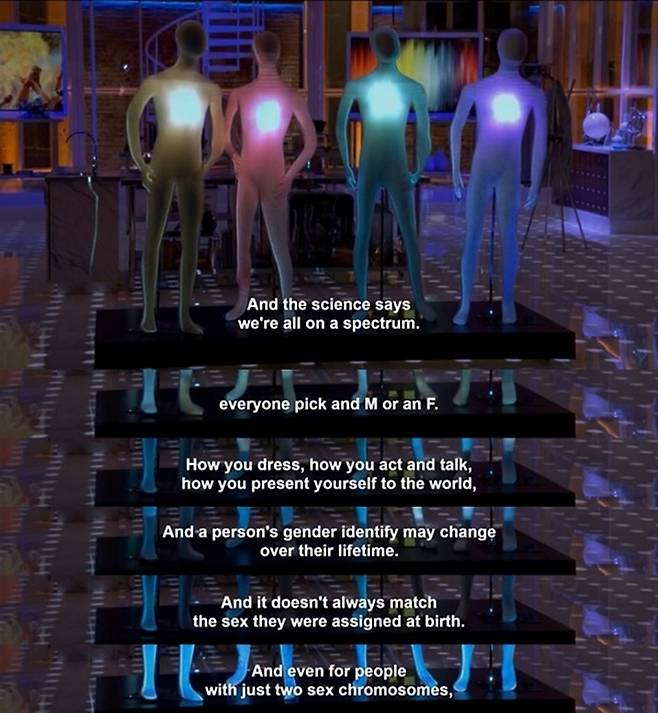
When I reached the conclusion that the voice, figure, and genitals which make it “not cumbersome” for me to have a lesbian relationship do not describe who I am, it became difficult for me to feel a sense of belonging in the lesbian community I had been part of. That space was for ‘women’, but since I did not think of myself as a woman, I felt anxious and thought that I shouldn’t be there. Incidentally, an announcement posted on the community website included a sentence that forbade transgender people from joining the group.
For a long time, I lived this way—unable to tell my story. There was the difficulty of finding a community I could stay in, but it was also because I didn’t know where I could talk about my experiences as a transgender person who was assigned female at birth. I thought I may be so ambiguous that I could not fully belong anywhere. I’d now understood to some degree that I was transgender, but could I call myself transgender without undergoing any surgical transition? I wondered for a long time how to name myself. Could I just ignore the ‘feminine’ markers that I had but did not want?
The Sense of Liberation the Term “Genderqueer” Brought Me
Then, through coincidence, I came across the term “genderqueer” online. In my memory, it was defined as a term describing “individuals who are outside of the female-male gender system”, and I thought this described exactly who I was. In my experience, the ability to perform the gender role in accordance with one’s assigned gender was the most common way of being even in the queer community. Whether gay or lesbian, this was the case for popular individuals. So I thought that people like me, whose gender determination and expression were ambiguous, were relatively less welcomed. I got the impression that even when such people were popular, they were still viewed as non-normative—though the non-normativity was read as a positive aspect.
If I had met someone who said that they didn’t define their gender identity within a female/male binary, I may have found my identity more quickly. I would have felt more relieved and assured if I knew I wasn’t the only one like this in the world.
There was a period in my life where I had many gay and lesbian people around me, but few genderqueer acquaintances. I think it was late 2013. I lacked the ability to find information on my own, but there weren’t visible trans organizations or pamphlets at the time either. That year, the KSCRC (Korean Sexual-minority Culture & Rights Center) hosted the LGBT counseling conference “Breaking the Framework of Gender”. This was the first trans-related event I attended in my life, where I heard about counseling guidelines for gender diversity and the transgender human library. It was the first experience I had where I saw that my internal perception could merge with reality, even if just a little.
In retrospect, I didn’t have to distinguish whether I was ‘butch’ or ‘femme’ in terms of sexuality when I was in a lesbian relationship. There wasn’t a sense of superiority or inferiority, either, as both parties were ‘women’. (This may not be the case for everyone, depending on personality.) But I came to feel and sense emotions and aspects I hadn’t in relationships with women when I started dating ‘men’.
Perhaps because of the awareness that my partner was ‘heterosexual’, I would unconsciously position myself as a ‘woman’. (Despite the fact that what is ‘feminine’ is also just a social construction.) I worried that my partner would feel less attracted to me if I were too ‘masculine’, and thought they would like me more if my behavior was ‘feminine’. There was also the pressure to always accept sexual advances. It was exciting to see my partner aroused, but sometimes I thought, “We could try something other than bodily contact to feel different kinds of intimacy.” I felt strange about the fact that the physical relationship was centered out of so many different kinds of communication methods, and how I was becoming so absorbed in it too.
Becoming an object of desire, asking to be desired, and feeling that my own worth decreased if I was not desired—these were experiences and thoughts I had for the first time. The most enthusiastic reaction toward me was sex, so I would sometimes feel sad when we didn’t have sex. I think an understanding of physical response as a form of affection underlay that response. It was not simply because this ‘heterosexual relationship’ was different, but because I constantly felt that I was placed in a role that I didn’t feel comfortable in and felt like I was performing, but also felt obligated to perform—something I hadn’t felt in my lesbian relationships in the past.
I never talked about mastectomies in front of a partner. I thought that I would lose attractiveness toward them once I ‘got rid of’ my breasts, and thought I may not be able to satisfy them as ‘heterosexuals’. I always felt that I would not be loved without breasts. My breasts were the cause of my dysphoria, but I was also keenly aware that they were objects of sexual desire for other people. The protruding swells of my breasts were physical features that allowed me to pass as a woman, but I didn’t think they were so gendered that I needed to surgically remove them. So I spent several years in ambivalence. They existed as they had before, but I could no longer interpret them through the conventional framework of meaning.
Just as my body has gendered features that are read as female or male (whether I want to be or not), many non-transgender people live within the gender system without experiencing any particular difficulties. Since I feel alone in resisting this system that categorizes people into women or men wherever they go and whatever they do, whether it be going to the restroom, a job interview, or a blind date, or getting married, I’m sometimes reminded of the children’s story “The Emperor’s New Clothes”. No one believes or understands me right away, but I am creating space for myself by honoring the feelings I have and interpreting reality from a non-binary perspective. The more I learn about who I am, the more curious I become about how it feels for cisgender people to identify as female or male.
Impoverished and Limited Understandings and Imaginations
I experience things that I would never have to if the world were only populated by transgender people. For example, I came out to a male colleague at work about being transgender a while ago. My colleague then asked me three questions that I still cannot forget.
1) “But doesn’t your resident registration number begin with 2?”[In Korea, the latter half of the 13-digit resident registration number assigned to all residents begins with either 1 or 2. A sequence that begins with the number “1” indicates categorization as male, and the number “2” categorization as female.]
2) “Didn’t you enter this company as a woman? How did you do that?”
3) “How does that make sense? You’re a woman.”
A transgender woman might go through the process of correcting ID documents and change her resident registration number to 2; a transgender man assigned female at birth may live with a registration number that begins with 2 while preparing for transition. But in comparison to the world I know, the imaginations of the people I met were much more limited.
Thus, I could not even mention the word “genderqueer”, which questions the entire female/male gender binary, in front of those people. I thought my story and my context might be understood if I met someone who doubted and felt discomfort about the gender system itself, or someone who felt they did not fit into the preexisting ideology. And when I actually did begin to regularly meet people who described themselves as genderqueer, I was able to talk about gender expression and my thoughts.
Compared to participating in an average queer gathering where I was always passed or passing as female, this experience was much more comfortable. Though I knew I would be called someone’s daughter, female employee, young woman, or young female student the moment I stepped out of this gathering, the experience of being in a space where one’s gender was not simply assumed led me to feel pride in my gender identity. (Participating in an ‘assigned gender clothing flea market’ with them was also a great experience.)
For the past few years, I’ve been imagining what it would be like to be pregnant. (Even though living as I am now is difficult enough!) I think I’d like to support my child to make more agentive decisions in a gender-neutral environment. This desire feels like the result of having survived a gender-binary-centered world where I did not have access to any information until I’d ascertained my gender identity myself.
I also thought that thinking like this might be dismissive of others’ realities. I thought I shouldn’t have such thoughts in a reality where a woman’s decision to discontinue her pregnancy is a crime, and only very few transgender women are able to receive a uterus implant. Giving birth as a transgender person sounded like something that might appear as a piece of news from abroad. Such stories were absent from my surroundings.
Then, one day, I read an article about an American transgender man in a gay couple who had given birth to a child. (https://edition.cnn.com/2017/06/08/health/trans-man-pregnant-trnd/index.html) When I heard this news, I thought that this would not have been possible in Korea. While there isn’t an actual law in Korea about changing sex designations on ID documents, established rulings of the Supreme Court have entailed submitting documents certifying the surgical removal of organs with “reproductive capability”.
Not every transgender person removes their reproductive organs, but I’ve rarely met a trans person who says, “I’m planning on giving birth later,” so I think I need to gather much more courage and perspective to imagine and prepare for my future. A world where I am allowed to become a ‘mother’ would be a good world for women to live as mothers, too. (However, childbirth and marriage are not default steps in a woman’s life.)
A Narrative of Myself As I am Now
It’s queer culture festival season. Beginning with a parade in Daegu on June 23rd, festivals are being held all over Korea. During the festival last year in Seoul, I saw an image that left a big impression on me. It was a photo of a female participant who was topless in the parade. I’d become used to men going topless, but I hadn’t thought of a woman doing the same. And the moment I saw the photo, I felt something stir inside me. “Why can’t I just take my shirt off like those people?”
As I am a transgender person who has not gone through surgical intervention, my body would probably be charged with a misdemeanor. But if my breasts are not those of a woman, who could think that I am being obscene? Haven’t I actually been thinking of my body as something that should be hidden and cautiously protected due to social conventions I’ve internalized? Since women are sexually objectified in society, aren’t women and I together in being oppressed and barred from free gender expression? What kind of bodies do not face restrictions when visible, and what kind of bodies are restricted and erased? And who decides such things? If I go topless at a queer culture festival, is my body female, male, or neither?
I think this dilemma will continue. Whether I live a ‘life that appears to be a lesbian’s’ in which I cannot even marry the person I love, live with a ‘heterosexual’ and seemingly contribute to strengthening the heterocentric narrative, or live as a transgender person without surgical intervention who envies feminists’ free and impressive acts of self-expression, I will need more narratives of things as they are.
|
▲ The late Lee Muk, from director Lee Young’s documentary Troublers (2015) |
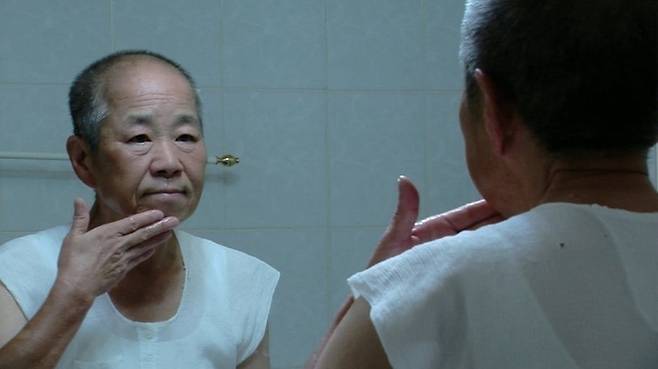
After all, this is what I wanted to talk about. Just a few years ago, I thought that transgender people did not exist in generations before me. But seeing Lee Muk in the documentary Troublers (directed by Lee Young) changed my mind. Through the documentary, Lee Muk left these words with us: “I’m an active person. I don’t live in hiding. I hope that the generations after me live with pride, too.”
I don’t think that I’m an authority on these issues. But if the activities I engage in as a trans rights activist offer someone courage and assistance, or contribute to someone’s sense of confidence about taking this path (of life as a transgender person), I want to continue to live in these dilemmas.
After being misunderstood and hurt in communities both queer and not, I have come to feel over time that I want to persist and live as I am. I hope this feeling I’ve journeyed toward supports queer people I haven’t met to accept themselves. Just as you have deliberated at many different crossroads and made difficult decisions, I have too. I hope that sharing my experience of reflecting on similar issues can offer some consolation. [Translated by Hoyoung Moon]
*Original article: http://www.ildaro.com/8243 Published June 28, 2018
Copyright © ildaro.com