Samsung, SK hynix on Course for KRW 650 Trillion Profit, 2.5 Times Start-of-Year Forecasts
AI investment accelerates, supply shortage persists
Won strength a variable, but DRAM prices keep soaring
Memory prices are rising faster than expected because demand has grown with expanded investment in AI data centers, while supply is also constrained. The won's strength, driven by a lower exchange rate since the third quarter, is weighing on earnings, but memory prices are rising even more steeply.
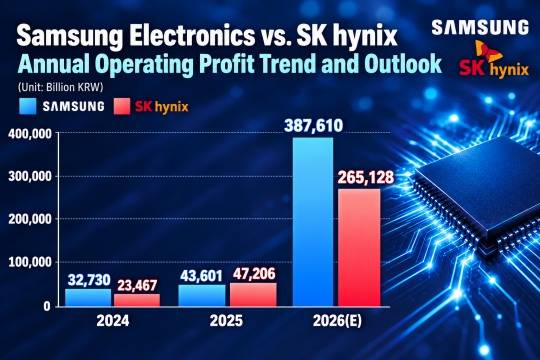
According to financial data provider FnGuide, as of Sept. 29, the consensus for Samsung Electronics' full-year operating profit stood at KRW 387.61 trillion. That is 6.4% higher than the KRW 364.426 trillion forecast three months earlier.
SK hynix's consensus came to KRW 265.128 trillion, about the same as the KRW 266.7 trillion forecast three months earlier. The combined forecast for the two companies is KRW 652.74 trillion.
Earnings are improving at an accelerating pace. Samsung Electronics posted operating profit of KRW 57.2 trillion in the first quarter and KRW 89.5 trillion in the second, while SK hynix earned KRW 37.6 trillion and KRW 60.5 trillion, respectively.
Second-quarter operating profit rose 56% from the first quarter for Samsung Electronics and 61% for SK hynix. The two companies' combined operating profit for the first half was KRW 244.9 trillion.
The increase is expected to widen further in the third quarter. Based on current estimates, third-quarter operating profit is projected at KRW 110.3 trillion for Samsung Electronics and KRW 78.1 trillion for SK hynix, for a combined KRW 188.4 trillion. Samsung Electronics is expected to post quarterly operating profit above KRW 100 trillion for the first time ever.
The exchange rate is the variable. The average dollar-won rate in the second quarter was about KRW 1,502, but the third-quarter average is around KRW 1,430, down 4.8%.
For companies that sell memory chips in dollars, such as Samsung Electronics and SK hynix, a lower exchange rate reduces the sales and profit translated into won, even when dollar revenue is unchanged.
Even so, the full-year earnings outlook has not wavered significantly. The full-year operating profit forecast for Samsung Electronics has actually risen by more than KRW 23 trillion from three months ago, while SK hynix's has held steady in the KRW 265 trillion range. Even after accounting for the exchange rate, expectations of higher memory prices and improved supply-demand conditions have been weighted more heavily.
The most direct factor lifting earnings forecasts is memory prices.
Mirae Asset Securities projects that Samsung Electronics' average selling price (ASP) for DRAM will rise 16.5% in the third quarter from the previous quarter. Eugene Investment & Securities also estimates that Samsung Electronics' ASPs for DRAM and NAND flash will rise 17% and 18%, respectively.
Behind the price increases are rising demand centered on AI data centers and limited supply. Demand for HBM (high bandwidth memory) and server DRAM needed for AI servers is growing rapidly, but memory makers find it difficult to expand production capacity significantly in the short term.
Existing capacity is also being allocated first to high-value products such as HBM and server DRAM, leaving the supply of commodity DRAM relatively tight. In a recent company analysis report on Samsung Electronics, Daishin Securities said, "Customers' purchase volumes are higher than expected while capacity expansion is limited, so the short-term price ceiling could rise."
The rise in commodity DRAM prices is also translating into high profitability.
SK hynix's operating margin climbed to 76% in the second quarter, and its memory business operating margin is expected to reach the high 70% range in the third quarter. Samsung Electronics' DRAM business operating margin could also exceed 80% in the third quarter, helped by yield improvements in next-generation (sixth-generation 10-nanometer-class) DRAM and rising memory prices.
Some analysts say the memory price increase may not be a passing phenomenon, since the supply shortage is unlikely to ease soon. Lee Seung-woo, head of the research center at Eugene Investment & Securities, said AI infrastructure investment is far outpacing memory makers' capacity expansion, so supply shortages could recur.
He explained that fab expansion cannot keep pace with demand growth in the short term because of constraints such as technical difficulty, equipment lead times and yields. Lee also suggested that the current rise in DRAM prices may be a structural change that goes beyond past cycles.
In the HBM market, Samsung Electronics is catching up quickly. According to Counterpoint Research, global HBM market share by second-quarter revenue this year was 50% for SK hynix and 33% for Samsung Electronics.
In the first quarter, SK hynix held 58% and Samsung Electronics 21%, so the gap between the two narrowed from 37 percentage points to 17 percentage points. Some forecast that Samsung Electronics' share could keep growing as HBM4 shipments get under way in earnest.
Gwak Horyung (horr@fntimes.com)
Copyright © 한국금융신문 All Rights Reserved.