Same Group, Opposite Fortunes: LG Electronics Up 116%, LG Display Down 30%
LG Electronics expands its reach through business overhaul
Tech-focused LG Display seeks a turnaround
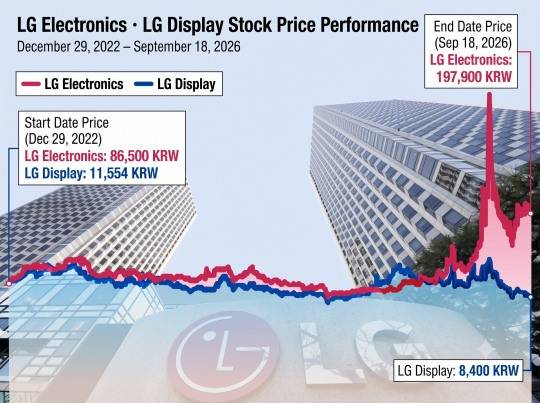
LG Electronics has broadened its business into automotive components, heating, ventilation and air conditioning (HVAC), and platforms as the weight of legacy businesses such as TVs has diminished. LG Display, by contrast, is shifting its business structure toward OLED but has yet to break free of a structure in which its earnings hinge heavily on the demand and pricing policies of major customers such as Apple.
Korea Financial Times calculated the total shareholder return (TSR) of LG Electronics and LG Display from Jan. 2, 2024, to Sept. 18, 2026, using corporate data platform DeepSearch. LG Electronics posted a TSR of 110.6%, while LG Display recorded -25.8%.
TSR measures the return shareholders earn over a given period through share price gains and dividends. It is calculated by adding the change in market capitalization at the comparison point to total dividends paid, then dividing the sum by the market capitalization at the time of purchase.
For example, a shareholder who bought KRW 10 million worth of each company's stock at the start of the analysis period and held it throughout would have seen the LG Electronics stake grow to KRW 21.06 million, while the LG Display stake would have shrunk to KRW 7.42 million.
On an annual basis, the two companies' performance split most starkly this year. LG Electronics' TSR rose from -17% in 2024 to 11.7% in 2025 and 115.9% this year. LG Display rebounded from -25.2% in 2024 to 29.4% in 2025 but fell back to -30% this year.
In other words, the two stocks, which had moved in similar patterns through last year, went in opposite directions this year. The divergence is all the more striking given that LG Electronics is LG Display's largest shareholder, with a 36.7% stake.
However, the business ties between the two companies have weakened compared with the past, as LG Electronics exited the smartphone business in 2021 and then the LCD TV business in 2024.
According to LG Display's business reports, revenue generated through related parties LG Electronics and LG Innotek fell 31% from KRW 4.9202 trillion in 2021 to KRW 3.3911 trillion in 2025. Their share of total revenue declined 3.4 percentage points over the same period, from 16.5% to 13.1%.
LG Electronics is diversifying its business portfolio by filling the gap left by its diminishing TV business with automotive components, HVAC, and platforms.
In 2025, its Media Entertainment Solution (MS) Company posted revenue of KRW 19.43 trillion and an operating loss of KRW 750.9 billion, while its Vehicle Solution (VS) Company recorded revenue of KRW 11.14 trillion and operating profit of KRW 559 billion.
LG Electronics is expanding not only into automotive components but also into HVAC, platforms and content, and robotics. The center of gravity of its portfolio is also shifting, with the combined operating profit of its B2B businesses, VS and Eco Solution (ES), exceeding KRW 1 trillion for the first time.
Expectations for its AI and robotics businesses also helped lift LG Electronics' share price this year. The stock surged from late May as hopes for collaboration grew ahead of Nvidia CEO Jensen Huang's visit to Korea, at one point topping KRW 300,000 in early June.
The market viewed potential cooperation between Nvidia and LG Group in physical AI, robotics and AI data centers as a new growth engine for LG Electronics.
Huang and LG Group Chairman Koo Kwang-mo met in June to discuss AI cooperation, followed by further talks, including visits by LG affiliate executives to Nvidia's headquarters. Analysts interpret the stock's rise as reflecting expectations for future businesses such as AI, robotics and data centers.
The HVAC business is also emerging as a new growth engine in tandem with the expanding AI data center market. As the number of AI servers grows and data center cooling demand rises, LG Electronics is expanding its presence in the data center HVAC market with cooling solutions such as chillers.
LG Display, on the other hand, has lacked a comparably prominent growth driver to lift its share price this year, despite its shift to OLED.
The OLED transition itself is focused on restoring the profitability of existing businesses, and the company remains in a structure where it must respond to the demand and price negotiations of global customers.
LG Display must shift its product portfolio toward OLED while simultaneously responding to the demand and price negotiations of global customers.
As of the second quarter of this year, mobile accounted for 36% of revenue by product, IT (monitors, laptops and tablets) for 32%, and TVs for 21%.
LG Display posted operating profit of KRW 39 billion in the first half of this year, its first first-half profit in five years, but recorded an operating loss of KRW 108 billion in the second quarter. Although profitability is improving as the company restructures around OLED, quarterly earnings volatility persists.
Against this backdrop, Apple's component cost burden emerged this year as a key variable for LG Display's share price. Because LG Display supplies OLED panels for the iPhone, there are concerns that rising costs at Apple, driven by factors such as higher memory chip prices, could translate into pressure on panel prices.
Indeed, LG Display shares weakened after Apple announced iPhone price increases, falling sharply from their June peak.
LG Display's strategy is to strengthen its supply relationship with key customer Apple through technological and price competitiveness. In his New Year's address this year, CEO Jeong Cheoldong set out "securing top-tier technology," "technology-based cost innovation" and "executing AI transformation (AX) across all areas" as core priorities. Since then, the company has extended tandem OLED from TVs and IT products to smartphones and is preparing next-generation technologies such as 8.6th-generation OLED.
Gwak Horyung (horr@fntimes.com)
Copyright © 한국금융신문 All Rights Reserved.