‘Dress Like a Museum Exhibit’ is anything but a flop as an earnest fish captures hearts, top prize
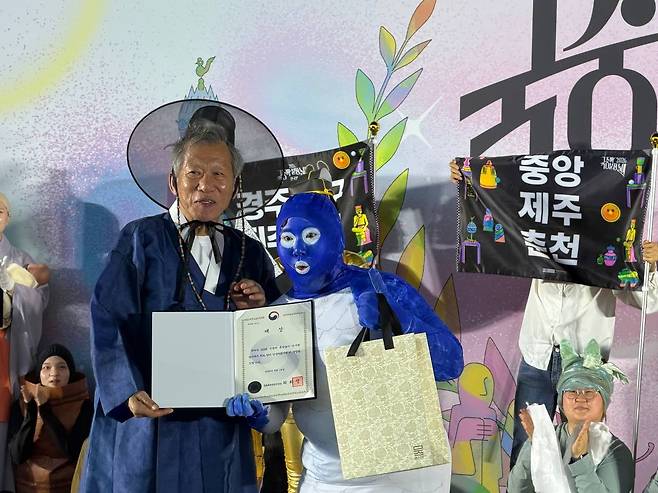

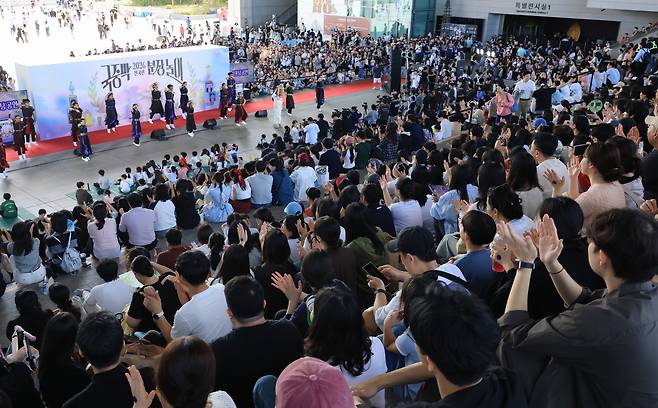
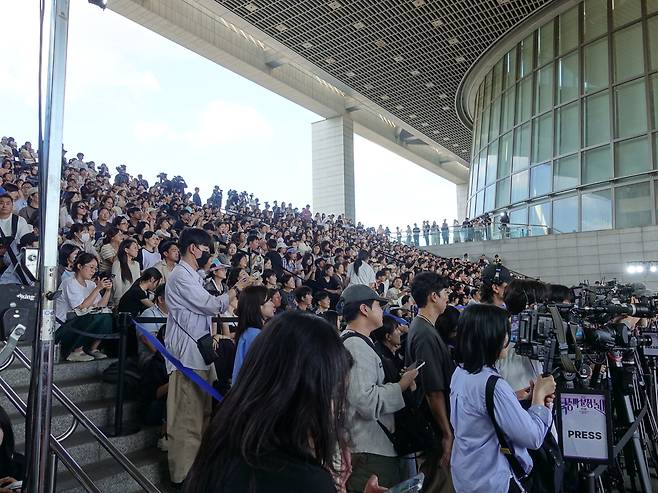
The final round of the “Dress Like a Museum Exhibit” competition was held at the museum in Yongsan District, central Seoul, and the outdoor plaza was packed with thousands of spectators who had come to see who would win the top honor. The Grand Prize went to Jeon Eun-seul, a nursing student who cosplayed as a blue-and-white porcelain water dropper shaped like a fish.
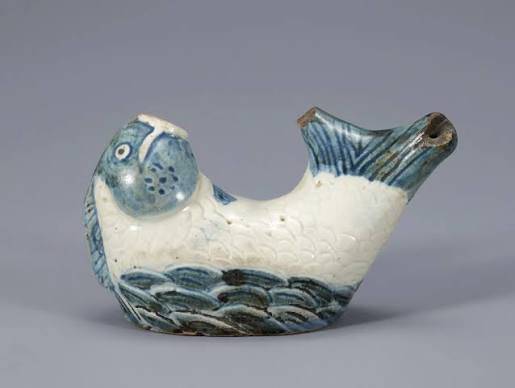
The object is a Joseon-era (1392-1910) stationery piece shaped like a carp caught mid-leap that scholars used to pour water on an inkstone. Jeon took home the Grand Prize and 3 million won ($2,200) — and, judging by the noise, the crowd’s hearts. Her entrance drew the loudest cheer of the evening, louder than for any of the gilded, towering or elaborately engineered entries around her. She was, quite simply, adorable.
“I wanted to take some time before graduating to draw a line of my own, in my own way,” Jeon said. “Honestly, I’m a job-seeker who doesn’t know what I’m good at, and this award gave me courage.”
Bunjang-nori — dress-up play, as the competition is called in Korean — drew 83 teams when it debuted last year. The winners, a team dressed as a pair of gold earrings excavated in Gyeongju, ended up on national television.
Expanded to a nationwide event for the first time this year, the competition drew 275 teams and 643 people across four regions, more than three times as many as last year, with contestants posting reels of their preparations that clocked hundreds of thousands of views. Fifty teams advanced to regional rounds at the national museums in Seoul-Chuncheon, Gongju, Daegu and Jeonju, and on-site judging narrowed the field to the 25 who competed on Saturday.
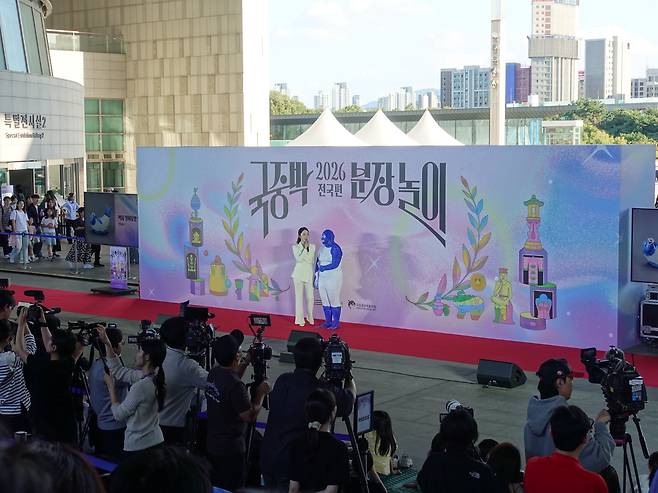
Spectators seemed to draw their own conclusions about the event. A visitor surnamed Choi who had come up from Busan with two sons in tow said the trip was made for the competition alone.
“My boys usually aren’t very interested in museums or artifacts, but they had so much fun watching,” Choi said. “We even talked about entering as a family next year.”
Kim Young-ji, an office worker, drew a comparison the evening seemed to invite.
“I hear the United States has the Met Gala, but I think an event like this, where everyone can take part, means more than watching celebrities dress up,” Kim said. “And the winner didn’t use expensive materials or fancy tools. She took an artifact that isn’t well known, dressed as it in her own style and made it lovable. I think that’s what makes her win meaningful.”
There was nowhere to move in the plaza of the museum on Saturday. A row of children sat along the front edge of the red carpet, close enough to touch the hems of passing bodhisattvas, and their giggles and laughing screams filled the plaza.
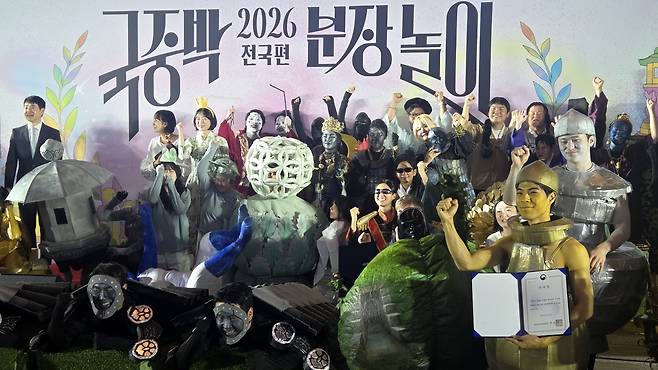
Another five teams took the Merit Award, including one dressed as the Divine Bell of King Seongdeok, titled “School Bell Emile,” a name that winks at the bell’s nickname and at the child-sacrifice legend the team had set out to debunk. The remaining 14 teams received honorable mentions.
“Amid the fervent participation from across the country, our artifacts were brought back to life in witty new forms,” You said, adding that the audience’s response showed a deep affection for Korea's cultural heritage. “I am confident that this competition will establish itself as an important festival.”
That is roughly the theory the competition runs on: The quickest way to make somebody care about a national treasure is to hand them the job of building one. Saturday suggested a corollary — that it also works on the people who only spectate. Two thousand audience members have now at least seen a water dropper hop around on feet-fins, and a good number were young enough to have spent the evening sitting cross-legged at the edge of the carpet, a few feet from where the fish landed. That is a memory that may stay with them forever.
BY LIM JEONG-WON [lim.jeongwon@joongang.co.kr]
Copyright © 코리아중앙데일리. 무단전재 및 재배포 금지.