How Trump's order to scale back drills complicates Seoul's wartime command bid
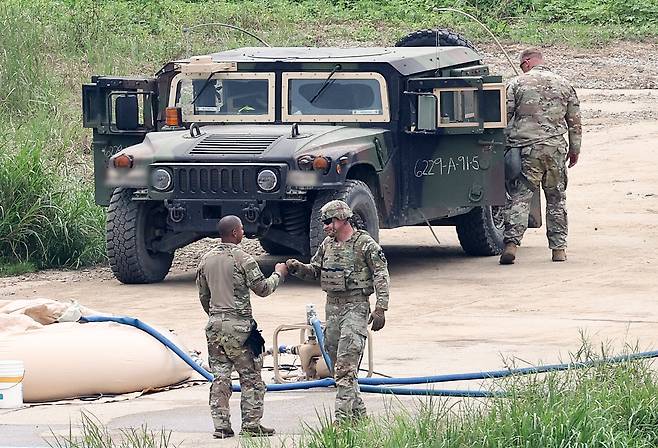
South Korea and the United States cut short this year's Ulchi Freedom Shield (UFS) exercise on Aug. 21, six days ahead of schedule, after U.S. President Donald Trump ordered the Pentagon to substantially reduce the drills.
The second phase, built around a simulated counteroffensive against North Korea, was scrapped entirely.
South Korea's Ministry of National Defense says the cut has not affected the country's push to reclaim wartime operational control (Opcon) of its own military.
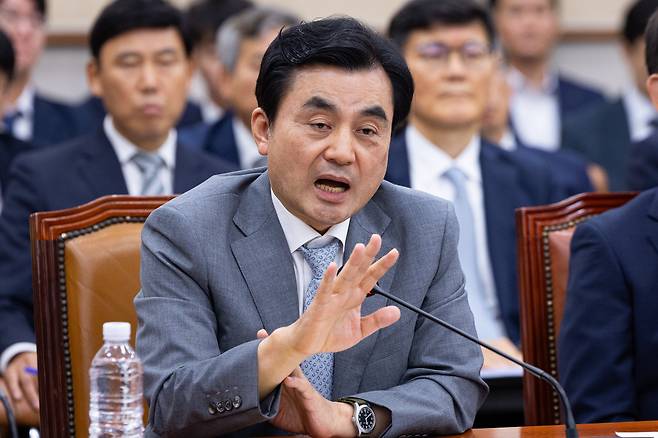
Defense Minister Ahn Gyu-back told the National Assembly on Aug. 20 that two evaluations tied to the transition — including one covering fire-support coordination — were already completed during the exercise's first phase.
The real test of that claim comes in October, when defense chiefs from both countries are expected to meet in Washington and decide whether to name a target year for the handover — a decision that will show whether Washington's read of this summer's verification actually matches Seoul's.
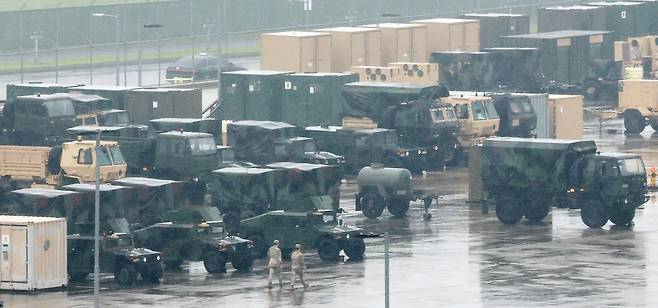
What exactly changed about this year's UFS exercise?
UFS, the allies' annual summertime command-post exercise, was originally scheduled to run 11 days, from Aug. 17 to 27.
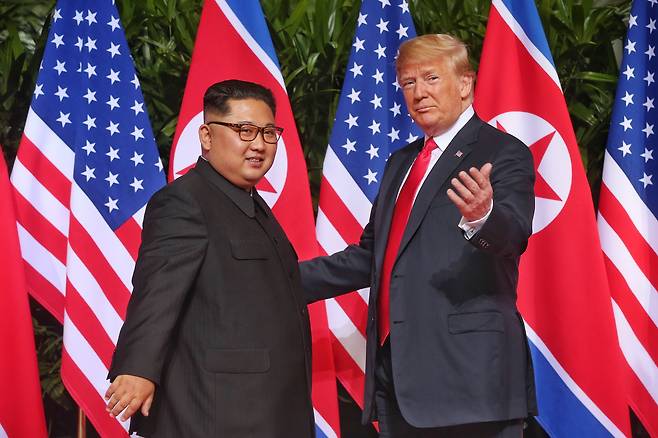
Trump, on the day before the start of the drills, however, directed Defense Secretary Pete Hegseth to substantially reduce the exercise, citing his "very good relationship" with Kim Jong-un and calling the drills "costly" and a "totally inappropriate and hostile" signal to North Korea.
The order came without prior coordination with Seoul. South Korea's defense and foreign ministries said during a parliamentary committee session that they learned of the decision only after it was posted.
Field training exercises involving troops and equipment on the ground were reduced from 17 to 14, and the drill's second week — the counteroffensive phase — was canceled outright, leaving only the first week's defensive-phase drills.
It is highly unusual for a joint exercise already underway, and agreed to in advance by both militaries, to be cut short mid-exercise.
What is Opcon, and how is the transfer actually decided?
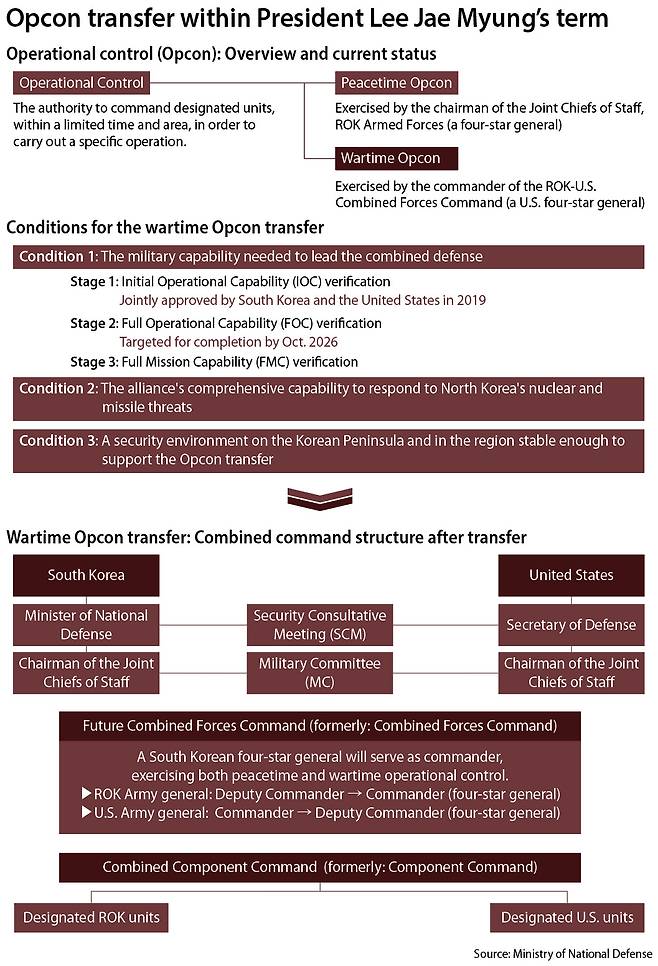
Opcon refers to the authority to command South Korean and U.S. forces in the event of a war on the peninsula.
South Korea transferred this authority to the U.S.-led United Nations Command at the outset of the 1950-53 Korean War. Peacetime operational control was returned to South Korea in 1994, but wartime control has remained with the commander of the Republic of Korea-U.S. Combined Forces Command — a post currently held by a U.S. four-star general who also serves as commander of U.S. Forces Korea (USFK).
Under the plan both governments have pursued since 2014, that role would eventually pass to a South Korean four-star general, with an American serving as deputy commander, under what is envisioned as a Future Combined Forces Command.
The two allies are following what they call a "conditions-based" transition plan, built around three requirements: South Korea's military capability to lead the combined defense, an alliance-wide capacity to counter North Korean nuclear and missile threats and a stable security environment on the peninsula and in the region.
Progress on the first condition is measured through a three-stage process for the future command: Initial Operational Capability, Full Operational Capability (FOC) and Full Mission Capability (FMC). South Korea has been working through the FOC stage this year.
At the 57th Security Consultative Meeting (SCM) in Seoul last November, the two countries' defense chiefs agreed to pursue FOC verification within 2026 — the target this year's UFS was meant to help meet.
The 58th SCM is expected to take place in Washington in October, where South Korea hopes the two countries' defense ministers will approve this year's FOC results and name a target year — referred to in Korean planning documents as the "X-year" — for the Opcon transfer.
Ahn Byung-seok, a retired four-star general who personally commanded South Korea's forces through the entire 2022 FOC evaluation as the prospective Future Combined Forces commander, told the Korea JoongAng Daily that a target year could still emerge from October's meeting in principle — but that "what's currently been disclosed doesn't seem to offer sufficient military grounds" for setting one.
"What's more dangerous than delaying the date," he said, "is lowering the standard of judgment in order to meet it."
If a target year is announced, he added, Seoul and Washington should explain not just that FOC verification was "completed," but what standards were applied, how the canceled drill will be made up and what the next stage, FMC verification, will confirm.
Does the government's "no impact" claim hold up?
Korea's Ministry of Defense said on Aug. 19 that the joint evaluation planned for this year's UFS proceeded as scheduled despite the shortened exercise.
Defense Minister Ahn reaffirmed that position the next day at the National Assembly's defense committee, saying the shortened schedule did not affect the transition-related verification.
Ahn Byung-seok, who commanded the 2022 evaluation, distinguished evaluation from verification.
Completing a test item, he said, doesn't mean a capability has been verified as meeting the agreed standard, "much as passing part of a driving test doesn't mean a license has been issued, and having a license doesn't mean a driver can handle every road and weather condition."
The two items tested in this year's UFS, he said, checked capabilities still outstanding from 2022's FOC evaluation rather than repeating that evaluation in full.
"The training gap is a few days," he said. "But the proficiency gap could be a year" — since the allies typically get only one chance annually to rehearse the full arc from defense to counteroffensive, and staff officers who miss this cycle, given roughly annual rotations, may finish their postings having never experienced it.
He said he supports the Opcon transfer and wants stricter verification precisely because of that: a shoddy evaluation, he said, would weaken trust in the alliance as much as it would South Korea's own command authority after the transfer.
Others have taken a broader view.
Robert Rapson, deputy director of the Forum on Asia-Pacific Security at the National Committee on American Foreign Policy and a former Chargé d'Affaires at the U.S. Embassy in Seoul, said in a LinkedIn post he doesn't "see much impact on overall alliance readiness in the short term."
Rapson drew a parallel to 2018, when Trump unilaterally scaled back exercises after his first summit with Kim in Singapore, saying the effect on readiness then was similarly limited.
How has Washington reacted?
The abridged drill drew rare bipartisan criticism in the U.S. Congress.
Senate Armed Services Committee Democrat Jack Reed called it an "inane" decision that signals "America's commitments are negotiable."
Republican Sen. Thom Tillis of North Carolina joined the criticism, warning that reduced joint training "frees up thousands of North Korea's troops" to support Russia's war in Ukraine.
Victor Cha, the Korea chair at the Center for Strategic and International Studies, offered a different reading, arguing that Trump sees the truncation as serving two goals at once — pressuring Seoul to move faster on investment and defense cost-sharing, while giving Kim an incentive to return to talks.
The U.S. Senate Armed Services Committee added a provision to the fiscal 2027 defense authorization bill requiring the Pentagon to report to Congress on the Opcon transition road map every 90 days, starting March 1, 2027 — a sign of growing congressional scrutiny of how the handover is being managed.
Cheong Seong-chang, deputy director of the Seoul-based think tank Sejong Institute, argued that the more important variable going forward may not be U.S. military capability at all, but "the predictability of the U.S. president's alliance policy."
He added that the reduction is not a full stand-down: South Korea, the U.S. and Japan are still set to hold the trilateral Freedom Edge exercise in waters near Jeju Island from Wednesday to Friday.
Do Seoul and Washington agree on a timeline?
Not entirely.
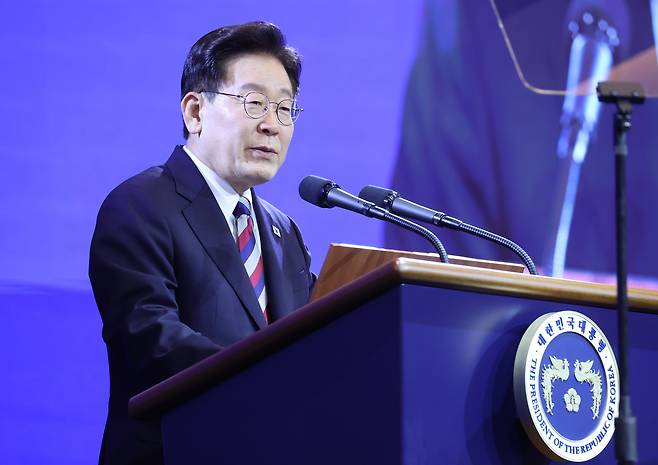
President Lee Jae Myung has pushed for the Opcon transfer before his single five-year term ends in June 2030, and government officials have floated 2028 as an internal target.
Lee reaffirmed that commitment within days of the UFS cut, saying the transfer should proceed "without disruption, according to the government's original plan." He struck a similar note on Wednesday at a Peaceful Unification Advisory Council meeting in Incheon, casting the Opcon transfer as part of South Korea's "responsibility as a direct stakeholder" in regional stability and global peace.
Gen. Xavier Brunson, commander of both USFK and the Combined Forces Command, told the U.S. House Armed Services Committee in April that the military conditions for transfer were likely to be met sometime before the second quarter of fiscal year 2029 — a notably later timeline.
He had struck the same note a day earlier before the Senate Armed Services Committee, saying political convenience should not be allowed to get ahead of the conditions — underscoring that Washington intends to judge the handover by military readiness rather than either government's political calendar.
South Korea's Defense Ministry, addressing the remarks at its regular briefing on April 23, said the transition timing would ultimately be decided by the two countries' defense ministers at the October SCM based on a joint military recommendation, then referred to both presidents.
That October decision is, structurally, hard to avoid.
Once FOC verification is complete, the process moves into its final stage, FMC — which works by setting a target year first and then carrying out verification against it, rather than verifying first and setting a date after.
South Korea's Defense Ministry has separately disputed that Brunson's 2029 timeline represented an agreed bilateral road map, saying no such document had been jointly signed off. The USFK, in turn, told reporters it remained committed to the conditions-based approach.
Chun In-bum, a retired lieutenant general who once commanded South Korea's Special Warfare Command, echoed the same caution from the Korean side.
"Even if the scale of exercises is adjusted due to political circumstances or external factors, the evaluation standards for the three conditions for the Opcon transfer must remain firmly maintained," he said.
If this year's reduced drills left a gap in the evaluation, he added, the answer is to make it up with additional verification periods and training opportunities — not to rush the transfer to fit a timetable.
BY SEO JI-EUN [seo.jieun1@joongang.co.kr]
Copyright © 코리아중앙데일리. 무단전재 및 재배포 금지.
- Lee says Trump’s gestures revive hope for Korean peace regime, vows to help resume talks
- North Korea doubles down on nuclear arsenal, rebukes U.S. denuclearization demand
- The art of the bluff: Trump claims Lee said, 'No thanks.' Seoul says no call.
- Korea-U.S. joint drill to end Friday after Trump orders cutback
- Pyongyang fires missiles as Trump offers talks, Seoul seeks Beijing's help to revive North Korea diplomacy