Bad then, fun now? How 'D-War' and other forgotten films are finding new life on Netflix.

Bad then, entertaining now? No one can predict where public attention will turn — and sometimes, what audiences overlooked years ago suddenly finds its moment. That is what is happening to “D-War,” Shim Hyung-rae’s controversial 2007 sci-fi film, which has surged up Netflix charts 19 years after its release.
“D-War” ranked No. 6 globally in Netflix’s movie chart on Aug. 10, according to FlixPatrol, a website that tracks streaming rankings worldwide. The film entered the top 10 in 20 countries and climbed as high as No. 2 in major European markets, including France, Germany and Italy.
People liked it; critics less so
The film’s commercial success and critical reception upon its 2007 release made for an intriguing contrast.
“D-War” drew around 8.4 million moviegoers in Korea, making it a box-office hit. Yet it was widely criticized for its implausible narrative, awkward computer-generated imagery (CGI), exaggerated acting and crude editing.
Another controversial moment came just before the end credits, when a grand rendition of “Arirang” — one of Korea's best-known traditional folk songs — played as an on-screen message from Shim appeared.
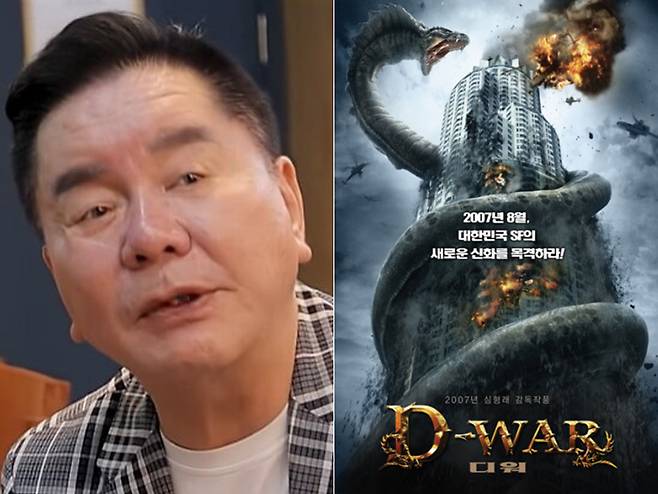
Shim is a first-generation Korean comedian who later became a filmmaker. He debuted in 1982 and gained widespread popularity for his character Young-gu, a bumbling but lovable figure who became one of his signature roles.
A heated debate also erupted online between supporters and critics of the film after cultural critic Chin Jung-kwon and other panelists sharply criticized its quality on MBC’s debate program “100-Minute Debate” (1999-).
Despite the criticism, the film ironically won awards for those very visual effects. “D-War” took home the visual effects award at the Korean Film Awards in 2007 and the visual technology award at the Daejong Film Awards in 2008.
Given the state of computer graphics in the Korean film industry in the mid-2000s, perhaps the festival juries were applauding the film’s experimental spirit in pushing the limits of Korea’s CGI industry rather than the polish of the effects themselves.
Failed movies of the past see newfound popularity, thanks to streaming
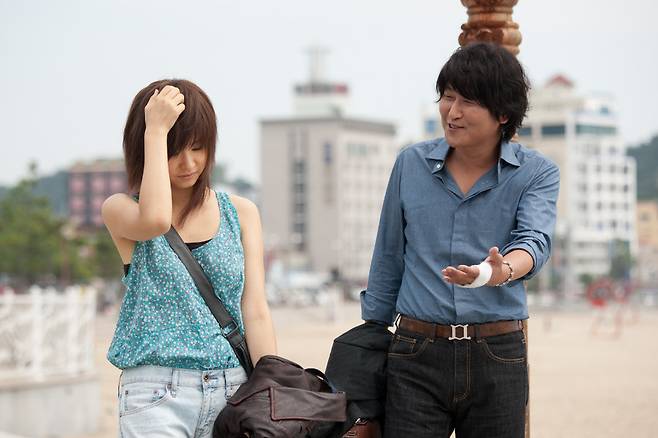
Like “D-War,” several older films have enjoyed similar revivals on Netflix over the past year or two. “Hindsight” (2011), starring Song Kang-ho and Shin Sae-kyeong, ranked No. 3 on Netflix’s Top 10 movie chart in Korea on July 30.
“Hindsight” was directed by Lee Hyeon-seung, known for the striking visuals in films such as “Il Mare” (2000) and “The Blue in You” (1992). The 2011 film featured Song alongside a lineup of then-rising young performers, including Shin, Chun Jung-myoung and Kim Min-jun.
Yet it drew only about 770,000 moviegoers nationwide during its theatrical run and failed at the box office. Critics were not particularly generous either.
While Lee’s distinctive visual style and mise-en-scène, particularly his sophisticated use of blue and green hues, received praise, the film was generally criticized for an unconvincing narrative and underwhelming noir action. Now, however, reactions such as “It’s great to see Shin Sae-kyeong in her prime with short hair” and “Song Kang-ho doing romance?” have helped fuel its resurgence.

Why do these unexpected revivals happen?
One factor is Netflix’s recommendation algorithm, which suggests content based on users’ viewing histories and preferences. When an older film is newly added to the service, it can appear on the main-page banner or in recommendation sections. To younger people who missed the film when it first came out or to viewers overseas, an old movie can effectively feel like a new release. They may simply think, “Oh, they have this too. Why not give it a try?”
Another reason is that quality and entertainment value are not necessarily the same thing. For streaming viewers casually looking for something to watch at home, artistic quality may not be a major consideration. Unlike a trip to the theater that requires spending money and setting aside time, streaming content can be chosen casually with the press of a button. In that setting, lighter fare can actually have an advantage. Older action, monster and comedy films with straightforward, sensational stories can find new audiences as easy-to-watch popcorn movies rather than demanding works with complex, weighty narratives.
For viewers unfamiliar with a film, even its reputation as a “bad movie” can become a powerful source of curiosity. If they watch it and come away thinking, “It’s not as bad as I expected,” whether because of personal taste or changing standards over time, those reactions can spread on social media, leading to reassessment and further viewing.
Viewer curiosity can also be sparked by issues that gain attention in the media and on social media.

Not just movies
Comebacks triggered by specific controversies are also common in K-pop. Recently, girl group Rescene’s 2024 song “Love Attack” began climbing music charts nearly two years after its release.
The resurgence followed a political dispute involving member Woni.
Woni became embroiled in controversy over allegations that she had used language associated with Ilbe, a far-right online community, on her personal YouTube channel. At the center of the controversy was her use of “-no,” a sentence ending commonly used in the Gyeongsang dialect spoken in southeastern Korea, where sentences can end in “-no” rather than the “-ni” or “-da” endings used in standard Korean. Woni’s hometown is Geoje, South Gyeongsang.
The ending has also taken on political connotations because some Ilbe users append “-no” to sentences, even when it is grammatically unnatural, to mock late President Roh Moo-hyun. Although his surname is spelled “Roh” in English, it is pronounced “no” in Korean. The late president was also a native of the Gyeongsang region and often spoke in the local dialect, even during public events.
Some interpreted Woni’s use of “-no” as echoing Ilbe slang, while others argued that she was simply speaking in the local dialect of her hometown.
BY SEO JEONG-MIN [kim.jiye@joongang.co.kr]
Copyright © 코리아중앙데일리. 무단전재 및 재배포 금지.