[Exclusive] Google builds Korea team for full-functioning Maps service
전체 맥락을 이해하기 위해서는 본문 보기를 권장합니다.
"The map data Google currently receives through local partners is insufficient for a full-functioning service," Choi said. "It would need to source better base-map data and build a system to manage, maintain and update that data within Korean law."
"Google would also need additional points-of-interest and address data, as well as traffic, parking and public transit information," she said. "That would mean negotiating with and purchasing data from multiple local providers."
이 글자크기로 변경됩니다.
(예시) 가장 빠른 뉴스가 있고 다양한 정보, 쌍방향 소통이 숨쉬는 다음뉴스를 만나보세요. 다음뉴스는 국내외 주요이슈와 실시간 속보, 문화생활 및 다양한 분야의 뉴스를 입체적으로 전달하고 있습니다.

Google is stepping up preparations to expand Google Maps in South Korea by recruiting a senior partnerships manager, as the company says it is “officially launching full-functioning Google Maps capabilities” in the country.
The Seoul-based Strategic Partnerships Development Manager will join Google’s Global Product Partnerships team and work with private companies, public entities and technology partners. The job posting says Google is “building a team” around what it describes as a “monumental, historical turning point” in Korea.
Google confirmed that its plan for a full-functioning Maps service in Korea includes turn-by-turn directions, giving a clearer indication of what the expanded service would entail.
“The plan is to bring full-functioning Google Maps capabilities to Korea, which includes turn-by-turn directions, or navigation,” Google said in a statement provided to The Korea Herald through Google Korea.
Google Maps in Korea currently offers extensive place listings, reviews and public transit directions, but does not provide turn-by-turn driving or walking navigation. Walking segments within transit routes are shown only as dotted lines rather than guided directions.
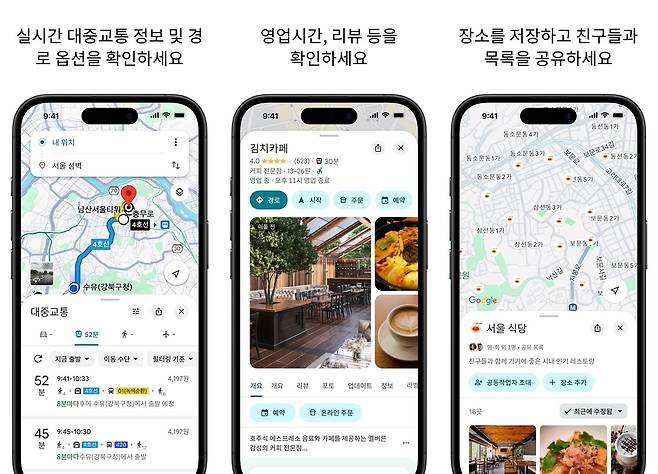
A broader rollout would put Google into more direct competition with entrenched local mapping platforms. In April, Naver Map had 29.25 million monthly active users, compared with 12.77 million for Kakao Map and 9.08 million for Google Maps, according to mobile-app analytics firm Mobile Index.
The company did not provide a launch date or specify which other features would be included.
The hiring follows South Korea’s Feb. 27 decision to conditionally approve Google’s export of 1:5,000-scale high-precision map data, reversing earlier rejections in 2007 and 2016 over national security concerns.
At the time of the approval, Google Vice President Cris Turner said the company looked forward to working with Korean authorities to bring “a fully functioning Google Maps to Korea,” but did not spell out which features that would include.
The new partnerships role will negotiate “first-of-a-kind” agreements and go-to-market opportunities, build relationships with Korean companies and public entities, and feed local market insights into Google’s Geo product strategy.
Choi Bo-kyung, founder and CEO of geospatial firm A Piece of Map and a former TomTom map-data sourcing executive, said the new role appears to be tied to building the local partner ecosystem needed for a fully functioning Maps service.
“The map data Google currently receives through local partners is insufficient for a full-functioning service,” Choi said. “It would need to source better base-map data and build a system to manage, maintain and update that data within Korean law.”
“Google would also need additional points-of-interest and address data, as well as traffic, parking and public transit information,” she said. “That would mean negotiating with and purchasing data from multiple local providers.”
Copyright © 코리아헤럴드. 무단전재 및 재배포 금지.