Independence activist Ahn Jung-geun's final prison calligraphy unveiled
전체 맥락을 이해하기 위해서는 본문 보기를 권장합니다.
The anonymous individual wrote on the work's reverse side that one of the reasons for keeping the work was "out of compassion for Ahn's state of mind."
The ink hand print stamped on the lower-left corner also bears a distinctive trait of Ahn's left hand. Ahn had severed his ring finger on that hand along with 11 comrades of the Korea independence army in 1909 as a pledge for their resolve. The print vividly shows a much shorter fourth finger. Next to it is Ahn's handwriting, noting the calligraphy "is written by Ahn Jung-geun in March, 1910 in Lushun prison."
이 글자크기로 변경됩니다.
(예시) 가장 빠른 뉴스가 있고 다양한 정보, 쌍방향 소통이 숨쉬는 다음뉴스를 만나보세요. 다음뉴스는 국내외 주요이슈와 실시간 속보, 문화생활 및 다양한 분야의 뉴스를 입체적으로 전달하고 있습니다.
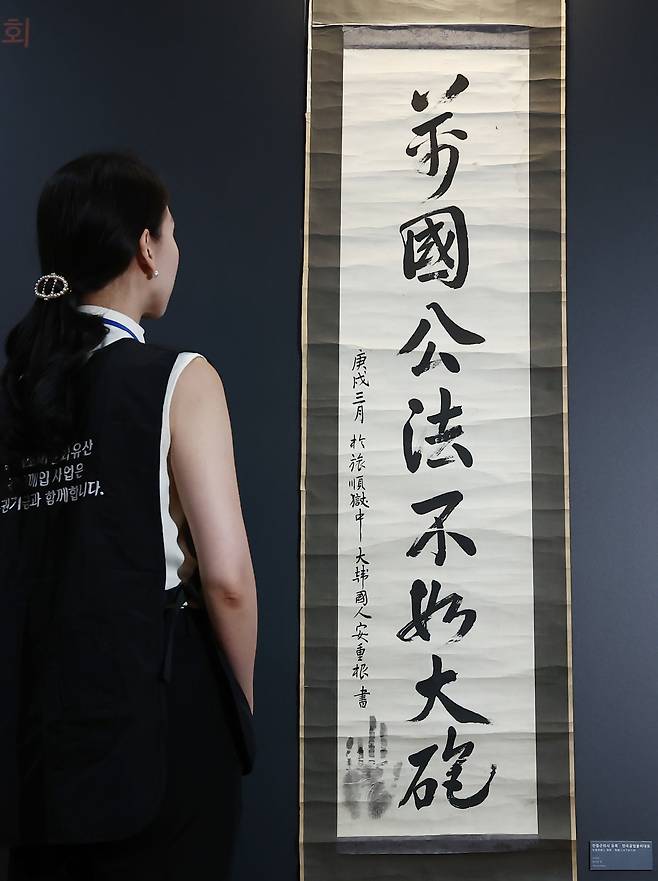
Calligraphy written by Korean independence activist Ahn Jung-geun (1879-1910) just days before his execution was disclosed to the media Thursday for the first time, following its return from Japan last year.
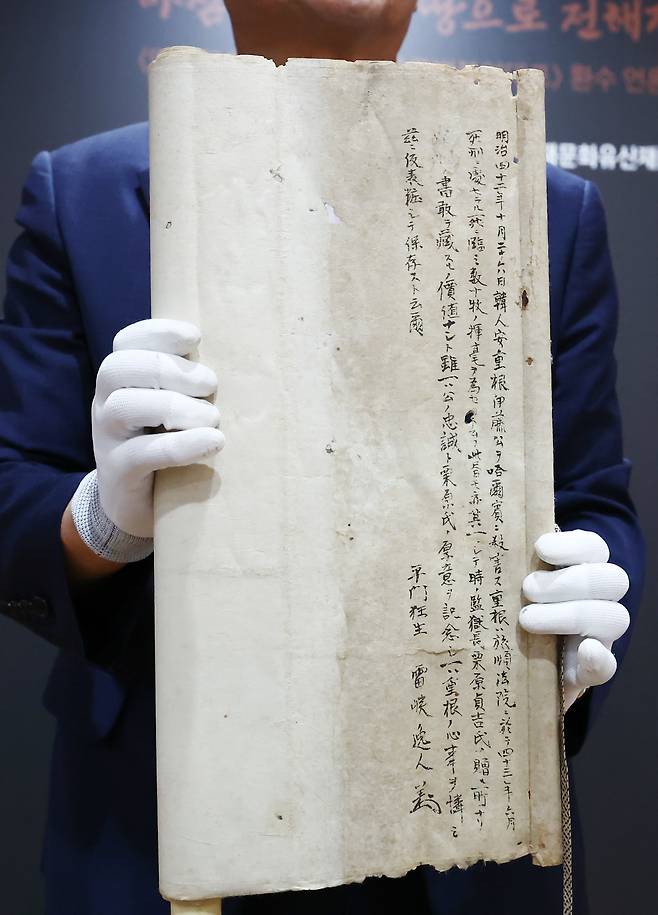
Given the rare inscription on the back detailing the work's provenance and route of transmission, as well as its style and structure, experts consider this calligraphy to be among the finest examples of Ahn's works. A total of 31 calligraphic works of Ahn have been designated as national treasures of Korea.
"Ahn is known to have written numerous calligraphic works in prison, but this piece holds particular value for directly reflecting his insight into the cold realities of international relations," said Park Jeong-hye, secretary general of the Overseas Korean Cultural Heritage Foundation, at a press conference held Thursday at Jungmyeong Hall in Deoksu Palace.
The Overseas Korean Cultural Heritage Foundation is a nonprofit organization under the Korea Heritage Service tasked with managing Korean cultural heritage located abroad.
"I believe the work embodies Ahn's characteristically powerful brushstrokes, which remained unwavering even in the face of death," Park added.
Ahn was known to be a devoted advocate of international law as laid out in "Elements of International Law," a treatise published by American jurist Henry Wheaton in 1836 that was later widely circulated in China, Japan, and Korea.
Ahn died by hanging in Lushun Prison on March 29, 1910 at the age of 30.
Ahn was no expert in calligraphy so his works had the tendency of tilting in an upright direction with strong brush strokes.
"International Law is No Match for Cannons," however, balances that tendency, according to the experts.
"Out of all calligraphy work of Ahn found, this work, in terms of style and everything, is extraordinary and near perfection," said literature researcher Park Cheol-sang.
The inscription recorded on the reverse side — rare for Ahn's works — adds to the historical value. Records state that the original owner of the calligraphy was Kurihara Sadakichi and the work was later passed on to an anonymous individual from a family with the surname Pyeong.
Kurihara was a Japanese warden of the Lushun Prison who is said to have shown respect toward Ahn. He requested for the postponement of Ahn's execution and delivered a white hanbok (Korean traditional clothing) to him before the execution, according to historical records.
The anonymous individual wrote on the work's reverse side that one of the reasons for keeping the work was "out of compassion for Ahn's state of mind."
"The fact that this person felt pity for Ahn indicates that maybe when Kurihara passed this on to this person, he may have explained Ahn's story in detail," said Jang Ji-hoon, a professor at Kyonggi University's Department of Korean Painting and Calligraphy.
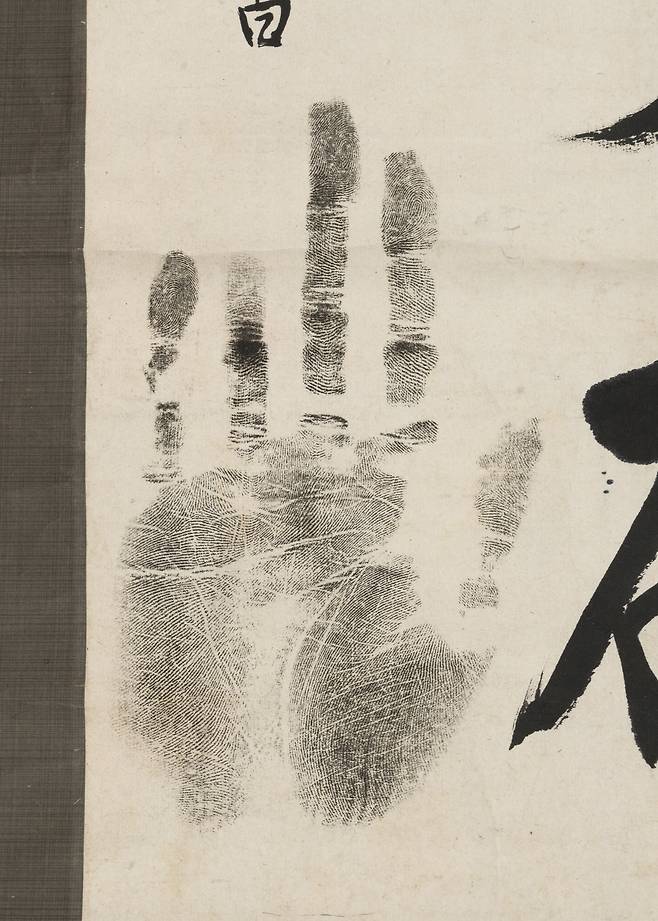
The ink hand print stamped on the lower-left corner also bears a distinctive trait of Ahn's left hand. Ahn had severed his ring finger on that hand along with 11 comrades of the Korea independence army in 1909 as a pledge for their resolve. The print vividly shows a much shorter fourth finger. Next to it is Ahn's handwriting, noting the calligraphy "is written by Ahn Jung-geun in March, 1910 in Lushun prison."
The calligraphy was unveiled to the media ahead of Korea's Liberation Day which falls on Saturday.
Jungmyeong Hall, where the unveiling took place, is the same site where Korea and Japan signed the Eulsa Treaty in 1905 with Ito in attendance — a coerced agreement that stripped Korea of its diplomatic sovereignty.
The Overseas Korean Cultural Heritage Foundation pledged Thursday to continue discovering and retrieving Korean cultural heritage located overseas and to share its value with the public in Korea.
BY JIN EUN-SOO [jin.eunsoo@joongang.co.kr]
Copyright © 코리아중앙데일리. 무단전재 및 재배포 금지.