K-Heritage House travels through time, with technology and analog mastery
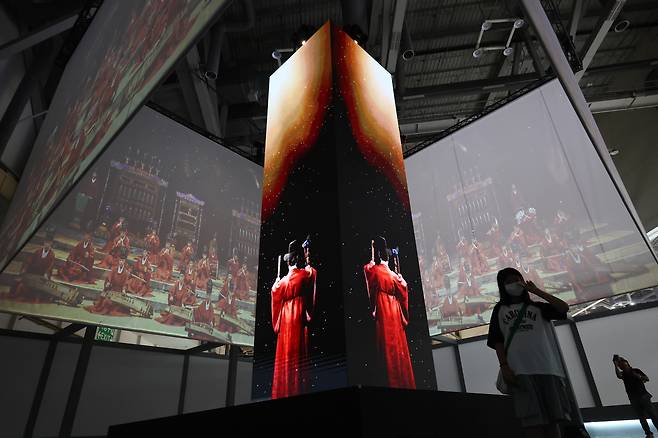
BUSAN — Inside a darkened cube, a panoramic screen immerses visitors in a digital recreation of jerye, the grand royal ancestral rites performed during the Joseon Dynasty (1392–1910).
The digital exhibition draws on the uigwe, a collection of detailed royal protocols from the dynasty inscribed on the Unesco Memory of the World Register.
At a neighboring booth, a towering LED monolith re-enacts the volcanic eruption that gave birth to Jeju Island and its lava tubes, one of Korea's two Unesco-listed natural World Heritage sites.
"The technological level at this booth is unlike none other," says John Knightly of Ireland's state-run National Monument Service. "This is my fifth time participating in the World Heritage Committee, and there have been cases of putting technology upfront, but by far, this was the most fascinating, in terms of size and technology level."
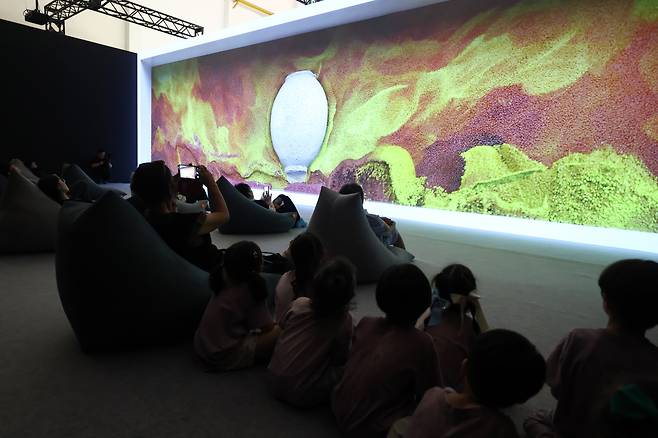
"The K-Heritage House is more about just introducing heritage, but also about introducing Korea's technological prowess," said Korea Heritage Service Administrator Huh Min in an interview with the Korea JoongAng Daily done last month. "Digital exhibitions on Korea's tangible and intangible heritage will help visitors understand Korean heritage better."
The first booth visitors encounter, an exhibition titled “K-Heritage Pavilion: A Story in Every Step,” is a feast for both the senses and the mind. Built around the concept of Korea as a book, it invites visitors to various corners of the country to learn about its history, landscape and culture.
The journey begins with a media art featuring the Petroglyphs along the Bangucheon Stream in Ulsan, including vivid images of whales carved into stratified rock cliffs. The site was inscribed on Unesco’s World Heritage list last year.
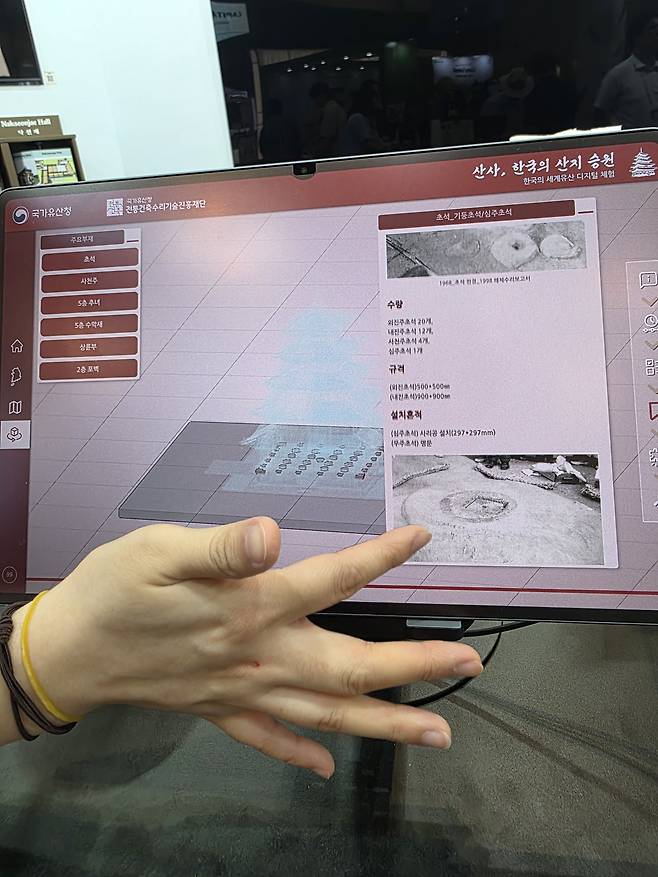
A 3-D modeling exhibit about Korea's traditional architecture such as Geunjeongjeon at Gyeongbok Palace in downtown Seoul or Daewoongjeon at Bongjeong Temple in Andong allows visitors to trace not only the structure but the historical records of its restoration as well.
“It uses a technology called Heritage Building Information Modeling, or HBIM, which helps us better understand the architecture of our heritage while also managing related data,” a staff member at the booth said. “That information can then be used for preservation as well as restoration if a structure is damaged."
Technology is not all there is at the K-Heritage House. Some corners encourage visitors to slow down.
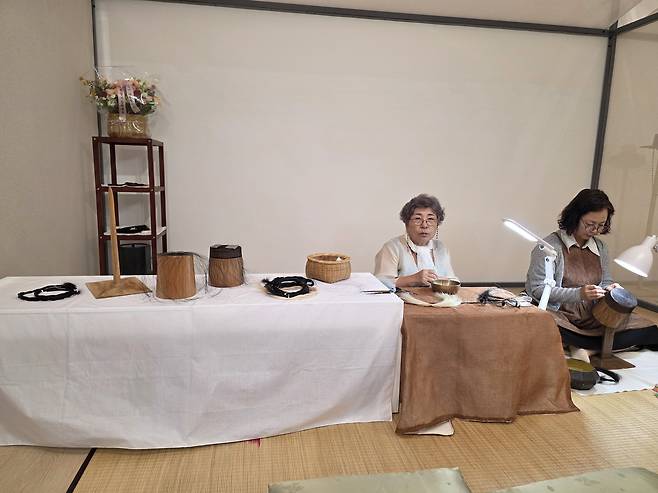
At the "Living Heritage" section, state-certified holders of National Intangible Cultural Heritage demonstrate their craftsmanship in person. Gang Sun-ja, who is a master of gannil, the process of making gat (Korea's traditional hat for men), was assembling gat with horse tail hair, one by one.
It takes at least three months of work to make a single gat, she says.
"It is a very arduous work," she said.
Masters of 11 intangible cultural heritage, including traditional Korean embroidery and needlework, have participated to demonstrate their craft.
Among the most popular attractionns were the K-Heritage Store, which sold heritage-themed merchandise, and a booth operated by the Juspeace Foundation, a nonprofit organization established by K-pop star G-Dragon.
One side of the Juspeace booth featured a poster of Korea's iconic white porcelain moon jar bearing G-Dragon's signature in the Busan dialect. Fans covered the poster with handwritten notes expressing their support for both Korean heritage and the singer.
The K-Heritage House at the Bexco convention hall in Busan is open from 10 a.m. to 6 p.m., with final admission at 5 p.m. The exhibition runs through July 29.
Copyright © 코리아중앙데일리. 무단전재 및 재배포 금지.