At Seoul’s Space K, KAWS brings new tensions between friendship, conflict and fame
전체 맥락을 이해하기 위해서는 본문 보기를 권장합니다.
"When I came up with the title 'Friends and Neighbors,' I was thinking about the small and the large — these relationships within yourself, your block and your community, and then the more global relationships happening everywhere," KAWS said. "It was something I felt could scale very easily and be looked at from both intimate and expansive perspectives."
"I don't think of it so much as a shift in their behavior," the artist said. "I feel like these behaviors have always existed. I also have two children who are nine and 12. Not that they fight like this, but I'm very aware of tensions, and I wanted to create works that embody that."
이 글자크기로 변경됩니다.
(예시) 가장 빠른 뉴스가 있고 다양한 정보, 쌍방향 소통이 숨쉬는 다음뉴스를 만나보세요. 다음뉴스는 국내외 주요이슈와 실시간 속보, 문화생활 및 다양한 분야의 뉴스를 입체적으로 전달하고 있습니다.
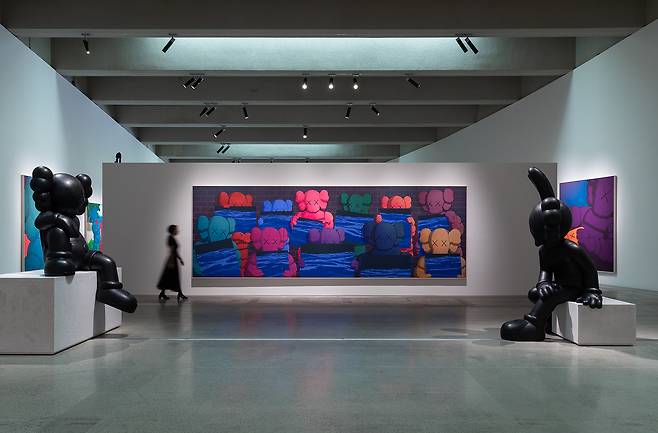
There are few artists whose work you can own for the price of a T-shirt and also meet on a museum’s pedestal, and fewer still who reached the latter by way of the former.
American artist KAWS, whose real name is Brian Donnelly — one of the most recognized contemporary artists from the Brooklyn scene — has spent 30 years moving between graffiti, vinyl toys, fashion and the gallery as though the walls between them were a mere facade. He remembers being told otherwise, though.
The rules lost their battle with KAWS. When he opened his OriginalFake shop in Tokyo in 2006, KAWS made a quiet peace with the idea that the galleries might stop calling, and decided that turning down opportunities to honor somebody else’s territory was, in his own word, self-defeating.
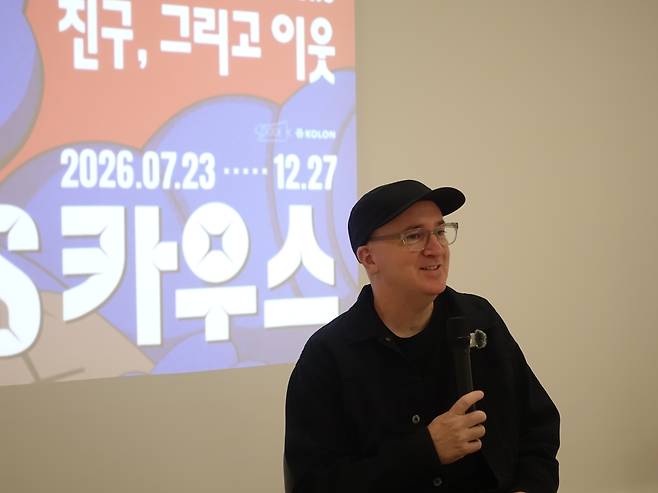
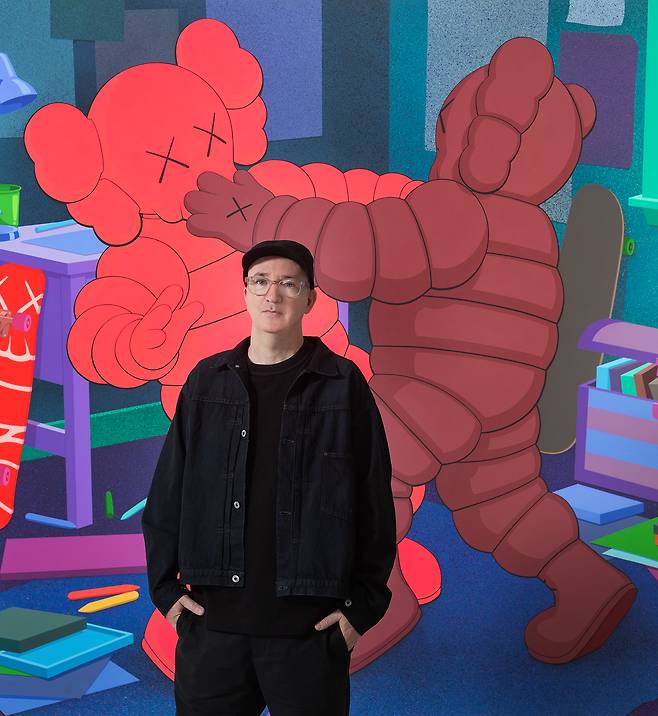
Twenty years later the territory has rearranged itself around him. KAWS — born in Jersey City in 1974, now working in Brooklyn — arrives at Space K Seoul with his new solo exhibition “Friends and Neighbors,” opening on Thursday. The exhibition features 20 new paintings and sculptures for the Korean audience. The imagery needs no introduction — the eyes on faces with huge “X”s over them, the Michelin-man bodies, the toys and the tees are already familiar.
“When I came up with the title ‘Friends and Neighbors,’ I was thinking about the small and the large — these relationships within yourself, your block and your community, and then the more global relationships happening everywhere,” KAWS said. “It was something I felt could scale very easily and be looked at from both intimate and expansive perspectives.”
“You can choose your friends, but when a new family moves in upstairs and starts working out at night, there’s nothing you can do about it,” added Lee Jung-uk, the show’s chief curator.
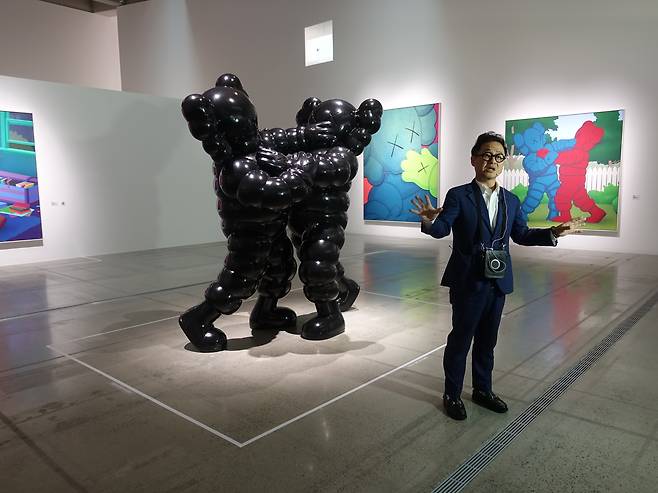
And in these rooms, the characters have started fighting. Where earlier KAWS figures stood alone like icons, or leaned on one another for comfort, the ones here grab, tangle and shove. He resists calling it a change.
“I don’t think of it so much as a shift in their behavior,” the artist said. “I feel like these behaviors have always existed. I also have two children who are nine and 12. Not that they fight like this, but I’m very aware of tensions, and I wanted to create works that embody that.”
The centerpiece is “Neck and Neck” (2026): two CHUM figures — CHUM being one of KAWS's characters, whose name means friend, colleague, the person nearest you — locked at the throat in a pose caught between wrestling and an embrace. The title comes from a phrase in horse racing, referring to a race so close you can’t call the winner.
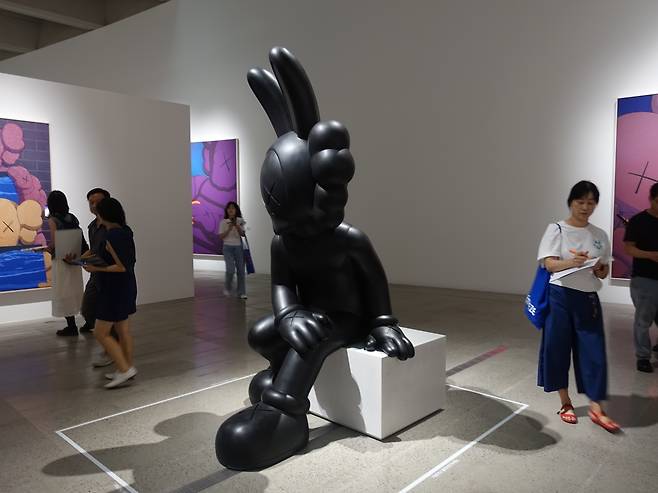
Then there is “Therapy” (2025), in which 11 CHUM figures hold a canvas that, seen together, resolves into a single sea.
“For ‘Therapy,’ I had seen an image online of a group of women attending an art class together,” KAWS explained. “When I was thinking about therapy, I asked myself what puts me at ease. It was simply staring into water — looking toward a horizon and thinking about the endless repetition of the water.”
“It’s something I did in the 90s on these small paintings,” he said. “I would take the pressure out of spray cans — if you hold a can upside down, it lets all the pressure out, and when you spray it upright again, the paint just splatters. Recently, maybe it has to do with turning 50, I find myself caring less and less about following those guidelines. It is something that interests me, so I’ve continued doing it, but if I stopped tomorrow, I wouldn’t lose sleep over it.”
For all that shrugging off guidelines, the museums keep calling. Seoul is only the newest stop: In five years, KAWS has filled the Brooklyn Museum, London’s Serpentine, the Art Gallery of Ontario, the Andy Warhol Museum and Sfmoma. The institutions that once weren’t sure what to do with the toys now build rooms around them. What KAWS wants from Seoul is older-fashioned.
“I’m just happy to bring my work to Seoul and have people experience the paintings and sculptures in person, as opposed to digitally on a screen,” he said. “Standing in front of a painting is a much different experience than viewing it on a small device.”
“Friends and Neighbors” runs through Dec. 27 at Space K Seoul. Admission for adults is 8,000 won ($5.40).
BY LIM JEONG-WON [lim.jeongwon@joongang.co.kr]
Copyright © 코리아중앙데일리. 무단전재 및 재배포 금지.