Unesco-listed Ulsan petroglyphs captivate heritage experts, but preservation challenge remains
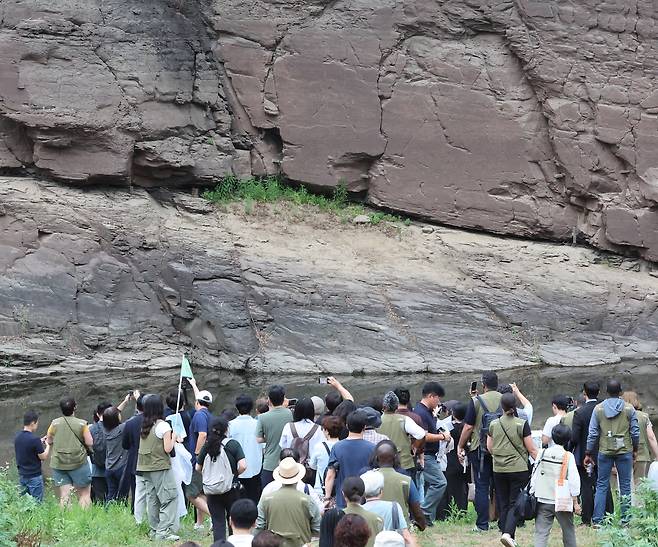
ULSAN — The towering, stratified cliff along the Bangu Stream and the ancient petroglyphs carved into its rock faces fascinated some 100 heritage experts from around the world who gathered at the site on Friday.
"It's a fantastic site because of the landscape; where it's situated is truly fantastic," said Cyril Dworsky, an archaeologist, participating in the forum representing Austria.
XR (extended reality) devices installed across from the cliff allowed visitors to examine even the faintest carvings in detail while comparing the digitally enlarged image with what was visible to the naked eye.
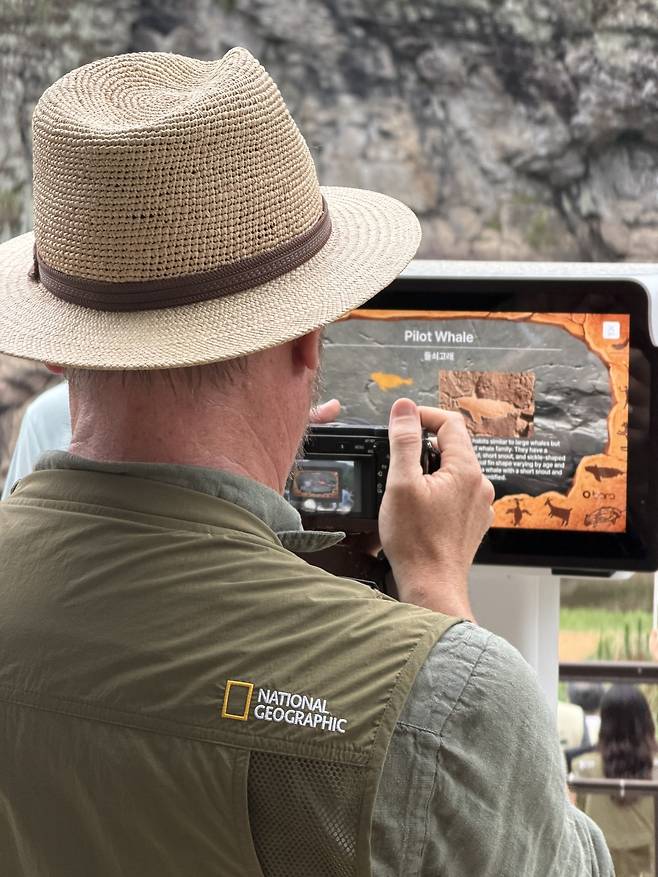
The visit was part of Unesco's Site Manager Forum, an official event held ahead of the opening of the World Heritage Committee session in Busan two days later on Sunday. The forum brought together managers and conservation experts responsible for World Heritage sites worldwide and took them to some of Korea's key heritage destinations, including Yangdong Folk Village and Oksan Seowon in Gyeongju.
"When you get close to the cliff, it feels as if you have entered another world," explained Park Mi-hyun, a researcher associated with the Ulsan Metropolitan City.
"Ancient people from some 7,000 years ago used this cliff as if it were one gigantic canvas."
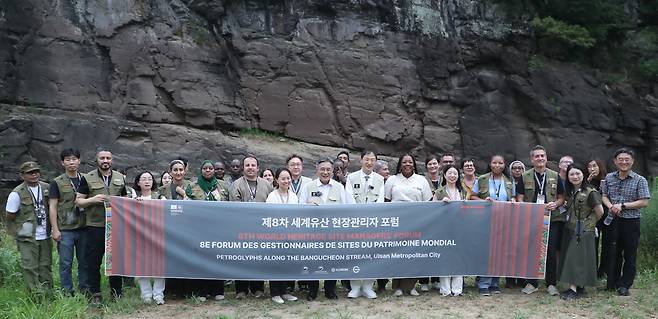
The Daegok-ri panel, which the site managers visited on Friday, features more than 300 engravings, including highly detailed depictions of various whale species, as well as a wide variety of marine and terrestrial animals.
For the Korea Heritage Service, the forum host, it wasn’t easy to choose the petroglyphs along the Bangu Stream as a forum destinations during the height of the monsoon season.
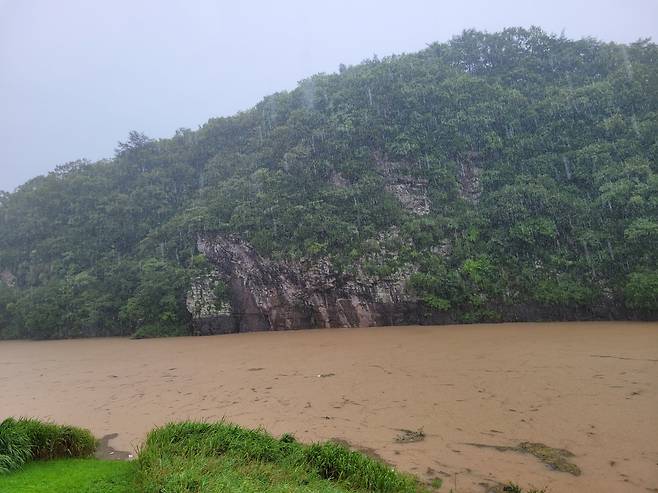
Flooding repeatedly submerges the petroglyphs, threatening their preservation. A solution has yet to be found.
The source of the problem lies at Sayeon Dam, about four kilometers (2.5 miles) downstream, which keeps the stream's water level relatively high.
Built in 1965 — before the petroglyphs were discovered — the dam supplies more than 40 percent of Ulsan's drinking water and operates under an older natural overflow system without spillway gates. This makes lowering the reservoir's water level impossible until it reaches the overflow threshold of 60 meters.
The petroglyphs, discovered in 1971, begin to be submerged when the water level reaches 53 meters (174 feet) and are completely submerged at 57 meters.
Last year, the heritage site was submerged for 37 days.
Over the past 25 years, various solutions have been proposed, including the construction of a movable dam and the diversion of the waterway. However, none of these proposals have materialized, as the interests of the Korea Heritage Service, Ulsan City, local residents and civic groups clash.
"We could've just not disclosed this site to global site managers, but I have added this destination to the tour's schedule because I believe a forum like this could help in finding a solution," Korea Heritage Service Administrator Huh Min said on Friday.
The Korean government is pushing to build three floodgates at the Sayeon Dam, with a target completion year of 2030 and a budget of 80 billion won ($53.8 million).
However, Huh said that due to climate change, floodgates won’t be enough and urged further discussion and collaboration among stakeholders.
"Preserving heritage is essential, but it must also be balanced with protecting the lives and livelihoods of the people who live around it," Ulsan Mayor Kim Sang-wook said. "I believe the [Bangu Stream] petroglyphs can become a model for how to achieve that balance."
Researcher Dworsky agreed that such global forums help find keys to deadlocked issues.
"A forum like this definitely helps because we have so many different sites with so many different challenges, but then with similar issues," he said. "So it's highly useful for us to have this kind of platform to exchange opinions with each other and get a bigger picture."
The 8th World Heritage Site Managers' Forum runs through Friday.
The 48th session of the World Heritage Committee kicked off in the coastal city of Busan on Sunday. The forum, which Korea is hosting for the first time since joining the World Heritage Convention in 1988, will examine 33 nomination dossiers, 30 of which are new and three extended or modified. The forum runs until July 29.
Korea's inscription of additional tidal mudflats to Unesco's World Heritage list will be determined on Saturday.
BY JIN EUN-SOO [jin.eunsoo@joongang.co.kr]
Copyright © 코리아중앙데일리. 무단전재 및 재배포 금지.