Foreign graduates in Korea see bigger paychecks
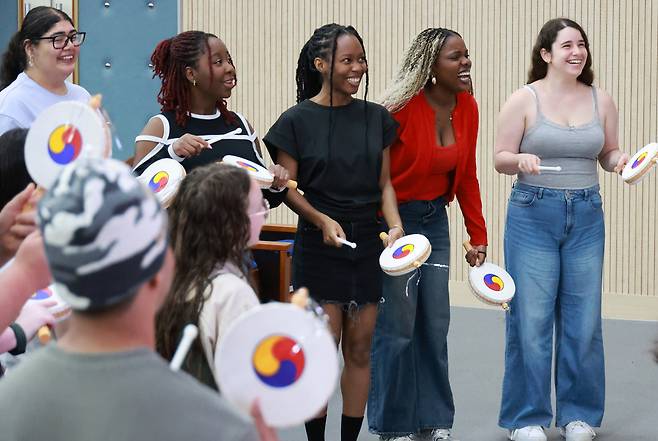
More international students in Korea are looking to stay after graduation, as foreign graduates of Korean colleges and universities see improved employment outcomes, a recent study showed.
The trend comes as more foreign graduates are earning at least 3 million won ($1,997) a month, while a growing share of students still in school say they hope to remain in Korea to work or continue their studies.
The study, conducted by the Korean Educational Development Institute, analyzed education and immigration data from government agencies, as well as interviews and statistics from colleges and universities.
It compared 2023 figures with data from previous years, excluding cases in which the sample size was too small to be statistically meaningful.
Among foreign graduates of two- or three-year colleges, 41.8 percent earned at least 3 million won a month in 2023, up from 15.4 percent in 2021.
For bachelor’s degree holders, the figure rose from 16.1 percent in 2017 to 30.8 percent in 2023.
Among those who earned master’s degrees from Korean universities, 43.8 percent made at least 3 million won a month in 2023, compared with 23.3 percent in 2017 and 34.6 percent in 2019.
The share was highest among doctoral degree holders. In 2023, 77.9 percent of foreign graduates with Ph.D.s earned at least 3 million won a month, up from 62.5 percent in 2019.
The study also looked at the future plans of international students still enrolled in Korean higher education programs.
In 2023, 63 percent said they wanted to stay in Korea after graduation, up from 41.2 percent in 2017 and 54.7 percent in 2020. Of those who wanted to stay, 35.4 percent said they hoped to find a job in Korea, while 27.4 percent wanted to continue studying here.
Plans varied widely by nationality. Among Vietnamese, Mongolian and Uzbek students, 80.3 percent, 74.7 percent and 77.8 percent, respectively, said they wanted to stay in Korea.
By contrast, only 38.1 percent of Chinese students said they planned to stay in Korea. Some 53.5 percent said they planned to return to China, while 8.4 percent said they intended to move to another country.
The desire to stay in Korea rose sharply among Vietnamese and Mongolian students compared with 2017, when the figures stood at 64.8 percent and 48.7 percent, respectively.
Researchers said foreign graduates of Korean higher education programs were generally satisfied with their jobs and showed low intent to change jobs. But they said improvements in welfare, wage levels and promotion opportunities were needed to help more international graduates remain in Korea over the long term.
Copyright © 코리아헤럴드. 무단전재 및 재배포 금지.