Interview with Chris Miller: Moving Past HBM, to the Next AI Memory Frontier
이 글자크기로 변경됩니다.
(예시) 가장 빠른 뉴스가 있고 다양한 정보, 쌍방향 소통이 숨쉬는 다음뉴스를 만나보세요. 다음뉴스는 국내외 주요이슈와 실시간 속보, 문화생활 및 다양한 분야의 뉴스를 입체적으로 전달하고 있습니다.
Chris Miller, the author of ‘Chip War: The Fight for the World’s Most Critical Technology’, in an interview with Kyunghyang Daily News, emphasized that it is crucial for Samsung Electronics and SK Hynix to innvoate beyond high-banndwidth memory(HBM) by leading memory architecture optimized for AI inference, in order to sustain its competitive edge over Chinese companies. He welcomed two South Korean memory giants’ planned investment of approximately KRW 800 trillion (about US$580 billion) in a semiconductor cluster, as it would “serve the economic and strategic interests of the non-Chinese world.” He expressed caution in Apple’s reported maneuvering of purchasing chips from Chinese memory makers, as it may lead eventually to the increase in market share globally.
By Yoojin Kim, Industry News Reporter
Editor’s note: This is a full transcript of the interview published exclusively by the Kyunghyang Daily News. Excerpting the entire or any part of the text without consulting the interviewee or the editor is strictly prohibited.
(Click here for Korean version)
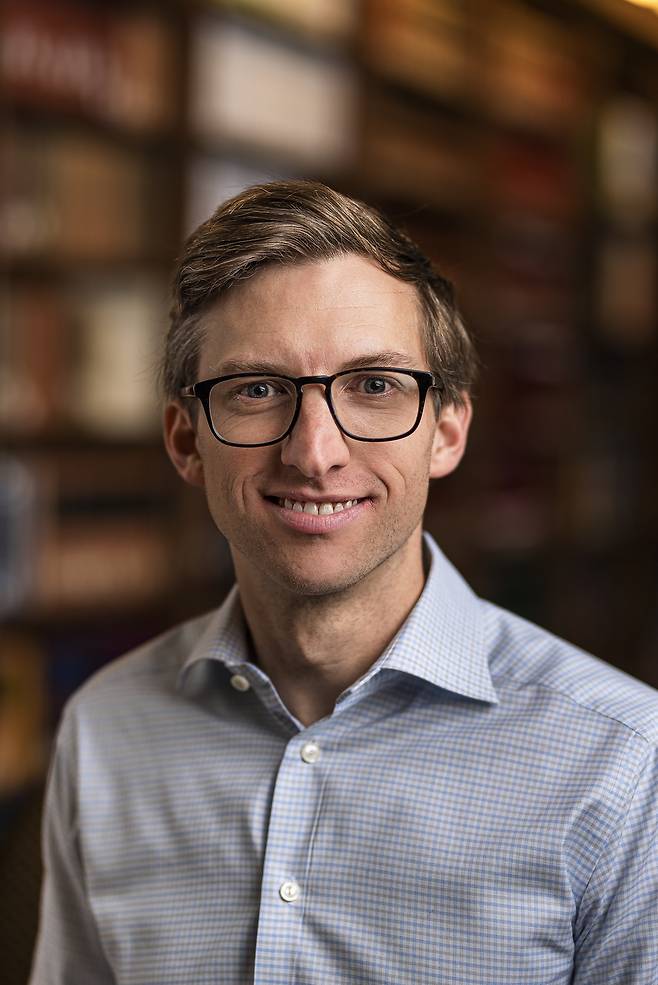
Q. South Korean government recently announced to build a new semiconductor cluster project in the country’s southwest, with Samsung Electronics and SK Hynix investing over $600 billion, aiming to double memory chips production capacity in five years. How do you evaluate the strategic significance of South Korea’s announcement, especially as it relates to the ongoing global competition?
A. The elevated prices of memory chips illustrate the strategic importance of high-end memory production. Korean firms like Samsung and SK Hynix are among the world’s leaders. AI data center build out globally will keep demand for these chips elevated at a structurally higher level than previously. So it’s critical that firms respond by building out new capacity, and it‘s especially important in light of the fact that China itself is trying to play a bigger role in the memory industry. It’s in the strategic interests as well as the economic interests of both South Korea, United States and the entire non-Chinese world that we have a continued dominant position of Western players in the memory space.
Q. What do you foresee as the main bottlenecks for this megacluster project?
A. I think the South Korean chip industry, like many other countries, regularly reports that talent is the primary blocker in the ability to scale projects rapidly. South Korea needs to continue deepening its talent pool to ensure it remains as competitive as possible in the semiconductor industry.
Q. Given President Trump’s emphasis on domestic manufacturing and the threat of tariffs on overseas chips, how likely is the U.S. administation to pressure South Korean companies to increase investment in the U.S. ?
A. It’s understandable that not just the U.S. government but U.S. firms want some diversification of the production of these absolutely critical semiconductors. But I also think that the administration has shown a fair amount of flexibility over the last two years in terms of not wanting to jeopardize the AI data center build up by imposing higher costs. It’ll continue to be reasonable, I think, with regard to to not imposing excessively high costs on U.S. technology firms and in recognizing the importance of a global value chain for semiconductor manufacturing.
Although Trump’s tactics were unique, his focus on having a domestic semiconductor supply chain that is healthy and growing is not unique to him, and prior administrations had a similar focus. Given the central role of AI in the U.S. economy, we should expect that to continue for some time to come.
Q. While global memory chip giants like Micron, Samsung and SK Hynix enjoy massive boom fueled by explosive demand for AI compute and infrastructure, concerns over AI bubble also remain. In your view, how does this current memory shortage differ from previous instances?
A. Yes, to a degree. The reason for difference is that we’ve now added an entire new use case for memory chips we didn’t previously have. In the past, there was memory chips for phones, memory chips for computers, memory chips for traditional cloud computing. Now there’s a major new growth driver, which is AI, that is leading to a step change higher in memory chip demand.
That doesn’t mean that there won’t be cycle. We should expect that growth, which has grown dramatically over the past couple of years, will at some point slow, but the cycles up and down will take place in the context of structurally higher need for memory chips because of AI.
Q. Recent reports suggest that Apple is maneuvering to purchase Chinese memory chips for devices sold within China, while there is a substantial political opposition against Apple’s move in Washington. What are the prospects of Apple’s such move being materialized, and what kind of ripple effects would it have on the global supply chain?
A. U.S. government and firms should be careful about buying chips from CXMT because of the risk that CXMT challenges the memory businesses of companies like SK Hynix, Samsung, and Micron, especially in more commoditized consumer facing sectors. Even if CXMT struggles with the high-end chips like HBM and the most advanced DRAM, if it’s able to threaten the profitability of Western firms, this will make it less able, less possible for them to invest.
Right now it seems unrealistic to talk about threatening profitability, when memory firms are extraordinarily profitable with elevated memory prices. But we must remember that there will be cycles in the memory industry and that in the future, whenever the next downturn comes, CXMT might have a privileged position because the Chinese state will backstop its ability to invest through a downturn; whereas companies that have shareholders and need to consider profitability might not have that same flexibility to invest. So the U.S. government and U.S. companies should be hesitant about allowing any expansion of CXMT market share, even with the memory memory crunch.
Q. If a severe memory crunch threatens U.S. competitiveness, is it conceivable that President Trump may intervene to pressure South Korean memory producers to prioritize shipments to U.S.?
A. The key driver right now of memory growth is artificial intelligence, and the key country in which AI data centers are being built is the United States. It’s already the case that HBM is flowing disproportionately to the United States. For consumer and PC supply chains, supply chains are highly complex and interconnected. And governments have learned over the past couple of years of tariff threats and impositions, the complexity of the supply chains. So I would be surprised heavy-handed government intervention to dictate which memory chips went to which users.
https://www.khan.co.kr/article/202607090600041
Q. How do you evaluate the strategic implications of the U.S. Department of Defense designating Chinese memory producers like CXMT and YMTC as “military companies”?
A. The U.S. government has signaled for some time that it views an expansion of China in the semiconductor space as a threat not just economically, but also strategically. CXMT and YMTC are two of the most important companies in the Chinese semiconductor ecosystem. So I’m not surprised at all to see further steps to try to limit these companies’ ability to win market share, to raise capital, and to strike partnerships, and to try to overall contain and limit the growth of China’s chip industry. The U.S. government doesn’t have the ability to stop China from investing in the chip industry. China has substantial capabilities technologically and economically, but the U.S. government doesn’t want to make it any easier for China to expand its position here.
Q. What are the primary technological (and broader) challenges South Korean companies face to maintain a multi-year lead over Chinese memory manufacturers?
A. The key challenge is that all companies need to race forward rapidly to stay at the cutting edge. This is not easy at all to do. and it’s getting harder as the manufacturing involved gets more complex. Moreover, there’s more demand for new memory architectures to make AI workloads more efficient. This is going to add new competitive stress to the memory industry.
We’ve seen SK Hynix do very well over the last couple of years given its focus on HBM before its competitors, but I think we should also recognize that HBM isn’t the only memory solution that AI needs. And there’s much more focus now on finding the right memory architecture for inference as well. So innovating in these new memory spaces is going to be very important for companies as they try to keep their lead.
Q. How do you assess Intel’s chances of regaining market and competitiveness, especially in light of the Trump administration’s active push for domestic manufacturing and its decision to acquire 10% stake in Intel?
A. Intel has done very well over the last six months because the types of chips it produces, CPU chips, have been rising rapidly in terms of their demand driven by inference workloads. I think this is largely uncorrelated with the US government’s decision to invest in Intel. The next question is whether Intel’s manufacturing operations can regain their competitiveness. It seems like the initial signs are more positive now than they were a year ago, but it still is a long way to go to compete with TSMC, which is still by far the market leader.
Q, What is your overall assessment of the effectiveness of Trump’s approach to technology export controls and tariffs regimes? What is your response to criticisms that transactional approach may undermine U.S. policy coherence on the strategic competition with China?
A. The Trump administration has been right to prioritize the chip industry and the need for a strong domestic semiconductor manufacturing base, but the tools that choose to do so have often had unintended consequences. The tariff threats are the most important, which is why in the semiconductor space, the Trump administration didn‘t actually carry through on the vast majority of their tariff threats.
In general, the administration has struggled to work efficiently with countries that ought to be seen more as partners rather than trade competitors. I would put Korea, Japan, and Taiwan as three countries in this space. Not to say that the Trump administration isn’t right to leave some criticism of these countries’ trade practices, but I think three countries should be viewed very differently than China, which is the primary economic and strategic challenge that the United States currently faces.
Q. On export controls, Taiwan is considering to criminalize sales of AI chips to China. How should South Korea and Japan respond to export controls?
A. I think South Korea should intensify focus on limiting export control violations. It is particularly critical that South Korea not provide components or materials needed for chipmaking tools to China, as this enables firms like CXMT and YMTC to produce more and higher quality memory chips.
Q. If the “race” metaphor is appropriate, who is winning the U.S.-China AI competition today?
A. If you look at model capabilities and revenue, it’s clearly Open AI and Anthropic who are ahead. Right now the U.S. is clearly winning the AI race, which isn’t to say that China is not impressive in many ways. But if you ask, would you rather be in the U .S. position or rather be in the Chinese position, I think the answer is fairly clear. I have more concerns about when it comes to physical AI capabilities, advances in robotics, for example. China looks much more strongly positioned in that sphere than it does in digital AI.
김유진 기자 yjkim@kyunghyang.com
Copyright © 경향신문. 무단전재 및 재배포 금지.
- “부캉아 왜 돌아왔니 ㅠㅠ”…먼 바다로 나간줄 알았더니 전날 밤 수로 재진입
- ‘억만장자세’ 피해 캘리포니아 떠나려던 저커버그, 돌연 ‘8년간 살겠다’고 마음 바꾼 이유
- 이정현 검찰총장 대행 “정치검사였다면 윤석열에 붙었다...윤이 ‘자백 안하면 고통줘야’ 말
- 윤석열, 내란 재판서 또 궤변…“북한 간첩 지령이 민주당 정책과 일치”
- ‘5·18유공자 명단 공개’ 느닷없이 요구한 주호영···민형배에 “잘 고민해 보시라”
- [속보] 헌재, 이진숙 국감 제척 효력정지 인용···22일부터 국감 들어간다
- “억지·궤변” 이어 오늘은 “탄핵사유·범죄”…이 대통령 “중수청장 국무회의 열외 주장은
- ‘낙지의 고장’ 무안에 정작 낙지가 없다···축제마저 취소, 이를 어쩌나
- ‘이번 겨울 얼마나 추우려고···’ 설악산 영하 6.6도···북춘천 첫 얼음 관측
- [단독] 오세훈 “훼손” 반발한 용산공원, 서울시는 17년 전부터 “60% 녹지 기능 상실” 분류