Korea's toughest World Cup opponent may actually be the altitude
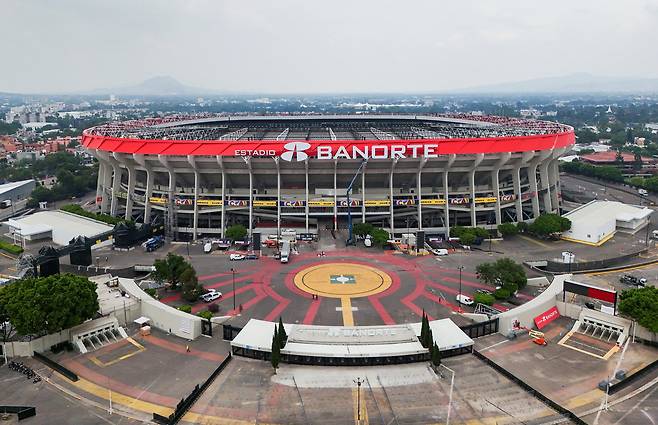
MEXICO CITY — A massive gray structure emerged after a little over an hour’s drive south from Mexico City on Sunday.
Through a thin veil of lingering mist left by an overnight rain, Estadio Azteca stood on a volcanic plateau 2,240 meters (7,350 feet) above sea level, like an ancient monument. Its gray silhouette seemingly deepened the sense of reverence that has made it one of football's most hallowed grounds.
Named after the Aztec civilization, the stadium is a sacred site of Mexican football history. The stadium could once again go down in football history when it hosts the opening match of the 2026 FIFA World Cup on Thursday.
It is set to become the first stadium in history to stage three World Cup opening games, after hosting the opening games in 1970 and 1986.
Originally built to hold more than 110,000 spectators, the venue now seats about 83,000 following a major renovation. Although the stadium was renamed after a financial firm following last year’s refurbishment, it will be referred to as Mexico City Stadium during the tournament under FIFA regulations.

In 1970, legendary Brazilian footballer Edson Arantes do Nascimento, better known as Pelé, lifted the World Cup trophy at the stadium. Sixteen years later, Diego Maradona of Argentina produced both the infamous “Hand of God” goal and the “Goal of the Century” against England on the same pitch.
Nowhere else on Earth have two players of such stature etched their legends into the same field, separated by just 16 years.
For Korean football, the stadium is more than a historic venue — it is the site of one of its defining moments.
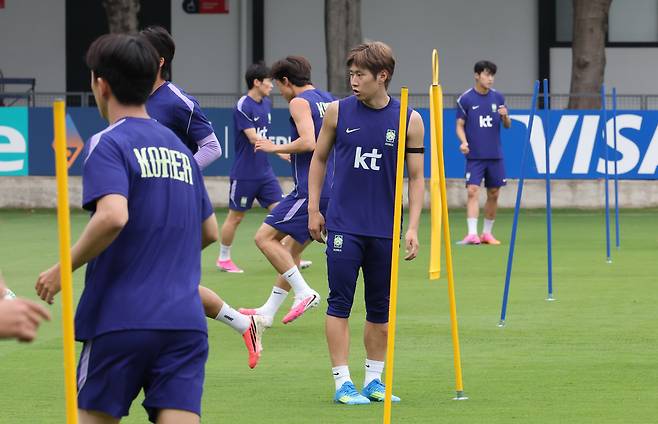
Korea, if it advances to tournament matches, will compete in the Round of 32 and Round of 16 at Estadio Azteca. Korea’s group-stage matches will take place at Guadalajara Stadium, which is 1,566 meters above sea level.
The Estadio Azteca sits roughly 700 meters higher than Guadalajara, where Korea will open against the Czech Republic.
Even walking briskly toward the venue left this JoongAng Ilbo reporter battling headaches, dizziness and shortness of breath all at once. It seemingly gave a firsthand lesson in why the stadium has long been feared as a graveyard for visiting teams.
Shin Yeon-ho, head coach at Korea University’s football team, said Korean footballers should brace for the physical toll of playing at altitude. Shin scored three goals and guided the national team to the semifinals at the FIFA youth championship in 1983. He earned the nickname of “Hero of Azteca.”

Shin noted that the ball’s movement was obviously different than what we are used to seeing at lower-altitude pitches.
"At times, the goals felt impossibly vast, as if they were 150 meters apart — although they were just 105 meters apart in reality,” Shin said.
Mexico sought to maximize its home-field advantage, Shin recalled.
“They scheduled the match at noon, when the heat was at its worst. The jeers from more than 70,000 home fans were enough to send chills down your spine,” he said. “Fortunately, the Mexican players were exhausted too. They kept misplacing passes. Once we realized they were struggling just as much as we were, the pressure eased considerably.”
In the 1983 match, Shin scored the winning goal as Korea went on to defeat host Mexico 2-1.
Then-Korean players drew international attention by training in masks to adapt to the thin air.

Former Korea international Lee Chun-soo also remembers the challenges of playing at altitude.
During a qualifier for the Athens 2004 Summer Olympics, Lee scored the winning free kick at Azadi Stadium in Tehran, Iran, which sits at 1,300 meters above sea level. Lee’s score ended Iran’s 40-year unbeaten home record.
“At Azadi, everything felt like slow motion,” Lee said. “My mind was already 20 meters ahead, but my body wouldn’t follow. The difficulty breathing led to more mistakes, and it made the match far tougher.”
While he agreed with the prevailing view that this is the strongest Korean squad in World Cup history, Lee said the altitude factor could turn the tournament into a far tougher test than many expect.

Meanwhile, the Czech Republic, Korea’s opening opponent at the World Cup, appears to have shifted into serious preparation mode with its closed-door training. The Eastern European squad held its second training session since arriving in the United States on Monday at Mansfield Stadium in Dallas, Texas.
Unlike the previous day’s FIFA-organized open training session, which was largely ceremonial, the team focused on tactical preparations, giving a only 15-minute window to the media.
The Czech Republic team has seemingly abandoned the idea of acclimatizing to Guadalajara's high altitude. After holding a send-off event in Prague on May 31, the team traveled to Harrison, New Jersey, and defeated Guatemala 3-1 in a friendly on Friday. New Jersey sits only 8 meters above sea level.
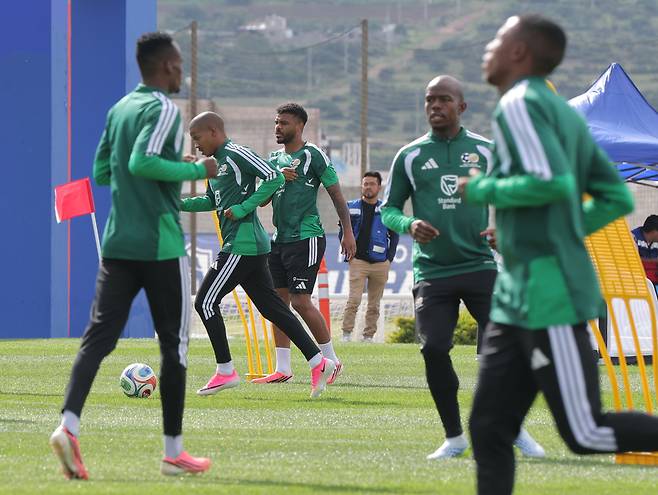
South Africa, Korea’s opponent in the final group-stage match, has taken secrecy to another level. A friendly match against Jamaica in Pachuca, Mexico, on Sunday was conducted entirely behind closed doors. There was no television broadcast, no spectators and no official release of either lineups or the final score.
Early reports circulating on social media claimed South Africa had secured a 1-0 victory, with Oswin Appollis scoring in the 32nd minute. Those reports later proved inaccurate.
Rudolph Speid, Jamaica’s head coach, subsequently told local Mexican media that Jamaica had equalized late in the match and earned a 1-1 draw.
Flashscore, the statistics service focusing on football, described the match as a “ghost game” because both the result and the details of the contest had been kept almost entirely under wraps.
Stuck at work or school when Korea kicks off? We've got you covered. The Korea JoongAng Daily is live-blogging every Korea match at the 2026 FIFA World Cup, around the clock. Don't miss a moment.
BY PIH JU-YOUNG [lee.soojung1@joongang.co.kr]
Copyright © 코리아중앙데일리. 무단전재 및 재배포 금지.