Missing Some Things in the Place that I Left
Editor’s note: Vacation, business travel, migrant labor, language study, study abroad, international marriage, immigration—many of us have such experiences of crossing national borders, and there are many immigrants living in our country. Ilda examines the emigrant sensibility we will need in order to live equally and peacefully in the age of globalization. This series is supported by the Korea Press Foundation’s Press Promotion Fund.
Remembering the Country of Forever Spring
A one year trip around the world. That was my plan when I left South Korea in the spring of 2008. However, when I actually returned in 2014, in those six years I had visited less than six countries.
Before leaving South Korea, I used to work as an editor at a publishing company, and now that I have returned, I also work as an editor. In this past entire year in South Korea, I have not only been struggling to catch up on everything that has changed in the last six years when I was not here, but I’m also struggling to accept everything that is still the same, even though six years have passed.
|
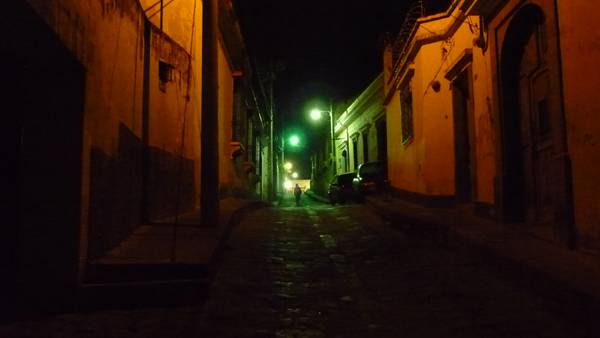
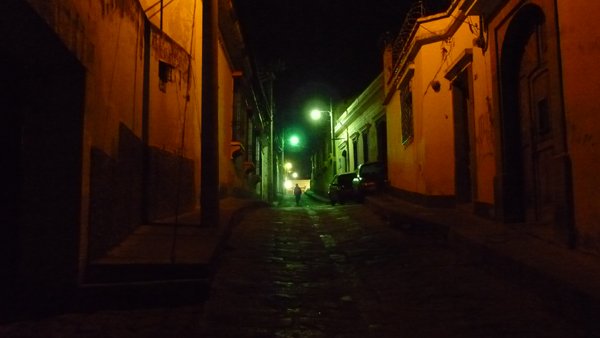
▲ On the way back home from the Café La Luna when I was living in Xela, Guatemala. ©Luna |
As I look back, when I was outside of this country, I realize that I very badly missed some things in South Korea. But now I do miss some things from the place that I left. Recently, someone told me:
“The worst thing is to miss somewhere else while living here.”
This person, now in her late forties, was born in South Korea, spent her teens and twenties in Argentina, and came back to South Korea in her thirties. She said that it took her five years to re-adapt herself to South Korea. At the early stages of when she had returned to South Korea, she wanted to go back to Argentina. She tried to find a way to do so but unfortunately it was not possible, so she eventually decided to settle down in South Korea. This was five years after from when she had come back.
“Anyway, South Korea was a good place to live,” she finally stated.
I wondered when I would be able to say those words.
Xela Greeted Me with a Story Prepared Especially for My Future
One year after I left, I stayed at a village bordering a huge lake, in Atitlan, Guatemala. One fellow traveler, from Belgium, looked like a typical hippie who seemed to simply be on a short excursion with just a light backpack. Nevertheless, when opened, his backpack exploded like magic with a number of items like portable pots, a burner, a bag of flour, a rolled mat, etc. Every day, he ate Indian Chapati bread that he made by himself, and each time he made the bread he joyously shouted “Chapati! Chapati!” I was surprised to find out that he had been traveling for eight years and I asked him how could that be possible?
“It’s easy to travel for eight years. It’s simple.”
After some time passed, I ended up fully understanding that statement, which I had not understood at that moment. A few weeks after my stay at Atitlan, I arrived in Xela, the city that was waiting for me with a story prepared especially for my future. Later, that place became a space that I called home for more than four years.
My trip, which started from San Francisco, USA—and felt like a split second—took over one year until I was about to leave North America. It took such a long time not only because of the huge size of the U.S. and Canadian territory but also because of an important factor which I had not counted on when scheduling: the people whom I would meet on the road.
|
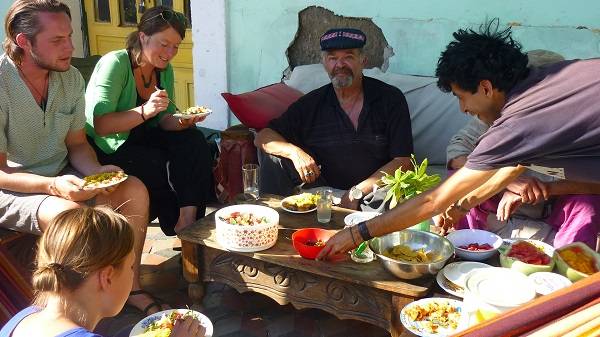
▲ “My Neighbors,” foreign friends I met in Xela. ©Luna |
Xela is the second largest city in Guatemala, Central America, but for South Koreans it looks like a very small city. Even though the city’s official name is Quetzaltenango, almost everyone call it Xela, which is the Mayan name of the city before Spanish colonization. As the city is located 2,330 meters above the sea level, its weather is cool, however, one should not expect a Himalayan landscape. The city has a McDonald’s and a Wal-Mart; people in this city enjoy TV dramas just like the people in Mexico or other Spanish language countries; and the majority of the younger generation listens to Techno and hip-hop music via smart phones.
On the other side, Guatemala continues its traditional culture which can be seen in two distinctive parts: Mayan culture before and after the Spanish colonization and catholic culture became implanted through the Spanish colonizers. Like other Central and South American countries, Guatemala was a Spanish colony for three hundred years until 1821, so the colonial culture which came across the ocean, implanted itself, and wiped out the Mayan culture which had strongly influenced not only the indigenous people’s collective unconsciousness but also their affective roots for a long time.
Many visitors are fascinated by the layouts of the streets in this city where the colonial style of the division of the city copied the configurations of old cities in Europe. So was I. There are dark, winding, and narrow paths like a maze; lights from small shops located at the corners; and a stoned ground not made for cars or humans but for horses passing by.
The main reason why I ended up staying in Xela for over one month was to take a Spanish language class. That was not only because most of the countries I travelled to were Spanish language countries in Central and South America, but also because I needed to learn Spanish to travel better. As Xela is a place where people use an appropriate speaking pace and have clear pronunciation, there are many foreigners who stay there in order to take Spanish language courses.
There are many cases in which travelers stayed there for at least two or three weeks, some staying for one more months because they are fascinated by the upbeat atmosphere, and then others even ending up staying for over one year. A number of communities, created by foreigners who left their homes and temporarily stayed there, unofficially and publicly became part of the culture in Xela.
At the Community House where Foreigners Live Together
“China! Chinita!”
People in Xela called all Asians Chino or China which means Chinese. Even though I lived there for over four years, this name calling in streets still made me uncomfortable. However, it could considered as acceptable since, in South Korea, people used to shout “American!” unconditionally whenever they saw foreigners who did not look Asian, even nowadays there are still a number of times when people look furtively and point a finger at foreigners.
|
▲ One windy morning at the window of where “I used to live” ©Luna |
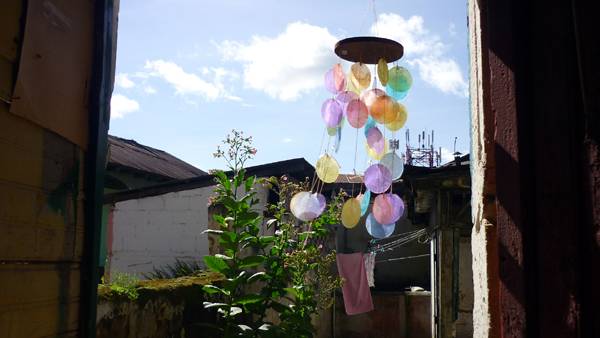
The atmosphere of the place where I lived in Xela was different from the one outside in the street. It was a sort of humble and rural community house where foreigners lived together, that had eight individual rooms, a spacious front yard, bathroom, etc, that people shared.
There are various reasons for young people in their twenties or thirties, mostly from North America and Europe, to come to Xela: people come in order to have a long vacation, learn Spanish, or do volunteering work for different kinds of associations; some people come to work or settle down after wandering to many places; others become fascinated by Xela and feel that they can live longer there; and others, still, come to Xela because they could not find jobs in their own countries and settle here because of the low-cost of living.
I spent enough time in Xela and Guatemala that I can generalize what I experienced there. However, the time that I spent there is the reason why I feel it difficult to generalize my experiences. That is why I do not want to compare a genuine story that one has to another genuine story such as that of Richard’s, an American in his sixties, who stayed in the house with me for a fairly long time, who had needed to leave his own country, and what he really wanted to attain from Guatemala, because I was deeply part of other people’s stories too.
So, after coming back from there with a certain outlook and a number of incomparable stories, I still sometimes feel so touched and moved to tears that I cannot answer the questions whenever I am asked about stories from Guatemala.
Cooking Became a Way of Expressing Myself
It is a common expression to call the weather in Guatemala a forever spring. Although the daytime sunshine is strong enough to dry laundry hung out in early morning then folded right after lunch, one does not sweat, unless one runs. Even though at dawn or at night the weather is chilly enough that one should wear a layer of sweaters, there is also no desperate need for heating appliances and no snow. The annual temperature range has no severe gaps and the climate has only two separate seasons in one year: six months of rainy season and six months of dry season. The all-year round cool weather was the other reason that made me stay in Xela longer.
|
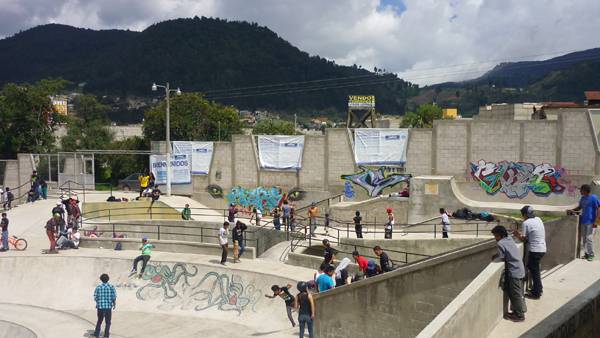
▲ The Xela skateboard park with a graffiti of Quetzal, a Mayan bird. ©Luna |
The Native people in Xela were pretty kind to me as a single Asian woman. Because foreigners from English speaking countries or Europe had an easier time communicating with each other, this made me feel comparatively much closer to the Native people.
Due to the fact that it was rare to see Asian people, especially Korean people, whenever I joined a group of foreigners they were unconditionally delighted stating that “our atmosphere is really international!” Interestingly, when I cooked to eat in the communal kitchen, all of my neighbors wanted to taste the food—even if just a fried vegetable—and were eager to find out what kind of healthy food diet an Asian person followed.
Whether [their expectation] made me feel uncomfortable in the kitchen or not, I didn’t show it because cooking gave me such energy. By handling various types of vegetables bought from the market, I felt like the energy of these items transmitted to my entire body via my hands. In the course of washing, cutting, frying, and mixing them, I was able to not only disperse unnecessary thoughts and meditate silently, but also to gain newly found courage and even come up with new ideas or solutions to problems.
Whenever I cooked something copiously seasoned without measure—gauging only with my senses—then it turned out to be delicious, and I was extremely proud of myself as if I had succeeded a laboratory experiment. Cooking was kind of a way of expressing myself as if I could communicate fully under the condition of language. I told the people in my house that if I mentioned to my family and friends in South Korea that I had cooked here, they wouldn’t believe me. The people laughed at me and said they did not believe what I just told them. [Translated by Jieun Lee]
*Original Article: http://ildaro.com/7265 Published: October 20, 2015
Copyright © ildaro.com