Nobel economist Howitt urges Korea to ‘wait and see’ on AI profit sharing
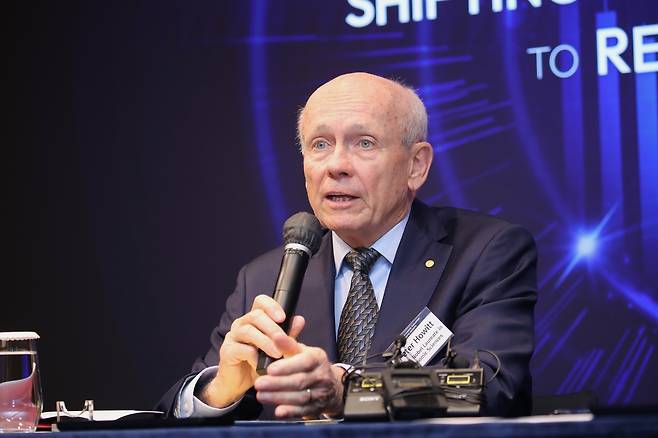
Peter Howitt, winner of the 2025 Nobel Prize in Economics, urged South Korea to adopt a cautious “wait-and-see” approach toward redistributing AI-driven semiconductor profits.
Howitt is a Brown University professor emeritus and a leading scholar of creative destruction, or the connection between innovation and economic displacement.
At a press briefing following the “Economic Paradigm Shift for Reversing the Growth Trend” conference held Friday at The Westin Josun Seoul, Howitt emphasized the importance of structural innovation and startup-led growth. He said policymakers should be cautious about introducing new redistribution mechanisms tied to AI-driven profits.
South Korea faces growing political and social debate over whether AI-era semiconductor profits generated by firms such as Samsung Electronics and SK hynix should be redistributed more broadly through concepts such as “AI dividends” or excess-profit sharing.
The debate intensified after Kim Yong-beom, the presidential chief of staff for policy, argued earlier this week that a portion of AI-era profits generated by semiconductor firms should be returned to the public, triggering investor concerns over potential taxation measures and contributing to sharp volatility in the Kospi on Tuesday.
Howitt, however, cautioned against moving too quickly.
“Their profits are being taxed, and that money is helping to finance a lot of government activities that are themselves going to be benefiting people,” he said.
Calling AI “a very young technology,” Howitt said it would be premature to introduce additional profit-sharing measures before policymakers fully understand how the technology reshapes the broader economy.
“It’s best to wait and see how things develop before we go down that direction,” he said.
Howitt also addressed the ongoing labor-management tensions at Samsung Electronics over wage negotiations and performance-based bonuses. He stressed that any profit-sharing arrangement should work symmetrically and remain tied to corporate profitability.
“When profitability is higher, wages should be higher. When profitability is lower, wages should be lower. That way everybody shares in the fortunes of the company,” Howitt said.
“If workers are going to profit when the company’s profits go up, then it would only be fair that they accept reduced compensation when profits go down,” he added.
Rather than focusing solely on redistribution debates, Howitt argued that Korea’s more urgent task is fostering startups and small and medium-sized enterprises capable of driving the next wave of innovation.
“What you need to focus on ... is to make sure that small and medium-sized firms and startups, in particular, are given strong incentives and encouragement and financial assistance,” he said.
“They are the source, the ultimate source of creative destruction.”
The economist also called for a hybrid innovation model combining private-sector competition with strong government coordination, citing the US DARPA system as an example.
“Ultimately, it is private companies who are going to do the innovation that is going to lead to economic growth,” Howitt said.
“But that will happen best if there is strong government support and coordination.”
Howitt further argued that AI may reduce, rather than worsen, inequality while fundamentally restructuring the economy over time.
Comparing AI to the electrification revolution, he believed transformative gains would emerge only after industries reorganize production systems around the technology.
“If it’s like any other general-purpose technology that we’ve seen, it is going to result not just in the replacement of people by machines, but in the entire reorganization of the way economic activity takes place,” he said.
Copyright © 코리아헤럴드. 무단전재 및 재배포 금지.